

GetApp offers objective, independent research and verified user reviews. We may earn a referral fee when you visit a vendor through our links.
Our commitment
Independent research methodology
Our researchers use a mix of verified reviews, independent research, and objective methodologies to bring you selection and ranking information you can trust. While we may earn a referral fee when you visit a provider through our links or speak to an advisor, this has no influence on our research or methodology.
Verified user reviews
GetApp maintains a proprietary database of millions of in-depth, verified user reviews across thousands of products in hundreds of software categories. Our data scientists apply advanced modeling techniques to identify key insights about products based on those reviews. We may also share aggregated ratings and select excerpts from those reviews throughout our site.
Our human moderators verify that reviewers are real people and that reviews are authentic. They use leading tech to analyze text quality and to detect plagiarism and generative AI.
How GetApp ensures transparency
GetApp lists all providers across its website—not just those that pay us—so that users can make informed purchase decisions. GetApp is free for users. Software providers pay us for sponsored profiles to receive web traffic and sales opportunities. Sponsored profiles include a link-out icon that takes users to the provider’s website.
The Difference Between an IT Project Manager and Business Program Manager
It's easy to confuse the two, but doing so could cost your business during hiring.


Businesses still struggle with distinguishing between the roles and responsibilities of IT project managers and business program managers.
The confusion is natural given both are involved in managing stakeholders, risks, resources, time, budget, and other similar aspects. However, their level of involvement and engagement differ greatly.
A misunderstanding here can have dire consequences—some businesses struggle to hire the right candidate with the right skill set. And, if they do get the right skill set onboard, they are unable to define roles and responsibilities for them.
This creates ambiguity in the accountability for project lifecycle, affecting the overall delivery of a project and leading to wastage of resources. To prevent this, we present you the differences and similarities between IT project managers and business program managers:
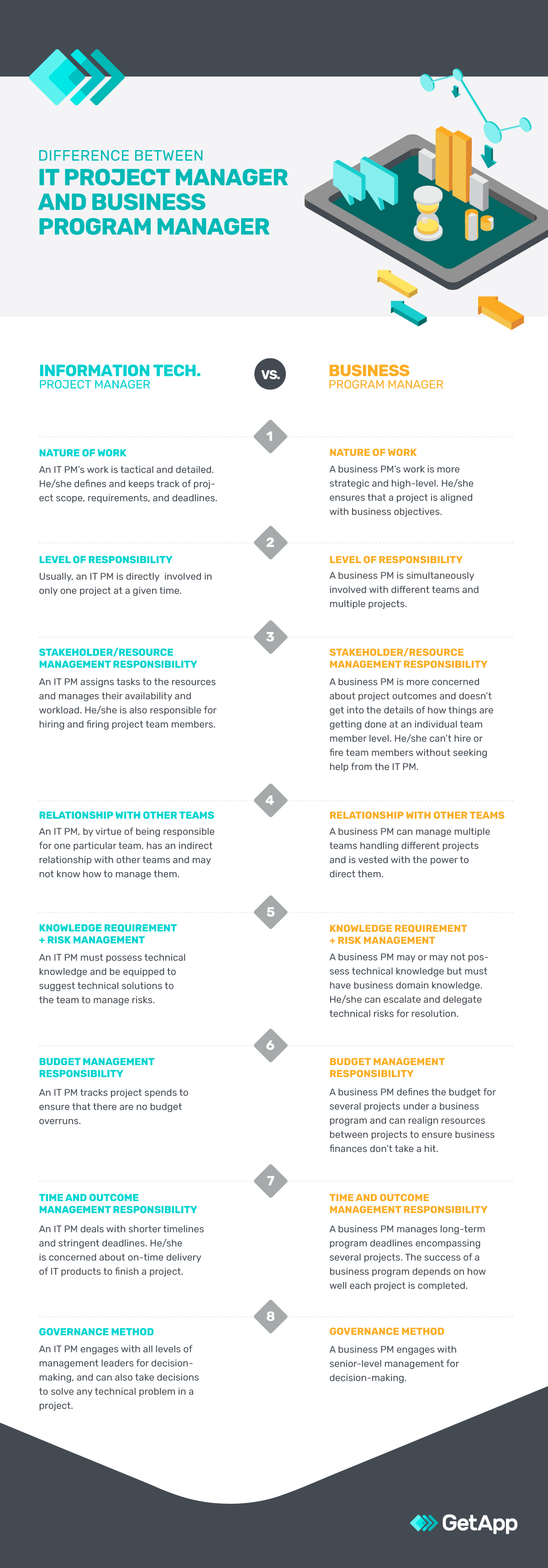
When do IT project managers and business program managers come together to work on a project?
Despite several contrasts the roles are not disjointed islands; they share a cohesive relationship that is vital to the success of a project and the overall business goal. Based on a Gartner report (full content available to Gartner clients only), we have curated a list of collaboration scenarios between IT project managers and business program managers.
When technical issues must be escalated to the senior management for resolution or customers in case the product needs changing. In such scenarios, an IT project manager would report to a business program manager. They can co-report to the stakeholders or customers.
In case there is a need to allocate/reallocate resources among different IT projects to optimize resource capacity and capability.
If there is a need to prioritize/deprioritize projects and there is resource- or expertise-crunch, an IT project manager can move in between projects and work with a business program manager to align as per the program priorities.
Sometimes, a business program manager may take assistance of an IT project manager to manage program schedules and scope so as to achieve business objectives in time.
Next steps
A small business may not always have the resources to hire both kinds of managers at once, so here are two tips for small business leaders to help them make the right decision:
Gauge the skillset of your team: If you have a technically mature team—the team is technically sound and capable of handling customer requirements to develop products—then you can appoint a tech spokesperson within your team. He/she can act as a team-lead to coach and mentor team members. Then, opt for an overall business program manager instead of having an IT project manager along with a business program manager.
Evaluate the budget: If you do not have enough budget to appoint both kinds of managers, you can train someone within the team with sound technical knowledge to handle the team responsibility for IT projects. You can focus on hiring a business program manager with good communication skills and domain knowledge for providing strategic inputs to the team and help your business grow.
Ankita Singh
More on IT Management


Aug 08, 2024



Sep 18, 2024

May 29, 2024