

GetApp offers objective, independent research and verified user reviews. We may earn a referral fee when you visit a vendor through our links.
Our commitment
Independent research methodology
Our researchers use a mix of verified reviews, independent research, and objective methodologies to bring you selection and ranking information you can trust. While we may earn a referral fee when you visit a provider through our links or speak to an advisor, this has no influence on our research or methodology.
Verified user reviews
GetApp maintains a proprietary database of millions of in-depth, verified user reviews across thousands of products in hundreds of software categories. Our data scientists apply advanced modeling techniques to identify key insights about products based on those reviews. We may also share aggregated ratings and select excerpts from those reviews throughout our site.
Our human moderators verify that reviewers are real people and that reviews are authentic. They use leading tech to analyze text quality and to detect plagiarism and generative AI.
How GetApp ensures transparency
GetApp lists all providers across its website—not just those that pay us—so that users can make informed purchase decisions. GetApp is free for users. Software providers pay us for sponsored profiles to receive web traffic and sales opportunities. Sponsored profiles include a link-out icon that takes users to the provider’s website.
Integrate Idea Management into a Project Lifecycle: A Guide for IT Project Stakeholders
Learn how IT project stakeholders and managers can boost idea management. Read about the steps and tips to integrate idea management into your project life cycle.

Idea management can be a challenge if IT projects aren’t structured well. Unstructured workflows imply lack of collaboration and communication among team members, which results in them being out of sync with one another when it comes to ideas and innovation.
If you’re a small-business IT project manager, make sure that your focus on project management doesn’t keep your team away from ideation. Set a process to store all these ideas to avoid missing opportunities for improving the business.
Small-business IT project managers should integrate idea management in various stages of their IT project lifecycle and company culture. It will boost innovation and mitigate the risks of being outcompeted.
This article discusses four challenges to successful idea management that IT project stakeholders face and how they can overcome them.
What we'll cover:
4 challenges to successful idea management in IT projects
IT project lifecycle stages and how to integrate idea management
Tips to boost idea management
4 challenges to successful idea management in IT projects
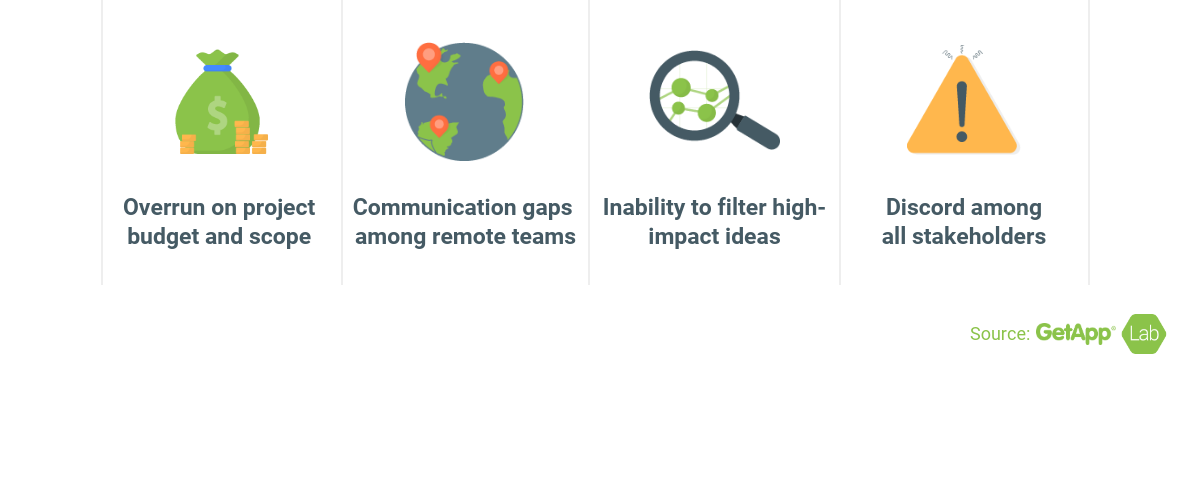
1. Overrun on the project scope and budget
Though idea generation and implementation promise better IT products, there’s always a risk of overrunning on your scope and budget. But without ideation and innovation, you won’t have any creativity and your small business will be at risk of getting outcompeted.
2. Communication gaps between remote team members
Sometimes, small businesses save costs by hiring remote workers. They could also expand to other countries over time, even hiring remote stakeholders. However, lack of a single platform for collaboration and communication makes it tough for IT teams to manage employees and prevents successful ideation and innovation on projects.
3. Inability to reliably filter high-impact ideas
Most small businesses aren’t aware that successful ideation starts with generating ideas, then filtrating, and, finally, implementing them. This is essential to not miss out on implementing great ideas and to promote a culture of innovation.
4. Discord among external and internal IT project stakeholders
Decision-makers, project team members, and the client should be in sync during all the project stages, especially at implementation and testing. Failing to collate ideas throughout the lifecycle decreases stakeholder satisfaction, causing disengagement and jeopardizing project success.
You can address these four major challenges by integrating idea management through various stages of an IT project lifecycle. The next section shows you how to do that.
IT project lifecycle stages and how to integrate idea management
As a project manager, it’s important to set aside ample time for ideation and idea management. To avoid low productivity, lack of innovation, and failure in the market, you need to integrate ideation and idea management at various phases of an IT project lifecycle. Here’s how you can do that:
Stage 1: Determining objectives and requirements
In this stage, an IT project manager works with customers and internal stakeholders (including team experts) to define the business needs and chart the way forward. They also identify the resources and skills needed to deliver the IT systems and products.
For instance, a small eCommerce business owner needs software to secure customer data and inventory. This will allow them to generate reports about preferred products, seasonal visitors and customer types. The software should help them share these reports with internal and external stakeholders.
Using these reports, an IT project manager can better understand the market demand. This helps them identify team resources who have the expertise to develop, test, and audit the products.
Here are the steps to integrate idea management at this stage:
Interview customers to understand their problems
Check out case studies on the problems that your customers face. You can develop a questionnaire for them to understand and identify their specific concerns and expectations. This will assure them that you understand their issues and are working to solve them all.
Run your team through the project charter
A project charter underlines the high-level scope, goal, and objectives of the project. Ideate with your local and remote team members about the project vision and timelines. Ask them to share their feedback on the primary problem and offer a possible solution.
Stage 2: Developing the IT architecture
Here, the project manager and head engineer (one person can handle both functions in a small business) identify the architectural elements to develop the IT product and systems. Then, the stakeholders discuss different architectural options and choose the most effective one based on time, scope, and budget.
For instance, a small business wants cloud-based or on-premise data management software (DMS) with report generation and sharing capabilities. Based on their architectural framework requirements, the IT engineer provides coding options to create various frameworks for the DMS.
Follow these steps to integrate idea management in this stage:
Form a core group to forecast risks and ideate on mitigation
Assuming that you know the strengths and weaknesses of your team (if not, follow these steps), identify critical thinkers and develop a core group to forecast risks (and ways to mitigate them) related to the IT architecture of the product.
Involve the client during ideation
Prepare a detailed document for your client, listing the pros and cons of different tiers of IT architecture and the possibilities of the system. Document the client’s feedback and preferences. Share this document with your team to ensure that everybody understands the objective. Then, assign an IT expert in your team to answer any client questions.
Stage 3: Creating the product design
Create a high-level design to demonstrate how various components in the IT product or system would interact with each other. If the design is detailed, it would include a detailed description of how each module would function, with a view of the overall interface of various components in the system.
For instance, a small-business owner would want to know how database management software will interact with their existing software and hardware. The IT project manager will show them the detailed design to help them understand the final product.
Here’s how you can integrate idea management in this stage:
Encourage your team to jointly create a checklist
Create an online hub to store your team’s ideas (across locations) and ask an employee to collate all the ideas and remove duplicate ones. Create a checklist from these ideas to ensure end-user satisfaction for the design. Later, share these insights with your developers.
Organize group calls with client and internal IT expert
Once the ideas are collected and filtered for feasibility, an IT project stakeholder and manager should organize calls or meetings with the client and the IT expert. Ensure that the IT expert in your team hosts and leads these calls.
Stage 4: Product construction and integration
This stage involves developing the code and building the product. Once the client approves the design, the IT project manager can schedule tasks and deadlines for the team.
For instance, the IT project manager would break the bigger project into several small tasks and assign each task to an individual. This way, nothing slips through the cracks. The manager would also assign dependencies to the individuals and mark deadlines against each item in the project management software being used.
In this stage, it’s likely that team members will be working in silos on their individual tasks. But during the development and integration process, an IT system may have to undergo change to prevent gaps between product expectations and the actual product.
These are the steps to integrate idea management during this stage:
Organize weekly team discussions to create a central idea repository
Have your team discuss the technical aspects of the product. They can share the risks and challenges as well as the solutions. This exercise will help them prepare for future projects and identify the right person to fix a specific problem. Create a database of the ideas shared in these meetings that can be reference points for the future.
Share weekly project reports and highlights with clients
You may think that it isn’t necessary to share every update with the client as the product constantly evolves during the creation process. But you should share weekly or fortnightly reports on the progress and key highlights of the features being developed. This can ensure client satisfaction as it lets them provide timely feedback to you.
Stage 5: Testing and improvement
The purpose of this stage is to understand whether the system/product being developed (or acquired) is ready for implementation. The IT manager independently tests the components of the product before and after integration to ensure that everything functions properly.
For instance, when developers create software for a small eCommerce business owner, the testers can check whether the fields, such as file name or project name, return the right values (i.e., data) once the user enters the keywords.
This is how you can integrate idea management at this stage:
Identify weak areas in the beginning
During the development phases, your team may encounter bugs and issues. Inform the testers about issues that need special attention during the testing phase. Invite ideas that can address the core areas for improvement.
Collaborate on bug resolution ideas
Once the product is developed, brainstorm bug reporting ideas with your internal and external stakeholders. Encourage your internal project team to collaborate on bug resolution by employing their learnings from previous IT products.
Next steps and additional resources
To recap, we’ve discussed the challenges and stages of an IT project lifecycle and ways to integrate ideation and innovation within them. Armed with this knowledge, here’s a checklist to help your IT project managers boost innovation and idea management in your small business:

Check out these additional sources to understand more about successful project management
Agile vs. Task Project Management Software: Which One Does Your Small Business Need?
6 Excellent Kanban Cards Templates That Will Raise Your Project Management Game
5 Insightful Tools for Big Data Project Management
7 Project Management and Planning Apps for Android
Ankita Singh
More on IT Management


Aug 08, 2024



Sep 18, 2024

May 29, 2024