

GetApp offers objective, independent research and verified user reviews. We may earn a referral fee when you visit a vendor through our links.
Our commitment
Independent research methodology
Our researchers use a mix of verified reviews, independent research, and objective methodologies to bring you selection and ranking information you can trust. While we may earn a referral fee when you visit a provider through our links or speak to an advisor, this has no influence on our research or methodology.
Verified user reviews
GetApp maintains a proprietary database of millions of in-depth, verified user reviews across thousands of products in hundreds of software categories. Our data scientists apply advanced modeling techniques to identify key insights about products based on those reviews. We may also share aggregated ratings and select excerpts from those reviews throughout our site.
Our human moderators verify that reviewers are real people and that reviews are authentic. They use leading tech to analyze text quality and to detect plagiarism and generative AI.
How GetApp ensures transparency
GetApp lists all providers across its website—not just those that pay us—so that users can make informed purchase decisions. GetApp is free for users. Software providers pay us for sponsored profiles to receive web traffic and sales opportunities. Sponsored profiles include a link-out icon that takes users to the provider’s website.
What Are Low-Code No-Code Platforms? A Startup Owner’s Guide
Create custom software and prototypes without burdening your IT engineering team.


Are you a startup entrepreneur or an SMB owner? Do you want to create high-quality software applications yourself without coding? What if we tell you there's a platform that lets you do that without any assistance from your software engineers?
We are talking about no-code and low-code platforms.
IT and software engineering teams are often backlogged, so many internal teams take things into their own hands and purchase their own software. However, this workaround can cause issues down the line. The new software could pose a security threat or may not integrate well with the existing tools. That's where low-code and no-code software platforms come in.
You can use these tools to create custom applications with minimal coding skills. The beauty of low-code and no-code platforms is that your IT team is often involved in shortlisting them, so they are fully sanctioned. Sounds too good to be true, right? But the benefits are real.
Many businesses are already using (and benefitting from) low-code or no-code platforms
To get an idea of how many businesses like yours are already leveraging low-code or no-code platforms, we ran a survey* in September 2022. Here's what we learned:
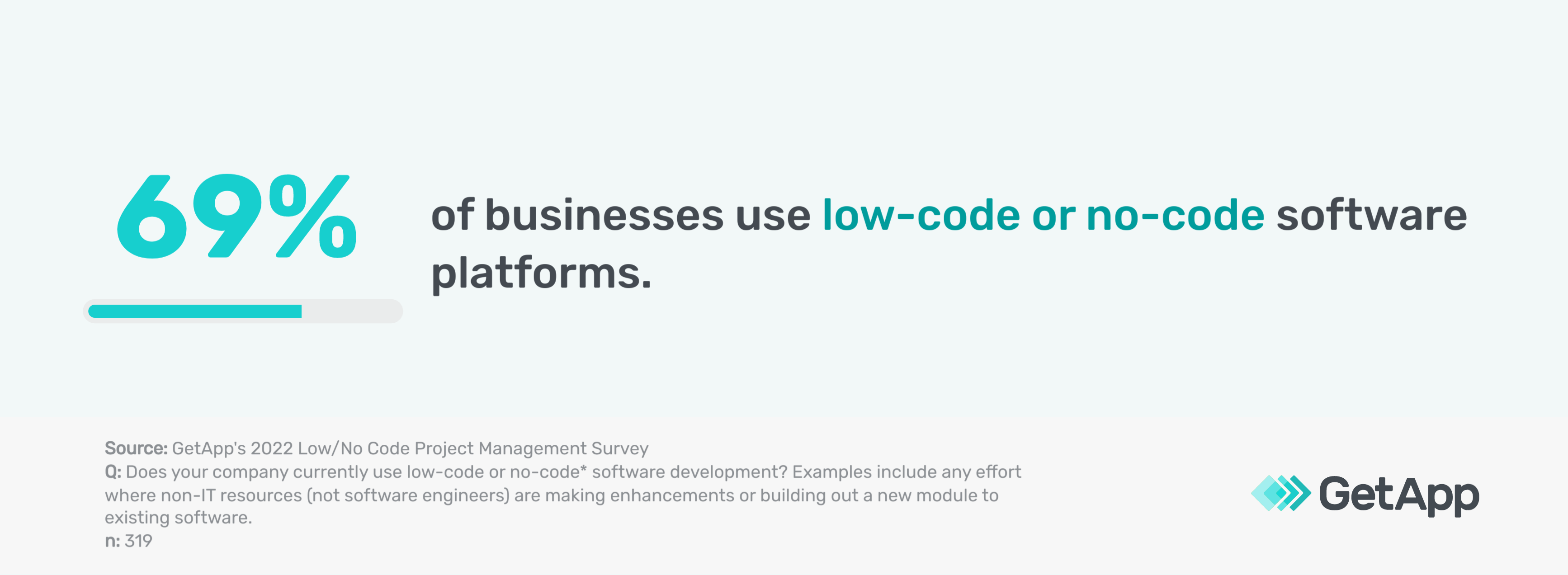
Sixty-nine percent of surveyed businesses use low-code or no-code tools to make it easier for their internal teams to develop software applications.
Additionally, more than three-quarters of those who use low-code or no-code platforms find them either very valuable or extremely valuable to their business. That makes sense, as SMBs can use these platforms to help illustrate a minimally viable product (MVP) or launch an early version of a new idea (among many other uses).
In this article, we explain what low-code and no-code platforms are, what their pros and cons are, and how these platforms are making businesses across industries more efficient. So, read on.
What is low-code software?
Low-code software is a broad term that encompasses many use cases. With this software, you can design and develop applications using simple building blocks or drag-and-drop widgets. As far as target users go, a low-code application development platform can be geared toward professional developers as a faster way to create apps or toward those who don’t have the coding skills to create an app from scratch.
In terms of the technical skills needed to operate these tools, low code can really run the gamut. This means that depending on the platform, you may still need a professional programmer to implement this software. Because of this wide variation, it’s important to ask software providers who their tool is suitable for.
What is no-code software?
No-code software usually needs fewer coding skills than low-code software, but it's worth noting that a “no-code platform” can also be a marketing term rather than an official terminology. This makes it even more important to ask software providers for specifics on what technological know-how is actually required for their product so you don’t end up with something your team can't use.
Even if no coding is required, you’ll still need some basic technical skills to use no-code software. These skills include an understanding of software development and how it works.
Low-code software vs. no-code software
Low-code platforms have more features, whereas no-code platforms are easier to use. It’s important to consider these differences to get a complete understanding of both tools. The table below offers a quick overview of the differences between low-code and no-code platforms.
| Criteria | Low-code software | No-code software |
|---|---|---|
| Target audience | Developers | Business professionals |
| Objective | Faster application development | Self-guided, easier application development |
| Coding required | Yes but minimal | No |
| Customization level | High (code can be entirely modified) | Low (pre-made templates available for customization) |
| Learning curve | Moderate | Low to moderate |
| Platform restrictions | Not very much; apps can be moved between platforms | Sometimes. Doesn’t allow moving apps across different platforms |
| App quality | Can design complex software | Can design only simple software |
| End-to-end app development | Good possibility | Limited possibility |
| Purpose | Help businesses with a team of developers | Help businesses with a smaller yet burdened team of developers |
Note:
With low-code and no-code tools, technically savvy people with specific industry expertise can put an app together without needing advanced coding or software development skills. These individuals are often referred to as citizen developers, and the undertaking is called citizen development.
Benefits of low-code and no-code platforms
As per GetApp's 2021 Marketing Technology Survey**, most startups use low-code and no-code platforms for three main purposes: build internal apps, develop customer-facing apps, and reduce IT dependency. Let’s discuss these and a few other ways you can use these platforms to improve your company’s workflow efficiency.
Build internal applications: Low-code and no-code software tools have a simple drag-and-drop interface that lets you easily build internal applications. They save app development time, promote team collaboration, and increase workflow productivity.
Develop customer-facing applications: You can also use no-code and low-code platforms’ intuitive pre-made templates to create customer-facing applications while understanding their functionality in real time.
Reduce IT dependency: These platforms let you create advanced applications without the need to write any complex codes. You can even launch the apps directly from these platforms without any IT assistance.
Enhance privacy and security: Low-code and no-code tools help eliminate the chances of an information breach. By allowing you to complete sensitive data-based tasks yourself (rather than outsourcing to an external development agency), they strengthen data privacy and security.
Promote innovation: Low-code and no-code platforms let you experiment and test new ideas without needing a lot of resources. Use these tools to bring your development ideas to life by enabling your team to contribute to them.
Drawbacks of low-code and no-code development
Now, let’s take a look at the challenges your business could face when using these tools.
Promotes shadow IT: Shadow IT is a practice of bypassing the IT department to create or find software solutions. To avoid this, check in with your IT team so they have a say in software selection. They can help you shortlist a tool that’s compatible with your existing tech stack and up-to-date with compliance best practices.
Offers limited customization: Sometimes, you may feel stuck with the pre-available templates. To avoid such a situation, explore as many options as possible because newer low-code and no-code tools offer high customization options that bring more precision to the apps you develop.
Vendor lock-in: If you become dependent on a particular vendor’s low- or no-code platform, and if the vendor decides to raise prices or discontinue the product, your business could find it challenging to switch to another platform. Therefore, ensure you select a trusted vendor with a good market reputation.
Will low-code and no-code tools replace software developers in the future?
Gartner[1] predicts that the use of low-code and no-code software would account for 65% of all application development activity by 2024. That’s because there’s a huge demand for app development but not enough people with the skills to do it.
Low code no code platforms are attractive to startups, as they allow even non-engineering staff to make their own apps. However, this doesn’t mean that they’ll replace professional developers with advanced programming knowledge.
Industry use cases of low-code and no-code software
The use of LCNC tools is not limited to the tech sector; several other industries are leveraging these platforms for their growth. Let’s discuss a few.
Banking
A low-code or no-code platform can be integrated into the core banking system to create a seamless banking experience for users.
Banking institutions can use low-code or no-code platforms to create user-friendly interfaces where customers can complete their account opening applications without worrying about data loss.
Banking firms can use no-code or low-code software to develop a loan sanctioning platform that automates related processes, improves compliance, and streamlines lending operations.
Supply chain
Low-code tools can automate the monitoring of everyday workflows, helping improve supply chain operations.
Supply chain businesses can develop responsive applications to improve the trackability and traceability of their products’ supply chains.
Low-code and no-code tools support the integration of old data with incoming data for accurate analytics and data-driven decision-making.
Insurance
Insurance companies can use low-code no-code platforms to build a policy underwriting engine that automates insurance processes with zero underwriting errors.
They can create a custom app that automatically retrieves policy information and prevents duplicacy to simplify claim processing.
They can also use the templates available on low-code no-code platforms to build a self-service portal through which customers can submit claims as well as track their status in real time.
Accounting
Accounting companies can use no-code low-code platforms to create a custom application for automated tax filing, client expense/income management, financial disclosures, and other file management activities.
They can also use low-code no-code tools to plan loan approvals and risk assessments for clients and advisors.
Human resources
HR teams can use low-code no-code tools to create an app that filters candidates’ applications, schedules interviews, and customizes job posts.
They can also use advanced no-code low-code tools to create a full-fledged software system that conducts employee training programs through interactive sessions and activities.
Up your organization’s tech game without burdening your engineers
Now that you know what low code and no code development is, what its benefits are, and how it can reduce your IT backlog, ask yourself the following questions to assess if your team needs LCNC platforms:
How many developers do you have in your organization?
If you’re experiencing an IT backlog, does your team have technically savvy professionals?
What are your objectives for using low-code no-code software?
What is the programming expertise of your team?
How big is the challenge you need to solve?
Would you require custom integrations with external and internal business apps?
Do your projects include confidential information?
Once you’ve finalized your requirements, check out our no-code and low-code software directories to get started. Low- or no-code software can help your startup become more efficient so you can stay hyper-focused on your goals, whether that’s building an effective online presence, a marketing campaign to increase engagement and active users, or anything else.
Methodology
* GetApp conducted the Strategic Project Management / Low/No Code Projects Survey in September 2022 of 319 U.S-based project managers to understand the level of influence and partnership PMs have in the technology strategy at their company. Respondents were screened to ensure they are very to extremely involved in project management at their current company.
** GetApp conducted a Marketing Technology Survey in February 2021 among 582 respondents to learn more about the use of marketing technology by startups and small businesses. Respondents were screened for leadership positions at startups and small businesses in healthcare, IT services, marketing/CRM, retail/eCommerce, software/web development, or AI/ML.
Sources
Bhavya Aggarwal
More on IT Management


Aug 08, 2024



Sep 18, 2024

May 29, 2024