GetApp offers objective, independent research and verified user reviews. We may earn a referral fee when you visit a vendor through our links.
Our commitment
Independent research methodology
Our researchers use a mix of verified reviews, independent research, and objective methodologies to bring you selection and ranking information you can trust. While we may earn a referral fee when you visit a provider through our links or speak to an advisor, this has no influence on our research or methodology.
Verified user reviews
GetApp maintains a proprietary database of millions of in-depth, verified user reviews across thousands of products in hundreds of software categories. Our data scientists apply advanced modeling techniques to identify key insights about products based on those reviews. We may also share aggregated ratings and select excerpts from those reviews throughout our site.
Our human moderators verify that reviewers are real people and that reviews are authentic. They use leading tech to analyze text quality and to detect plagiarism and generative AI.
How GetApp ensures transparency
GetApp lists all providers across its website—not just those that pay us—so that users can make informed purchase decisions. GetApp is free for users. Software providers pay us for sponsored profiles to receive web traffic and sales opportunities. Sponsored profiles include a link-out icon that takes users to the provider’s website.
What Is Affiliate Marketing, and How Does It Work?
80% of brands are running affiliate marketing programs. Learn more.


In order to compete with large enterprises, small businesses and entrepreneurial startups have to come up with creative marketing and operational tactics for overcoming skills gaps and limited staffing bandwidth. Entrepreneurs and small business owners without dedicated marketing experience who are looking to expand and maximize lead generation and sales are turning towards affiliate marketing as a solution.
WIth a global market value of more than $17 billion, affiliate marketing is a powerful tactic for attracting more customers, and small business owners should determine if it’s a tactic that will work well for their brand. [1] To understand the benefits of affiliate marketing, it’s important to understand the strategy for building sales from both sides of the affiliate partnership and to follow best practices for building and growing an affiliate marketing program that fits their business needs.
What is affiliate marketing?
Established brands create affiliate marketing programs to allow social media influencers and entrepreneurs to represent, market and advertise, and ultimately sell the parent company’s products or services. Joining an affiliate program allows entrepreneurs and small business owners to generate income streams through the commission on sales of those products or services while building visibility of their own personal brand by leveraging existing products and services.
In order to maximize their revenue streams and sales opportunities, affiliate marketers often partner with multiple programs. Affiliate marketing programs can be perfect platforms to support a small business or entrepreneur seeking to build their own personal brand by leveraging the reputation and quality of products or services of existing brands. To ensure success with each affiliate marketing program, participants will need to treat each affiliate partner as a unique lead generation path, creating landing pages, marketing funnels, and content to engage inbound leads.
How does affiliate marketing work?
While the exact terms and conditions of specific affiliate marketing programs are unique for each brand, the overall approach to affiliate marketing is to entice entrepreneurial-minded individuals to the brand by allowing affiliate partners to share in the profits of the sales they generate. There are several steps to get set up with affiliate marketing programs.
Choosing the right affiliate marketing program for your business
When exploring affiliate marketing programs, small business owners should take into consideration several factors beyond the relevance to their chosen niche and how well products or services complement the content they already serve to their audience.
What’s the commission rate the program offers, and how do affiliates get paid?
This can often be a percentage of sales the partner generates, but can also include down-stream recurring revenue if the parent brand’s products or services are attached to a subscription service. Affiliates can also benefit from bonus programs based on sales performance that might make less-than-ideal commissions worth the additional effort to reach certain thresholds.
With the average conversion rate of affiliate marketing campaigns ranging between 0.5% and 1%, it’s just as important to research what sales activity triggers a commission payout and how the bonus program works. [2] Some programs pay out on each transaction, while others require a minimum volume of sales and commission to accumulate before they will disburse payments.
Additionally, research how the company makes its payments. Do they use checks, wire transfers, direct deposit, or a cash application to transfer money to partners? These methods of pay can come with hidden costs, so it’s important to know ahead of time how payments are structured and what the cost of doing business might be over time.
Does the parent brand have a strong reputation with a high demand for products or services?
The popularity of affiliate marketing models means that there are a near endless array of options from which to choose as an aspiring affiliate partner. It’s important for aspiring partners to conduct research across social platforms, websites, and reviews on brands with relevant programs so as to ensure they have a strong reputation for quality and service, as partners end up inheriting that reputation as an affiliate.
Affiliates should also gather information about sales volume and demand for services and conversion rates of existing affiliates. Doing so will ensure there’s enough demand in the target audience for the products and services the affiliate marketer will be selling. An overcrowded affiliate program can limit the chances of turning a profit just as much as associating with a product or service with little to no market demand.
How much marketing support does the parent company offer?
Affiliate marketing partners are expected to handle advertising and marketing of the products they choose to sell, but they don’t always have to create the necessary marketing assets themselves. It’s important to partner with brands that support affiliates with banners, links, landing pages, and other marketing collateral optimized to maximize conversions.
Qualifying to participate in an affiliate program
Aspiring affiliate marketers have a plethora of opportunities to partner with profitable brands in niches the budding entrepreneurs are already involved in or in industries in which they have an interest. Having an interest, however, doesn’t mean that an interested entrepreneur will necessarily be allowed to participate in every affiliate program to which they apply.
While most affiliate marketing programs will want to know about a potential partner’s existing web presence, some go as far as requiring partners to have a certain number of social media account followers on specific platforms, or a certain amount of web traffic to an existing website. Requiring affiliate marketing partners to have an established presence is often a requirement for brands seeking to both protect the reputation of the parent company as well as ensure the success of their affiliate partners.
Tracking the sales affiliates generate
Affiliate marketing sales occur largely through online channels. In order to properly track sales back to affiliate partners, parent companies provide partners with affiliate sales tracking links. When determining whether to partner with a brand, affiliate candidates should find out how long tracking cookies are designed to track customer activity when an affiliate link has been clicked. The longer the cookie is tracked by the host company, the more likely partners will receive a commission for sales if the customer delays their purchase.
Types of affiliate marketing
There are three types of affiliate marketing programs, determined by the type of products or services an entrepreneur chooses to sell, how those products relate to the entrepreneur’s own brand, and the resulting methods by which the affiliate markets and sells to their audience.
Unattached affiliate marketing
Affiliate marketing programs don’t require partners to have authoritative knowledge of the products and services sold through the affiliate program, nor do affiliate partners’ brands have to be related to a parent organization’s business. Affiliates without any connection to the brands they sell are considered unattached affiliate marketers.
Unattached affiliate marketing partners are largely relying upon a shared customer base with the parent company and pay-per-click (PPC) advertising through Google Ads or social media-based advertising platforms to achieve sales. The unattached approach is more difficult than other affiliate models, as it requires time to build up trust with the target audience, but once that happens, unattached affiliate marketing can be extremely lucrative.
Related affiliate marketing
Related affiliate marketing is executed by affiliate marketers already creating content and participating in the niche related to the affiliate program. Because the affiliate program aligns with their existing branding and online activity and they’ve already built an audience around that niche, related affiliate marketers have an easier time selling products and services to that audience.
Involved affiliate marketing
Involved affiliate marketers take their involvement one step further than related affiliate marketing by integrating the products or services into their personal lives and creating content around their experience with the parent brand. Involved affiliates also attend events, speaking about their experience with the product, and help to expand brand awareness much more actively. Involved affiliates are seen as trusted sources of information who can make honest referrals, improving their ability to generate sales.
Benefits of affiliate marketing
Affiliate programs have significant benefits to both sides of the affiliate partnership, but the benefits to the brand hosting the affiliate program are substantial, as these programs allow small businesses and startups to achieve results that might be otherwise impossible.
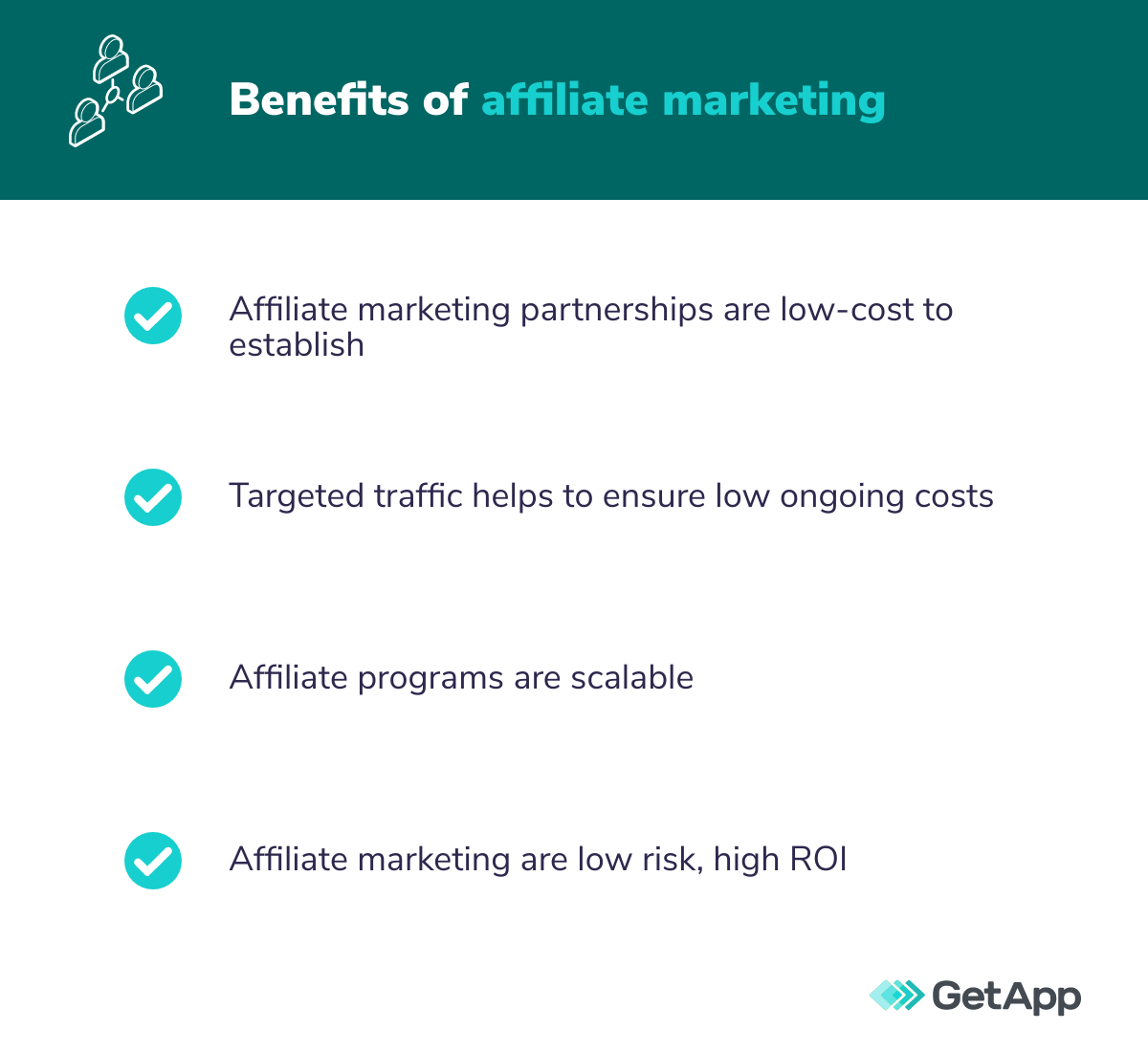
1. Affiliate marketing partnerships are low-cost to establish
While companies that host affiliate programs might need to provide the advertising collateral, they do not themselves need to rely as heavily upon marketing and advertising to build sales. Instead, they can rely upon the affiliate partners to create content and marketing initiatives of their own that result in organic growth and visibility of the parent company.
2. Targeted traffic helps to ensure low ongoing costs
While there are few barriers of entry for aspiring affiliates to join affiliate programs, the very nature of affiliate marketing ensures that partners will be creating content that appeals to a target audience aligned with your products and services. This helps affiliate marketing programs keep ongoing costs low because, while it might appear that commission payouts would dig into profitability, the company is not having to invest in paid media campaigns and other costly marketing tactics.
3. Affiliate programs are scalable
The beauty of affiliate marketing programs is that they are completely flexible. The parent company can accept as many or as few affiliate partners into the program as is necessary to achieve sales targets. However, the focus should always be on building quality relationships, rather than partnering with as many affiliates as possible.
This focus on quality is supported by the fact that the goal for many affiliate programs is that 20% of affiliate partners generate 80% of the parent company’s revenue [3]. Incentives can be modified and made more competitive to entice and attract more experienced partners, who in turn generate higher rates of organic traffic from qualified leads.
4. Affiliate marketing are low risk, high ROI
The combination of low-cost, high-volume sales traffic and operational costs that scale with the volume of sales generated ensure that affiliate marketing programs are extremely low risk to manage and maintain. With such targeted channeling of organic influence through the affiliate network, this low-cost marketing approach has an extremely high return on investment over time, with affiliate marketing programs boasting an average of $15 per dollar spent. [4]
How to start affiliate marketing for your business?
With around 80% of brands running affiliate marketing programs, it’s clear that affiliate marketing programs are an ideal channel for small businesses seeking to grow their business without taking on additional infrastructure or dedicating additional budget and resources to marketing. [5] There are several steps that must be taken by a business before their affiliate program opens to potential partners.
Establish your brand with your target audience and build your reputation. The success of an affiliate program relies heavily on the parent organization’s reputation for providing high quality products or services.
Plan out an affiliate program that has realistic goals and marketing expectations of affiliate partners. Goals should incentivize not only revenue or sales targets, but also traffic generated and brand perception and search volume. Track performance through affiliate links and provide assistance or make changes as needed. Establish an affiliate agreement that lays out terms and conditions.
Create a tiered and bonused commission structure that incentivizes sales heavily, and ensure that it is competitive relative to competitors in your industry.
Identify channels to attract and engage with potential affiliate partners. Affiliate networks are one path, but are known for withholding vital data and preventing contact with affiliates in the network. Explore potential partners through social media platforms and forums relevant to your niche, and provide a way for them to apply to be affiliate partners.
In assessing candidates, choose affiliates already aligned with your audience or ones you feel that, as partners, will expand your brand presence and recognition with new audience channels that are interested in the products and services you offer.
While affiliates are autonomous, they should never go unrecognized or operate in a vacuum. Establish strong communication practices by providing partners with access to support and assistance and keep your affiliates up-to-date via newsletters and other communication channels. Use these channels to also highlight top performing partners and create a culture of competition that rewards results.
What are the affiliate marketing channels?
Affiliate marketing partners can generate a wide range of content across multiple channels that engages and invites their audiences to interact with an affiliate link.
1. Influencers
Influencers are ideal affiliate marketing partners. Engaging with highly invested audiences on a single social media platform by leveraging video and audio content alongside targeted posts, influencers are skilled marketing partners who understand how to communicate the value of products and services created by others. They use targeted, informational messaging to motivate their followers to make purchases through their affiliate link.
2. Bloggers
Blog content can educate and inform an audience of the role products and services can play in solving problems they might have, making content marketing one of the most effective marketing tools for engaging with your target audience. Bloggers create content for their own websites as well as sponsored content across other platforms in order to strengthen backlinks, boost engagement, and increase sales across affiliate programs they might be involved with in order to generate revenue and attract advertising partners.
3. Email lists
Affiliate marketers engage with their audiences through a number of channels and invite their readers and audiences to submit their email addresses for future communications. This allows affiliates to quickly and effectively generate highly-curated and segmented email marketing lists. Using these lists for ongoing outreach, affiliates can communicate the value of their experiences with products or services they are selling.
4. Websites
At the heart of any effective marketing funnel is a brand’s website. Recent surveys show that affiliate marketing is the most successful channel for lead acquisition for 20% of brand marketers. [6] Because affiliate partners are often acting as their own brands, maintaining a website allows those affiliates to build and leverage landing pages to maximize conversions sourced through the other channels outlined above. Each landing page should be built around a specific product or service’s affiliate link, maximizing traffic back to the parent company’s sales platform.
Successful affiliate marketing examples
Affiliate marketing is widely leveraged by even small- to medium-sized brands, but some of the most popular affiliate programs in play today are large retail sites. Here are some of the most popular and successful examples of small- to large-scale affiliate programs:
Semrush is a great platform for affiliates involved in digital marketing and online marketing.
Teachable provides recurring commissions for affiliates who promote their course creation platform.
Shopify is one of the most popular and lucrative eCommerce service providers, providing affiliates the chance to sell subscriptions to those looking to open an online retail sales channel.
Amazon Associates affiliate program allows members to profit from promoting a wide array of products.
How can you leverage affiliate marketing software?
Explore GetApp's affiliate software directory to find an automation tool for managing your affiliate marketing program. These software solutions automate enrollment, track sale and referrals, and track and manage payouts to partners. Managing your affiliate program using a software solution positions the software as a vital source of data to assess program profitability and allows you to retain full control over your affiliate program rather than surrendering control to a third-party affiliate network.
Make your affiliate marketing partnerships work for you
Small business owners and entrepreneurs structure their businesses around their own strengths and skills, and then hire or outsource to fill in the gaps. Limited resources and skills often leave businesses with strong products or services, but no support to grow the business. Affiliate marketing can fill this gap by providing incentives to skilled entrepreneurs and sales-minded individuals to partner with brands seeking to grow their customer base.
Regardless of which side of the affiliate marketing partnership you’re operating on, you should continue to expand your knowledge of marketing tactics to find the right mix of strategies that will help your brand grow and expand:
Sources
136 Affiliate Marketing Statistics in 2024, AuthorityHacker
40+ Important Affiliate Marketing Statistics for 2024, AffiliateWP
How to Use the 80/20 Rule to Enhance Your Affiliate Marketing Program, EasyAffiliate
Affiliate Marketing Statistics 2024 For Merchants & Marketers, UpPromote
21 Affiliate Marketing Statistics: Proven Data to Boost Earnings, TrustPulse
David J. Brin