GetApp offers objective, independent research and verified user reviews. We may earn a referral fee when you visit a vendor through our links.
Our commitment
Independent research methodology
Our researchers use a mix of verified reviews, independent research, and objective methodologies to bring you selection and ranking information you can trust. While we may earn a referral fee when you visit a provider through our links or speak to an advisor, this has no influence on our research or methodology.
Verified user reviews
GetApp maintains a proprietary database of millions of in-depth, verified user reviews across thousands of products in hundreds of software categories. Our data scientists apply advanced modeling techniques to identify key insights about products based on those reviews. We may also share aggregated ratings and select excerpts from those reviews throughout our site.
Our human moderators verify that reviewers are real people and that reviews are authentic. They use leading tech to analyze text quality and to detect plagiarism and generative AI.
How GetApp ensures transparency
GetApp lists all providers across its website—not just those that pay us—so that users can make informed purchase decisions. GetApp is free for users. Software providers pay us for sponsored profiles to receive web traffic and sales opportunities. Sponsored profiles include a link-out icon that takes users to the provider’s website.
How To Perform a Cybersecurity Risk Assessment
Learn how to perform a cybersecurity risk assessment for SMBs. This guide covers steps to identify vulnerabilities, manage risks, and protect your business assets.


Small to midsize businesses (SMBs) face the challenge of ever-present cyber threats. For CIOs, IT managers, and business leaders responsible for managing their company's cybersecurity procedures, understanding and mitigating these risks is critical to business survival. And a cybersecurity risk assessment is an invaluable tool in this effort, providing a structured approach to identify and address potential vulnerabilities.
The undertaking of such an assessment can often feel overwhelming for those who aren’t prepared. But this guide is here to help. It will help demystify the process, providing practical steps and insights to empower you to conduct a thorough risk assessment. By understanding your organization's unique vulnerabilities and potential threats, you can make informed decisions to protect your valuable assets and ensure business continuity.
What is a cybersecurity risk assessment?
A cybersecurity risk assessment is a systematic evaluation of an organization's potential vulnerabilities to cyberattacks. It involves identifying, analyzing, and prioritizing risks to determine the likelihood and potential impact of the threats. In simpler terms, it's like a comprehensive health check for your digital infrastructure.
For SMBs, understanding and managing these risks is crucial. According to Gartner's Cyber Risk Primer for 2024, cyber risks are "risks that may impact the goals and values of an organization in terms of financial loss, operational disruption, damage or harm caused by the failure of the technologies employed for informational and/or operational functions within interconnected digital environments." [1]
Cyber risk opens the door to cyberattacks and the devastating consequences that come with them. By conducting a thorough risk assessment, you can pinpoint your organization's weak spots and implement targeted measures to protect your valuable assets.
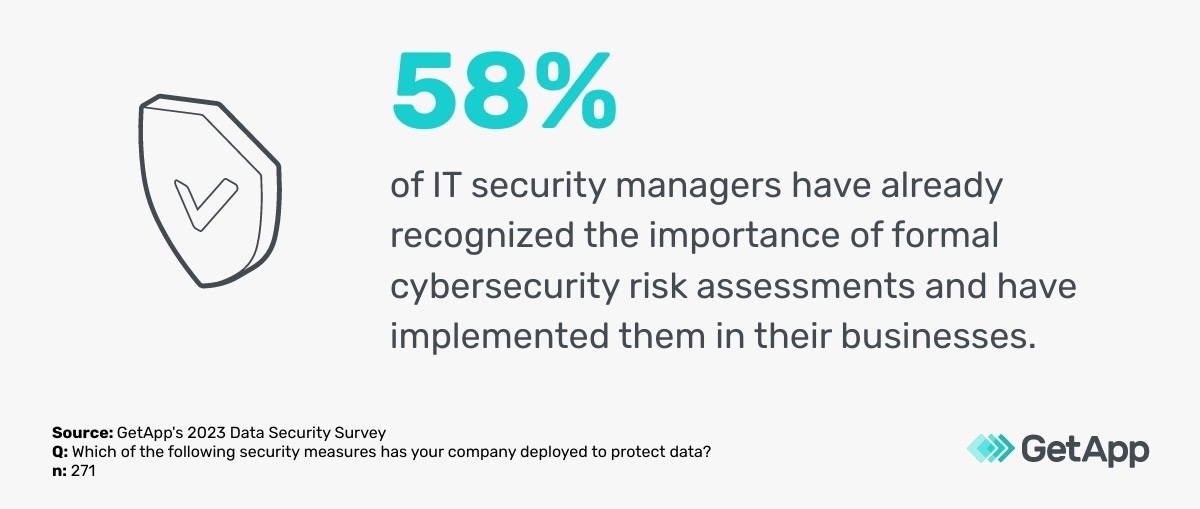
According to GetApp's 2023 Data Security Survey, 58% of IT security managers have already recognized the importance of formal cybersecurity risk assessments and have implemented them in their businesses.* This statistic highlights the growing awareness of the need to safeguard sensitive data.
The basics of a cybersecurity risk assessment
Cybercrime is now ubiquitous—it's the stranger danger of the digital world. To evaluate your company's vulnerability, you should consider three particular factors:
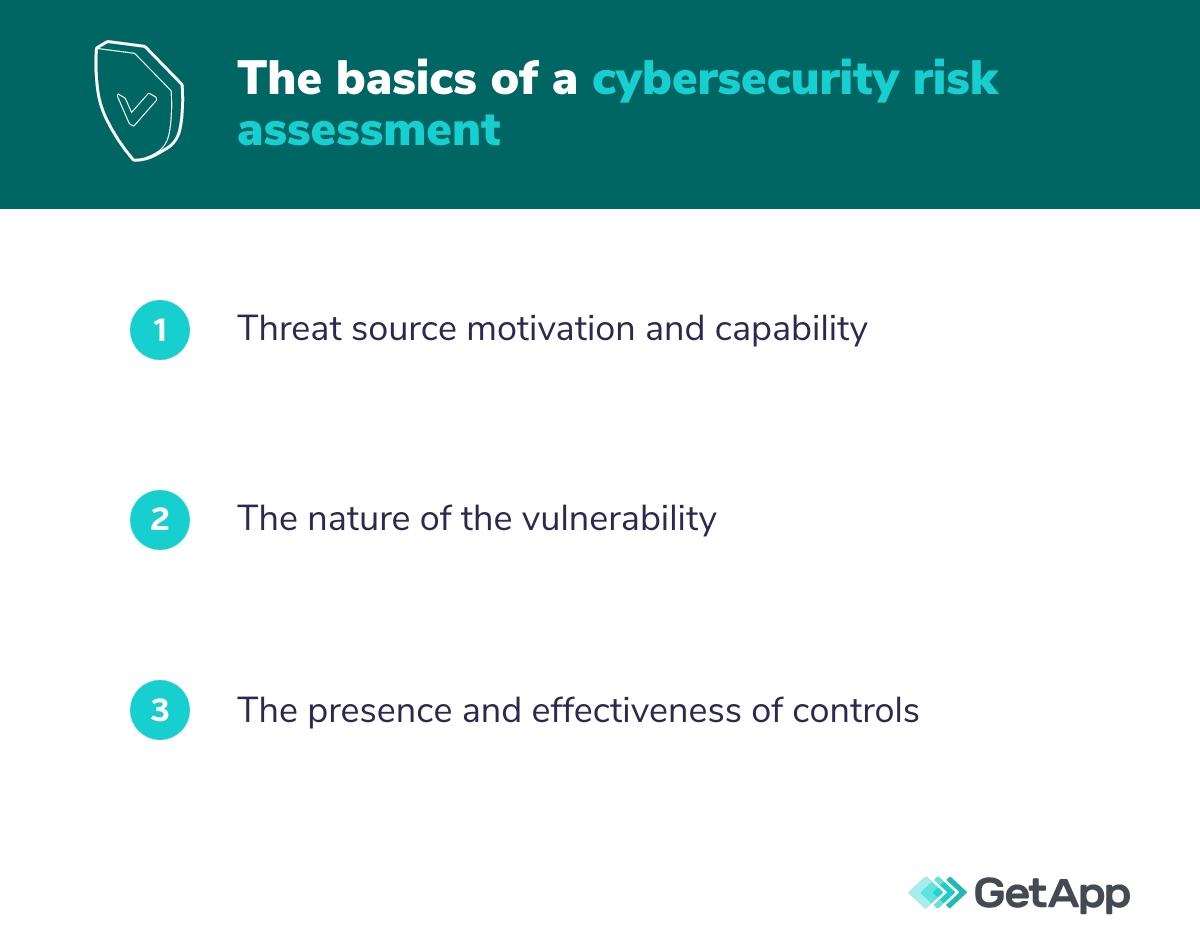
1. Threat source motivation and capability
Is the threat source interested in your information, and can they make money from it? Do they have tools that will allow them to attack your system?
2. The nature of the vulnerability
Is your company's data security weakness due to human nature or coding issues? Are cyberthieves currently exploiting this weakness elsewhere?
3. The presence and effectiveness of controls
Do you have security systems that can thwart bad actors from detecting and/or exploiting this weakness? Have other companies been able to address and correct this vulnerability?
These are general questions to ask and answer when you begin a threat assessment. You can start to calculate risk based on your answers to the above. They will give you a sense of your company's weaknesses.
Why perform a cyber risk assessment?
According to Gartner's Top Trends in Cybersecurity for 2024, cybersecurity risk management has become "more critical as organizations strive to balance protection with business value creation." [2] A cybersecurity risk assessment provides a clear understanding of your organization's vulnerabilities, helping you make informed decisions to protect your assets and mitigate potential losses.
Who should perform a cyber risk assessment?
While larger organizations might have dedicated security teams, in SMBs, the responsibility often falls to IT managers or business leaders. However, it's important to involve stakeholders from across the organization, including:
IT staff
Department heads
Legal and compliance teams
Human resources
Executive leadership
You might also consider bringing in external cybersecurity experts to provide an objective perspective and specialized knowledge.
Why you need to know your cybersecurity risk
Understanding your cybersecurity risk is essential for many reasons:
Improved decision-making: By understanding your risks, you can make informed choices about where to allocate resources and which security measures to prioritize.
Cost-effective security: A risk assessment helps you focus on the most critical areas, optimizing your security spending.
Regulatory compliance: Many industries have specific cybersecurity requirements. A risk assessment helps you meet these regulatory compliance obligations and avoid potential fines or penalties.
Enhanced preparedness: By identifying potential threats and vulnerabilities, you'll be better equipped to prevent incidents and respond quickly if they do occur.
Increased stakeholder confidence: Demonstrating a proactive approach to cybersecurity can boost trust among customers, partners, and investors.
How to perform a cybersecurity risk assessment
Now that we've covered the "why," let's look at the "how." Follow these steps to conduct a thorough risk assessment:
Key considerations before performing a cybersecurity risk assessment
Use this cybersecurity risk assessment checklist to begin:
Define the scope of your assessment (specific systems, departments, or the entire organization)
Identify key stakeholders and form a risk assessment team
Gather relevant documentation, such as network diagrams and asset inventories
Set clear objectives for what you hope to achieve with the assessment
Determine your risk likelihood
Start by identifying potential threats to your organization. Consider external threats, like hackers or malware, and internal risks, such as employee errors or insider threats. For each threat, estimate the likelihood of it occurring based on factors like:
Historical data on similar incidents
Current threat intelligence
The attractiveness of your assets to potential attackers
The strength of your existing security controls
You might categorize likelihood as high, medium, or low, or use a more granular scale if desired.
Determine the impact potential
Next, assess the potential impact of each identified threat. Consider the following categories:
High impact
This type of threat could result in data breaches, system outages, and ransomware attacks, which could become:
Significant financial losses
Long-term damage to reputation
Extensive downtime or business disruption
Violation of regulatory requirements leading to severe penalties
Medium impact
Examples of medium-impact threats include unauthorized access to sensitive data, phishing attacks, and denial-of-service (DoS) attacks, which could cause:
Moderate financial losses
Short-term reputational damage
Temporary business disruption
Minor regulatory violations
Low impact
Low-impact threats could result in minor system disruptions or unauthorized access to non-critical data, which might cause:
Minimal financial impact
Little to no reputational damage
Brief or no business disruption
No regulatory implications
Use the NIST matrix
The NIST matrix lists numerical "scores" for both likelihood and impact so that you can determine your risk. [3]
For instance, if you have a medium threat likelihood and a high impact probability, you would multiply 100 x 0.5 for a score of 50. This score means that your company is classified as a medium risk under the scoring scale: High (>50 to 100), Medium (>10 to 50), or Low (1 to 10). Any score of 10 or higher means you need to up your security measures.
It's also important to remember that cybersecurity risk management is an ongoing process, not a one-time event. As Gartner's Top Trends in Cybersecurity for 2024 emphasizes, organizations must continuously monitor and adapt their risk management strategies to address emerging threats and vulnerabilities. [2]
How you can leverage cybersecurity software to address your company's vulnerabilities
Cybersecurity software can be a powerful ally in your defense against cyber threats. By automating tasks, providing real-time insights, and centralizing security operations, these tools can help you address vulnerabilities more effectively.
GetApp's 2024 Executive Cybersecurity Survey revealed that 94% of companies have some form of cyber security incident response plan in place.** Cybersecurity software can enhance these plans by automating incident detection, response, and recovery processes. Additionally, 38% of companies whose senior executives have been targeted by a cyberattack in the past 18 months have invested in new security software within this timeframe, demonstrating a growing reliance on technology to strengthen defenses.
Employee training is another critical component of cybersecurity. While 74% of companies with mandatory security training provide cybersecurity training, employee training software can aid these efforts by offering interactive modules, simulations, and phishing awareness training.
It is also important to provide employees with a straightforward way to report cybersecurity incidents. According to GetApp's 2023 Data Security Survey, 93% of IT security managers say their organization has protocols in place to report a suspected cyberattack.* Cybersecurity software can streamline this process by providing centralized reporting systems, automated alert mechanisms, and incident-tracking capabilities.
To address these needs, businesses should explore various software categories, including:
Cybersecurity software: Offers comprehensive protection against a wide range of threats, including malware, ransomware, and phishing attacks. According to Gartner's 2024 Cybersecurity Primer: Meet Daily Cybersecurity Needs, one of the most important features to look for in cybersecurity risk assessment tools is continuous threat exposure management (CTEM) to help "identify and manage your exposures in real-time". [4]
IT management software: Provides tools for network monitoring, asset management, and patch deployment, helping to maintain a secure IT infrastructure.
Risk management software: Assists in identifying, assessing, and mitigating potential cybersecurity risks across the organization.
To find the right tools for your organization, explore GetApp's software category links above, which offer detailed comparisons and user reviews that will help you make informed decisions based on your specific needs and budget.
Turn insights into action
Navigating the complex world of cybersecurity can be overwhelming. But by understanding the fundamentals of risk assessment and following the steps outlined in this guide, you've taken a significant step toward safeguarding your organization.
Remember, a successful risk assessment is not a one-time event. It's an ongoing process that requires continuous monitoring and adaptation.
To solidify your organization's cybersecurity posture, take the following steps:
Prioritize actions: Based on your risk assessment findings, develop a prioritized action plan to address critical vulnerabilities.
Implement controls: Strengthen your defenses by implementing effective security controls aligned with your risk assessment.
Educate employees: Foster a culture of cybersecurity awareness through regular training and education.
Stay informed: Keep up to date with the latest cybersecurity threats and trends to stay ahead of potential attacks.
To learn more about managing cybersecurity risks, check out the following resources:
Sources
Cyber Risk Primer for 2024, Gartner
Top Trends in Cybersecurity for 2024, Gartner
Formula for Calculating Cyber Risk, State of Security
2024 Cybersecurity Primer: Meet Daily Cybersecurity Needs, Gartner
Survey methodologies
*GetApp's 2023 Data Security Survey was conducted in August 2023 among 872 respondents to learn more about data security practices at U.S. businesses. All respondents were screened for full-time employment at U.S. businesses. 362 respondents identified as IT management professionals, and 271 identified as IT security managers.
**GetApp's Executive Cybersecurity Survey was conducted in May 2024 among 2,648 respondents in the U.S. (n=238), Canada (n=235), Brazil (n=246), Mexico (n=238), the U.K. (n=254), France (n=235), Italy (n=233), Germany (n=243), Spain (n=243), Australia (n=241), and Japan (n=242). The goal of the study was to explore how IT and cybersecurity professionals are responding to the rising threat of biometric fraud. Respondents were screened for IT and cybersecurity roles at companies that use security software and have more than one employee. Respondents were screened for involvement in, or full awareness of, cybersecurity measures implemented at their company.
Stephan Miller
More on IT Management




May 29, 2024

Aug 08, 2024