GetApp offers objective, independent research and verified user reviews. We may earn a referral fee when you visit a vendor through our links.
Our commitment
Independent research methodology
Our researchers use a mix of verified reviews, independent research, and objective methodologies to bring you selection and ranking information you can trust. While we may earn a referral fee when you visit a provider through our links or speak to an advisor, this has no influence on our research or methodology.
Verified user reviews
GetApp maintains a proprietary database of millions of in-depth, verified user reviews across thousands of products in hundreds of software categories. Our data scientists apply advanced modeling techniques to identify key insights about products based on those reviews. We may also share aggregated ratings and select excerpts from those reviews throughout our site.
Our human moderators verify that reviewers are real people and that reviews are authentic. They use leading tech to analyze text quality and to detect plagiarism and generative AI.
How GetApp ensures transparency
GetApp lists all providers across its website—not just those that pay us—so that users can make informed purchase decisions. GetApp is free for users. Software providers pay us for sponsored profiles to receive web traffic and sales opportunities. Sponsored profiles include a link-out icon that takes users to the provider’s website.
Managing remote teams with a remote work policy
A remote work policy will not be successful without the support of management and trust in employees. Rather than control, focus on outcomes and accountability.

Employing remote workers opens your company to a larger talent pool and attracts those who prefer a flexible working environment (i.e., the vast majority of job seekers). In fact, a recent survey found that 86 percent of workers age 18-34 would be more likely to take a job that offers at least some remote work over one that doesn’t.
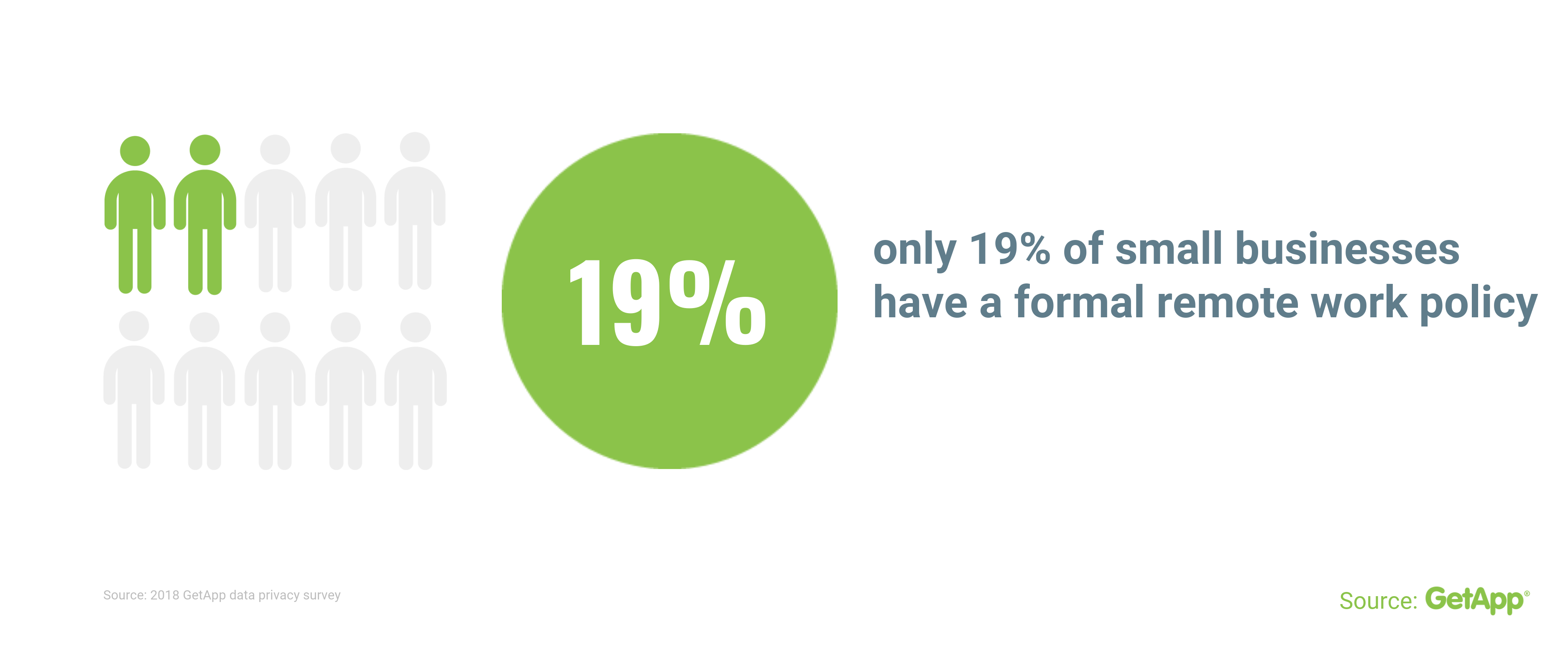
Recent data shows that up to 85 percent of U.S. companies allow some form of remote work. However, a recent GetApp survey found that a mere 19 percent of small businesses have a formal remote work policy in place. To retain employees and stay competitive, small businesses must develop remote work policies that fully embrace the changing dynamics of work that can be done at any time and from any place.
4 considerations before creating a remote work program
Remote work represents a fundamental change in the ways that teams function. This means a shift in philosophy and a genuine belief that remote work can benefit the organization. Before creating a remote work program, consider the following:

1. Technology
To be productive, remote employees must be equipped with the appropriate hardware and software. IT must design a mobile solution that includes laptops preconfigured with a secure VPN and cloud-based software that allows every employee equal access to company tools and data.
Collaboration tools are also essential. Remote employees must be able to communicate effectively with others. Email and basic chat apps are useful, but investing in a comprehensive communications tool, such as Slack, can ease collaboration and level the playing field for remote workers. These tools often integrate with other business systems and allow users to set status updates, manage projects, and create specific channels.

Collaboration software Slack (Source)
2. Suitability
Consider which roles are suitable for remote work and can be performed effectively from outside the office. If goals can be achieved and workflows maintained or adapted, the role is probably a good candidate. Once a role has been deemed suitable, the business must determine how much remote work is appropriate. Some jobs function perfectly well working from home full-time while others might require direct collaboration with co-workers in the office three days a week.
3. Motivation
Just because a job can be performed remotely doesn’t mean all employees want to work remotely, or have the discipline to do so. These employees might consider working from a co-working space, coffee shop, or library. When creating a remote work program, consider options for employees who either don’t want to participate or find that remote work isn’t for them.
4. Trust
Trust is the most important factor in whether your remote work program will be a success. Management must clearly convey that employees are trusted to do their work whether in or out of the office. Likewise, remote employees must remain accountable to their tasks or face the consequences just as if they were office-based.
4 areas to cover in your remote work policy
Once you’ve decided that remote work is a good fit for your business, it’s time to develop the policy. A remote work policy governs the eligibility, productivity, availability, and security expectations of employees working from outside the office.
1. Eligibility
Of course, some roles are more conducive to remote work than others, and there will be some positions that unfortunately do not qualify, such as those requiring onsite physical activity. Eligibility for remote work should be based on the role rather than the employee.
2. Productivity
Some businesses are hesitant to allow remote work because of fears that employees will be less productive when out of view or will treat a work-from-home day as a holiday. But studies have shown that working from home actually boosts overall productivity. Remote work is enabled by trust and measured by outcomes. Establish outcome-based metrics, set goals, and check progress through regularly scheduled videoconferences.
3. Availability
A key challenge when managing remote teams is knowing where everyone is at any given time. Some remote work policies are structured so that business hours are the same whether in the office or out. This is a hedge that betrays a lack of commitment to the remote work philosophy.
Employees must be empowered to make their own decisions about when and where they work. This doesn’t mean that employees are free to disappear until the next meeting. Remote employees must have the means to alert others to their availability or lack thereof. This could be a shared calendar application or simply setting an out-of-office email indicator. They must also show accountability by maintaining commitments to meetings and responding to messages within a reasonable timeframe.
4. Security
Remote work involves an additional layer of security concern. All data transactions now transmit through Wi-Fi, and conversations that would usually take place in a secure office environment take place online or in public. This makes data security even more important.
Employees working away from the office are more likely to use a variety of personal devices for work, which increases the chances of data breaches resulting from lost or compromised devices. Adopting cloud-based business applications makes remote work more secure because company data is stored in the cloud rather than on the device.
Remote work policies must:
Set requirements for automatic device locking
Insist on multi-factor authentication for applications
Require the use of a VPN when connecting to Wi-Fi
When working in public, business data must also be protected from low-tech methods used by fraudsters or those engaged in corporate espionage. A coffee shop might feel like a secure environment where you can get some work done, but it could be easy for someone to eavesdrop on your conversations or watch as you log in to an application. In a high-tech world, these low-tech methods are often overlooked, but they continue to be used and are highly effective.
6 steps to maintaining security while working in public

Managing remote teams starts with support
Stay in regular contact
A weekly video chat between a manager and employee ensures regular contact and a dependable time when information can be shared face-to-face. Some news, good and bad, is best delivered “in person” rather than email or messaging. Additionally, employees may be more likely to ask questions or voice concerns during a video chat than via email.
Likewise, a separate team call including all team members should be scheduled on a weekly or biweekly basis. Encourage remote teammates to engage in their own informal video calls with one another to catch up on projects or just stay in touch.
Ensure work-life balance doesn't become work-life blur
Maintaining a sense of separation between life and work is a critical factor in preventing overwork or burnout, requiring that employees take their scheduling game up a notch. It’s easy to get in the zone while working on a project at home and suddenly realize it’s after midnight and you forgot to eat dinner.
Conversely, when working from home, it’s easy to get distracted by dishes that need to be put away or a TV show you’ve been binging. Employees should be encouraged to schedule their time, keep up with hours worked, and not exceed them. Seek feedback from remote workers and consider sending out an anonymous survey to identify pain points.
Next steps
A remote work policy will not be successful without the support of management and a philosophy that believes in the benefits it brings. Rather than control, managers must focus on business outcomes, ensure accountability, and coach employees toward self-reliance.
This article is part of an ongoing series about the business value of IT.
GetApp's data privacy survey was conducted in November 2018 among 190 small businesses with 200 or fewer employees. The qualified respondents indicated involvement in the decision-making process for software and technology in their organizations.
Note: The information contained in this article has been obtained from sources believed to be reliable. The applications selected are examples to show a feature in context and are not intended as endorsements or recommendations.
More on Human Resources

Jul 09, 2024
Jan 17, 2024