GetApp offers objective, independent research and verified user reviews. We may earn a referral fee when you visit a vendor through our links.
Our commitment
Independent research methodology
Our researchers use a mix of verified reviews, independent research, and objective methodologies to bring you selection and ranking information you can trust. While we may earn a referral fee when you visit a provider through our links or speak to an advisor, this has no influence on our research or methodology.
Verified user reviews
GetApp maintains a proprietary database of millions of in-depth, verified user reviews across thousands of products in hundreds of software categories. Our data scientists apply advanced modeling techniques to identify key insights about products based on those reviews. We may also share aggregated ratings and select excerpts from those reviews throughout our site.
Our human moderators verify that reviewers are real people and that reviews are authentic. They use leading tech to analyze text quality and to detect plagiarism and generative AI.
How GetApp ensures transparency
GetApp lists all providers across its website—not just those that pay us—so that users can make informed purchase decisions. GetApp is free for users. Software providers pay us for sponsored profiles to receive web traffic and sales opportunities. Sponsored profiles include a link-out icon that takes users to the provider’s website.
The Essentials of Performance Monitoring for Business Success
Performance monitoring can improve your decision-making, boost efficiency, and drive growth. Here's your comprehensive guide.

In any small business, understanding and optimizing the performance in all aspects of your business is paramount in order to reduce wasted resources and maximize profit. If you are a business owner, then it’s important for you to be able to accurately measure how your business is performing, so you can then go on to address any problems.
Without proper measurement, you can easily miss issues that could compound over time, becoming a much bigger problem than it was originally. Read on to explore the world of performance monitoring and learn how it can be a game-changer for your small to midsize business (SMB).
What is performance monitoring in business?
Performance monitoring is the process of tracking and analyzing key performance indicators (KPIs) within a business to evaluate its overall health and effectiveness. By measuring and assessing metrics such as revenue, customer satisfaction, and operational efficiency, you can gain valuable insights into the performance of your business.
There are various types of business performance monitoring, including:
Financial performance monitoring involves tracking metrics such as revenue, profit margins, and cash flow to provide insights into the fiscal health of the company.
Operational performance monitoring assesses the efficiency of internal processes, ensuring streamlined workflows and resource optimization.
Customer performance monitoring measures customer satisfaction and loyalty monitoring by examining factors such as feedback, retention rates, and Net Promoter Score (NPS).
Employee performance monitoring evaluates workforce productivity, engagement levels, and skill development.
Setting up performance monitoring for your business
From defining KPIs to selecting the right tools, you can set the foundation for success with performance monitoring.
1. Define your objectives
Begin by clearly outlining the specific goals and objectives of your business. Identify the key areas you want to monitor and improve, whether it's sales performance, customer satisfaction, or operational efficiency.
2. Identify your KPIs
Once your objectives are defined, pinpoint the KPIs that align with each goal. These metrics provide measurable data to track progress and success.
3. Select appropriate tools
Explore and choose the right performance monitoring tools that suit the unique needs of your business. From analytics platforms to dedicated performance management software, the market offers a variety of solutions. Consider factors such as scalability, user-friendliness, and integration capabilities to ensure seamless implementation and utilization.
4. Collect data on your KPIs
Establish robust processes for collecting relevant data related to your chosen KPIs. This may involve integrating data sources, setting up tracking mechanisms, and ensuring data accuracy. The effectiveness of your performance monitoring hinges on the quality and consistency of the data collected, making this step crucial for actionable insights.
5. Establish baseline metrics
Before diving into active monitoring, establish baseline metrics for each KPI. This serves as a point of reference, allowing you to gauge performance improvement or identify areas of concern. Clearly understanding where your business stands at the outset provides context for future analysis and decision-making.
6. Set goals for your KPIs
Define acceptable thresholds and set achievable targets for each KPI. This step adds a layer of context to your monitoring efforts, enabling you to quickly identify when performance deviates from the desired path. Thresholds act as early warning signals, prompting timely interventions and adjustments.
7. Track your progress over time
Integrate real-time monitoring capabilities into your system to keep a pulse on your business's performance. Tracking your progress allows you to make decisions that are always relevant and up to date.
8. Establish reporting mechanisms
Develop a comprehensive reporting structure that translates raw data into meaningful insights. Create regular reports and dashboards that highlight key trends, performance against targets, and areas for improvement. Clear visualizations make it easier for stakeholders to grasp the nuances of your business's performance.
Improve your business with performance monitoring
By mastering the art of using performance monitoring to improve your business, you position yourself to not only react to challenges but proactively drive growth. It becomes a strategic tool that empowers your team to make informed decisions, adapt to market dynamics, and continuously enhance the overall performance and resilience of your business.
Here’s what to do once you’ve implemented performance monitoring for your company:
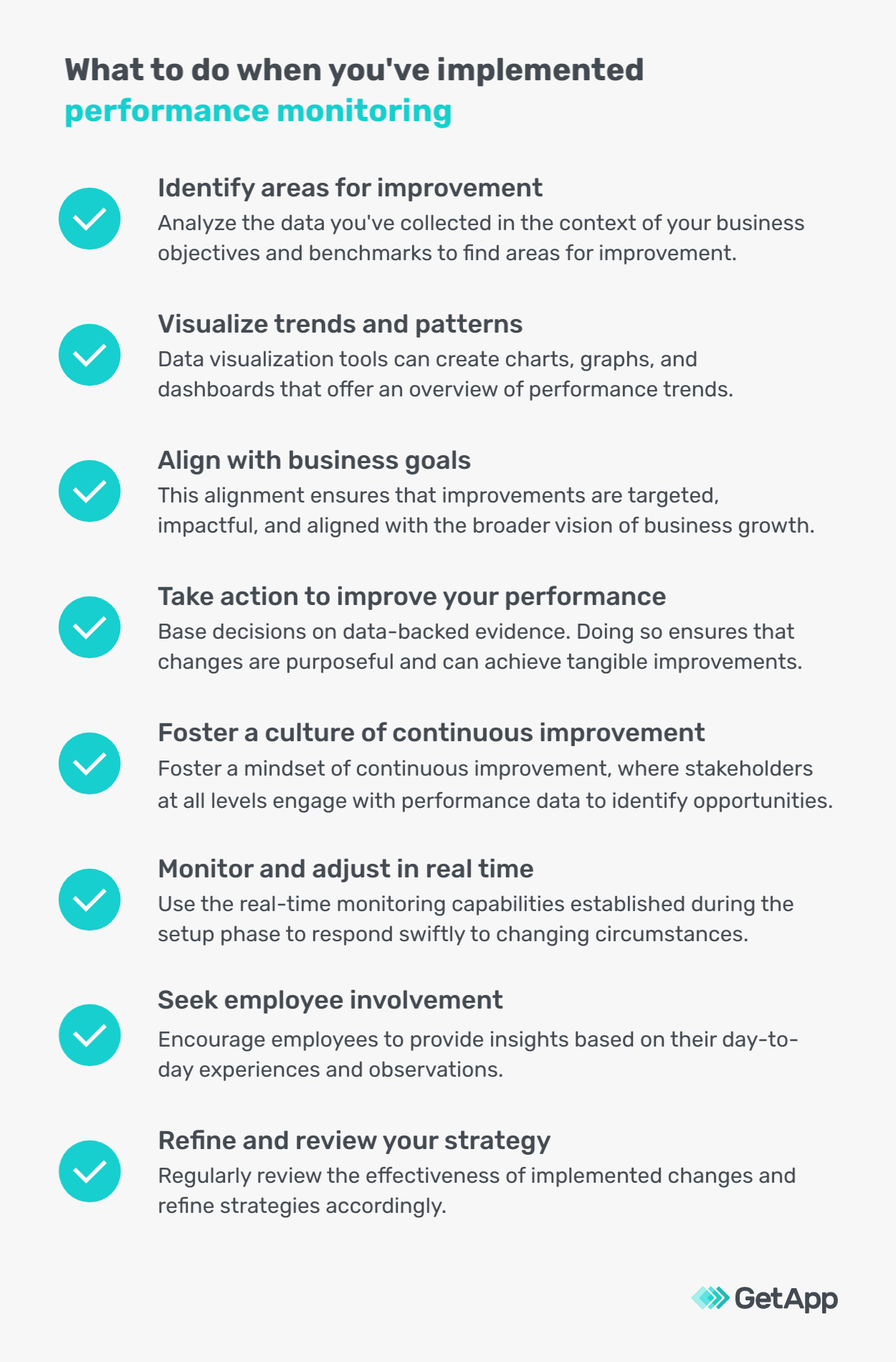
Take advantage of the benefits of performance monitoring
Performance monitoring provides real-time visibility into key metrics, enabling timely identification of potential issues and opportunities for improvement. By tracking financial, operational, and customer-centric data, businesses can enhance decision-making processes.
There is also the potential of added benefits such as improved operational efficiency, increased profitability, and the ability to proactively adapt to changing business environments.
You can embrace performance monitoring as an ally in your small-business journey. Equip yourself with the knowledge and tools needed to navigate the competitive landscape and foster continuous growth. The following resources can help.
Hannah Whiteoak