GetApp offers objective, independent research and verified user reviews. We may earn a referral fee when you visit a vendor through our links.
Our commitment
Independent research methodology
Our researchers use a mix of verified reviews, independent research, and objective methodologies to bring you selection and ranking information you can trust. While we may earn a referral fee when you visit a provider through our links or speak to an advisor, this has no influence on our research or methodology.
Verified user reviews
GetApp maintains a proprietary database of millions of in-depth, verified user reviews across thousands of products in hundreds of software categories. Our data scientists apply advanced modeling techniques to identify key insights about products based on those reviews. We may also share aggregated ratings and select excerpts from those reviews throughout our site.
Our human moderators verify that reviewers are real people and that reviews are authentic. They use leading tech to analyze text quality and to detect plagiarism and generative AI.
How GetApp ensures transparency
GetApp lists all providers across its website—not just those that pay us—so that users can make informed purchase decisions. GetApp is free for users. Software providers pay us for sponsored profiles to receive web traffic and sales opportunities. Sponsored profiles include a link-out icon that takes users to the provider’s website.
TikTok Will Dethrone Meta for SMB Marketing in 2024—Is Your Business Ready?
As TikTok evolves in 2024, your social media marketing strategy should as well.

TikTok is headed into 2024 with serious momentum. In 2023, the ByteDance-owned social media platform managed to avoid state and federal bans in the U.S., rolled out an eCommerce program, and helped launch countless small business success stories.
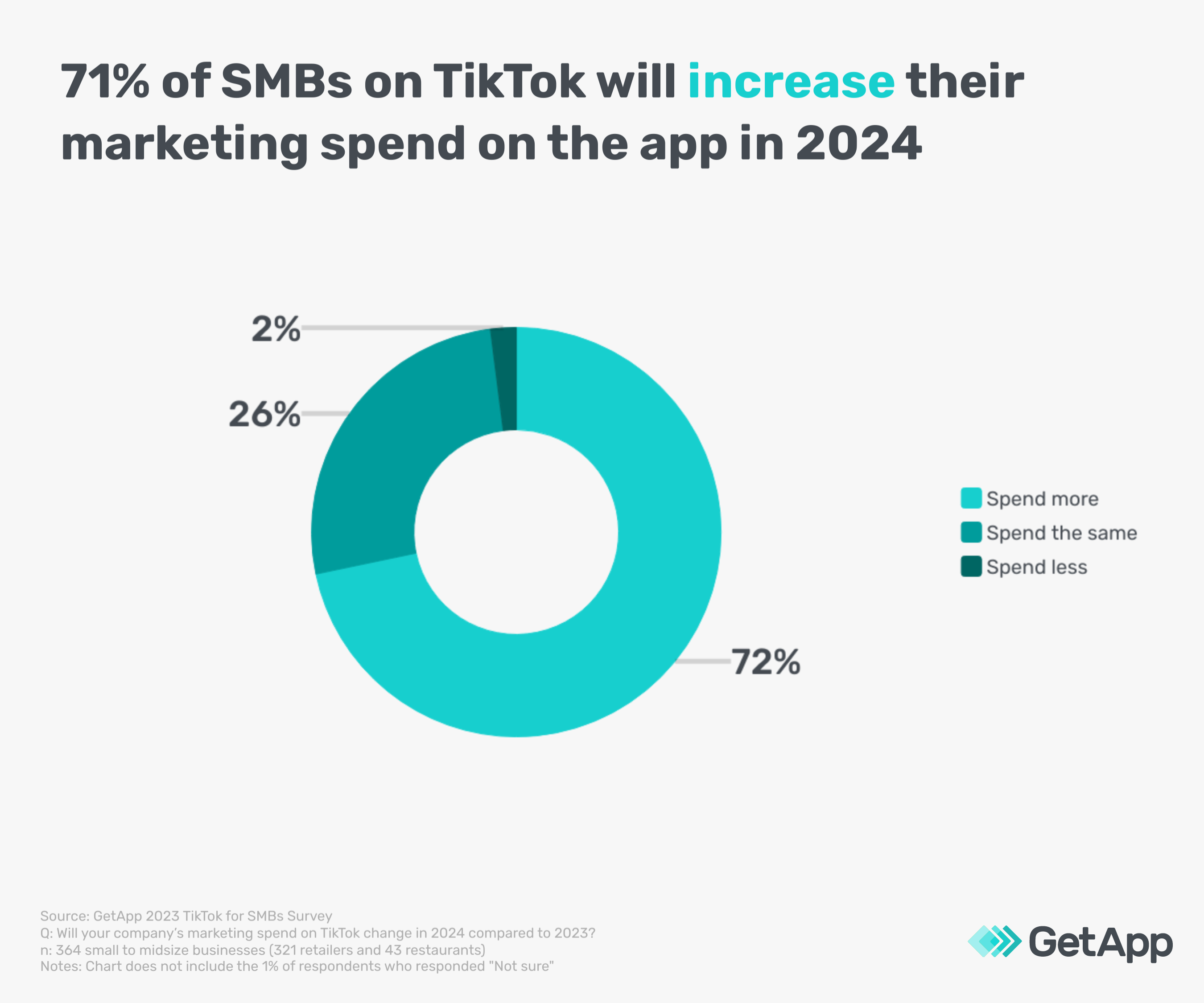
Using survey data from 364 small to midsize businesses,* GetApp has found that SMBs marketing on TikTok reap significant benefits, leading 71% to plan to increase their marketing spend on TikTok in 2024. As TikTok’s algorithm and eCommerce program evolves, SMBs can use our data-driven trends to adapt their strategy this year.
Key insights:
96% of small to midsize businesses on TikTok get more engagement on TikTok compared to Facebook, Instagram, YouTube, and Twitter.
97% of brands on TikTok use TikTok content and themes on other marketing channels.
92% already use generative AI to support their TikTok content strategy.
72% of SMBs on TikTok launched products on TikTok Shop in 2023, and 26% plan to do so in 2024.
TikTok will dethrone Instagram as the dominant social media marketing channel for small businesses
We’ve all heard enough about Instagram’s slow death by competition and algorithmic flops to know that it’s increasingly unpopular among younger consumers. Small to midsize businesses are adapting by shifting their marketing efforts over to TikTok.
TikTok’s discovery algorithm provides a unique opportunity for businesses hoping to get noticed on social media, which performance metrics support: 77% of SMBs on TikTok report a year-over-year increase in sales attributable to the app, and nearly all of them (96%) say their engagement on TikTok surpasses their engagement on Facebook, Instagram, YouTube, and Twitter.
In 2024, more small businesses will focus their marketing efforts on TikTok, rather than on Instagram or Facebook. In fact, 71% of surveyed SMBs on TikTok will increase their TikTok marketing spend next year, while 37% will spend less on Facebook and 32% will spend less on Instagram.
TikTok differs from other social media platforms in that it calls for a specialized—but not necessarily expensive or time-consuming—approach to content creation and branding. While Instagram content can seem overly precious and polished, top-performing TikTok content is irreverent, candid, and often vulnerable.
As TikTok’s footprint spreads to other marketing channels, it’s increasingly important for small to midsize businesses to join the platform and master its particular flavor of organic, vertical, short-form video content. [1]
Brands will continue to TikTok-ify other marketing channels
Of course, your business’s success on any given social media platform depends on how much of your audience happens to also use that platform. If your target demographic is retirees, you may well have more success on Facebook right now than on TikTok.
Here’s the caveat: With TikTok becoming wildly popular amongst U.S. consumers as a hub for product research, trusted reviews, and influencer content, 97% of SMBs in our survey are already repurposing TikTok content and themes in other marketing channels. That includes not just other social media channels, but eCommerce websites, in-store displays, and even the research and development of new products. In 2024, TikTok content will be everywhere—it will find your audience, wherever they are. It’s a good idea to get on board now.
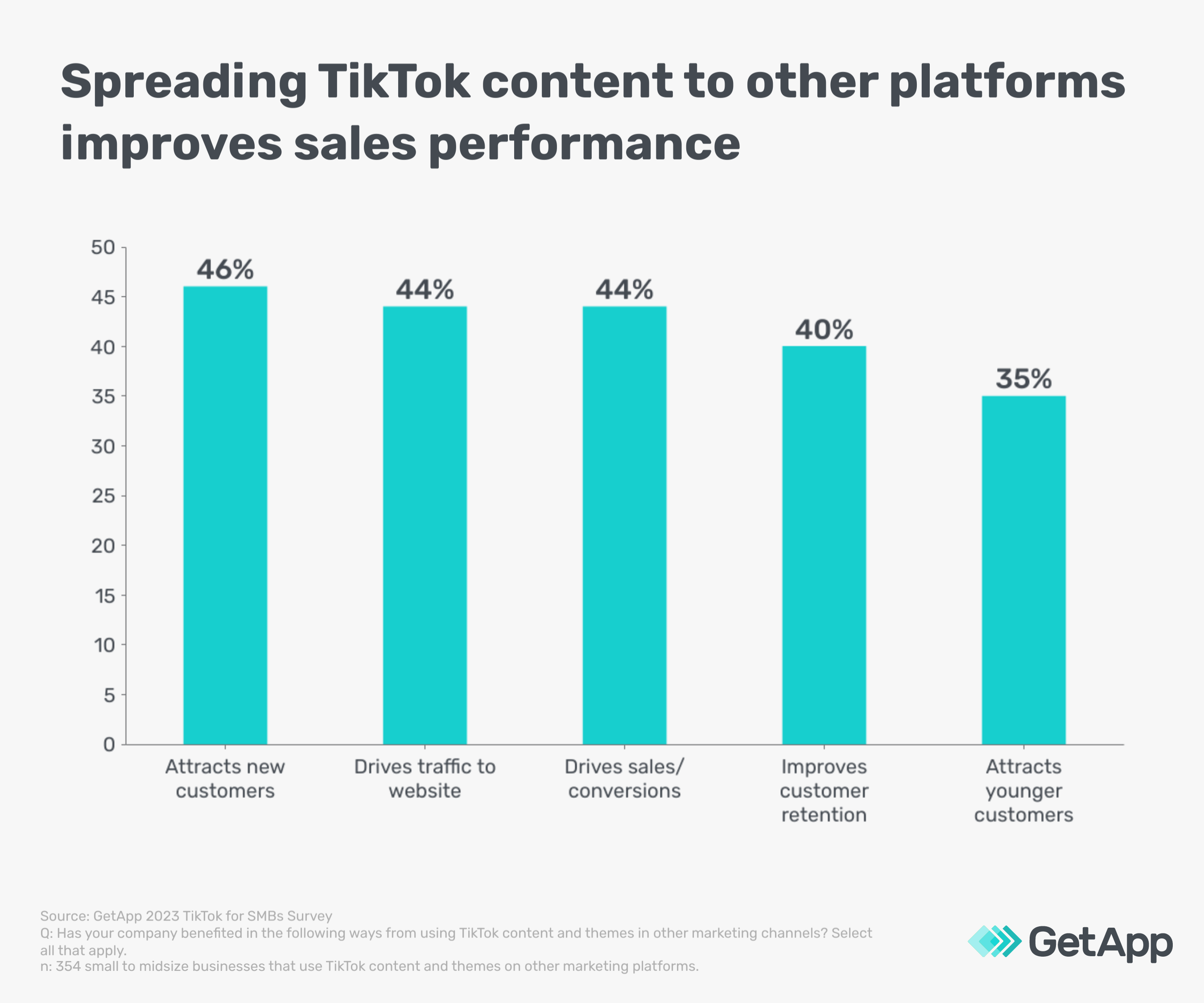
There are big advantages to spreading TikTok content to other channels, including attracting more customers, driving traffic to eCommerce websites, and boosting sales. As brands increase their marketing efforts on TikTok in 2024, they’ll use TikTok content and themes to imbue product pages, email campaigns, and even in-store displays with the app’s air of authenticity and entertainment.
The TikTok content you recycle doesn’t have to be only your own. In fact, you should regularly search TikTok for mentions of your brand in the form of UGC, or user-generated content. UGC provides social proof for your brand and products, and is especially helpful when created by micro-influencers, whose product reviews are gospel to their followers.
If you run a small business, you can use social media marketing software to find brand mentions and amplify them across marketing channels. Most major social media platforms now support, and in some cases prioritize, vertical video content, so reposting your TikTok videos to other apps is pretty straightforward—just be sure to remove the TikTok watermark before you upload to Instagram.
SMBs will leverage generative AI to improve their TikTok content strategies
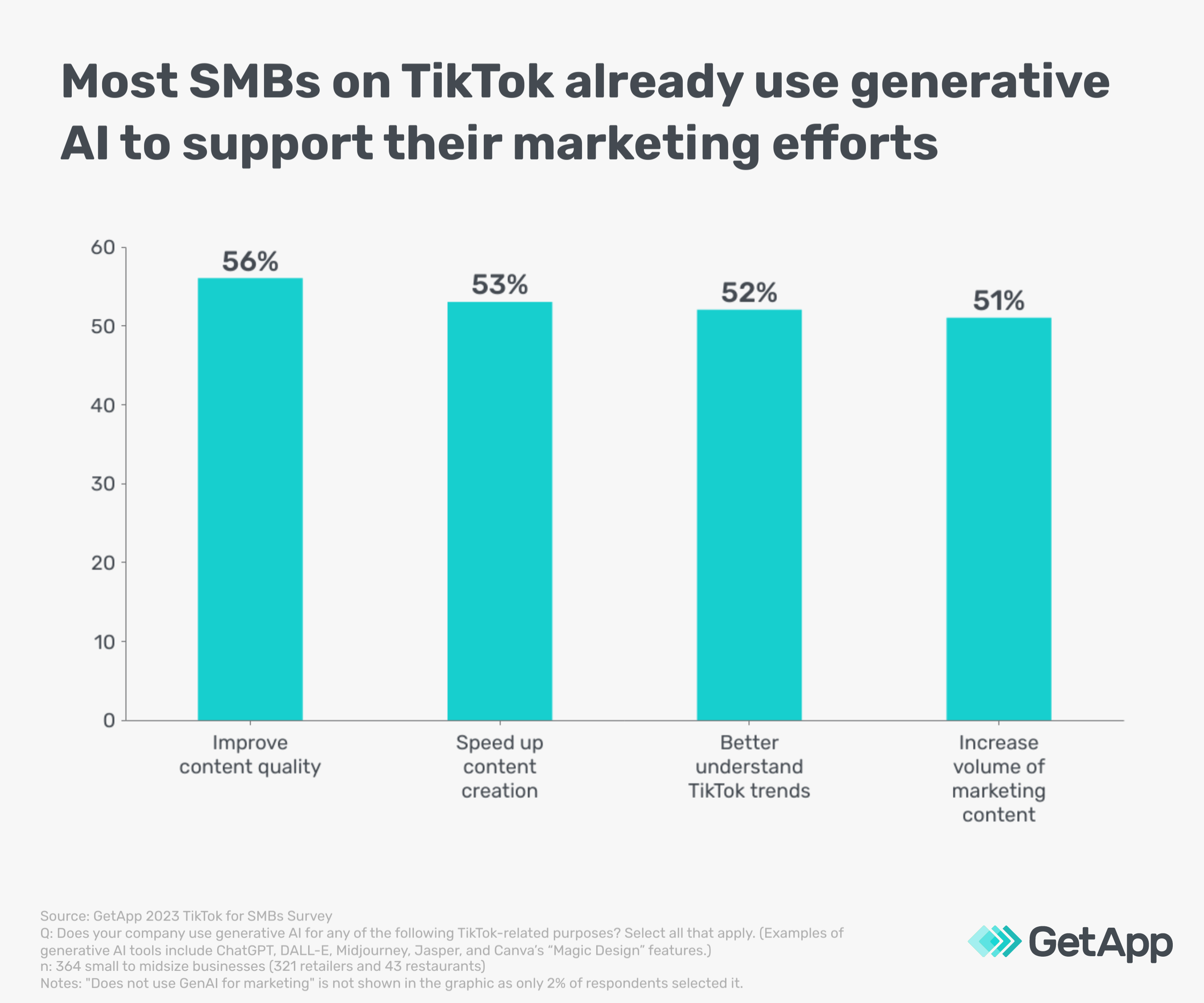
The vast majority of surveyed small businesses on TikTok (92%) already use generative AI in some capacity to fuel their social media content strategy. They generally lean on AI to improve, hasten, and scale content creation and campaign ideation, though they also use it to analyze and understand TikTok trends.
Additionally, new research by GetApp indicates that AI upskilling has become essential for SMB marketers, and that AI skills are prioritized when hiring junior-level employees such as marketing interns.
In 2024, TikTok users will experience the impact of GenAI as SMBs adopt it for a variety of marketing purposes, including content creation and hiring decisions. It’s likely that much of the TikTok content posted by SMBs, including the topics, themes, scripts, and even visuals for video content will be generated or influenced by AI’s interpretation of TikTok trends.
Whether this reliance on AI will yield the same quality of branded TikTok content—and by extension, user engagement and purchases—remains to be seen. Consumer outlook on the application of GenAI in social media suggests AI-generated content won’t live up to their standards. Over 70% of consumers think greater use of GenAI on social media will harm user experience; by 2025, a perceived decay in social media quality will lead half of consumers to spend less time on major platforms such as TikTok. [2]
The warning is clear: Retailers that rely too heavily on GenAI to create its content from start to finish run the risk of losing the uniqueness and authenticity that initially attracted followers. Small businesses should deploy AI tools with caution, and consider leaning on it for certain tasks, such as data entry and data analysis, freeing up marketing employees to spend more time on creative work. When using AI to create content, you should always include at least one content review in your publishing workflow to ensure what you publish meets quality expectations.
SMBs that focus on experience, not hard sales, will succeed with TikTok Shop
Small businesses are already piling into TikTok Shop, TikTok’s in-app shopping experience. Nearly three-quarters (72%) of surveyed SMBs on TikTok had launched products on TikTok Shop in 2023, and 26% plan to do so in 2024.
Given how Instagram transformed retail marketing and social commerce, from post-worthy store installations to hashtag-driven campaigns and the rise of influencers, it makes sense that its successor would follow a similar playbook. Nobody should be surprised that TikTok chose to capitalize on its incredible popularity by rolling out shoppable posts, an affiliate program, live commerce, and, soon, its own fulfillment logistics network. That TikTok is coming for Amazon’s crown should be seen as the logical next step for social commerce.
Even so, TikTok’s leap into eCommerce is risky. After all, Instagram’s commercialization pushed many of its users over to TikTok in the first place; no longer a place to connect with friends and family, Instagram was replaced by a platform that provided the humanity users felt it had lost. [3]
By expanding its eCommerce program and pushing more sponsored content to “For You” pages, TikTok could find itself on a similar downward spiral. Users have already begun vocalizing their disdain for the influx of content created by brands, paid influencers, or affiliates, with some defecting from social media to private group chats, where they’re less visible to advertisers. [4]
Like Instagram, TikTok could remain a useful tool for product research and shopping, but see a decline in organic content creation and engagement as users seek new outlets for social interaction online.
How should SMBs navigate TikTok’s evolution without alienating users? Complementing ads with plenty of organic content that embodies the spirit of “old” TikTok is a good start.
Users don’t want to be inundated with content urging them to buy something. If you want your brand to have followers and organic engagement, your TikTok content should take the focus off of selling products and prioritize making your audience laugh, teaching them something genuinely helpful, and fostering community through candid discussion. While it’s important to use social media to educate potential customers about your products and brand, you’ll need to layer calls to action into the kind of entertainment content TikTok users want to watch.
Make the right moves on TikTok to remain competitive in 2024
TikTok’s continued transformation into a fully-fledged eCommerce platform, and the algorithmic changes that come with it, means it’s about to get more difficult for businesses to stand out among a sea of competitors to a base of increasingly frustrated users.
A tried and tested way forward is to prioritize content that users want to engage with, which requires empowering your marketing employees to get creative, have fun, and think outside the box.
Want to upgrade your social media strategy?
Browse our extensive list of social media marketing software, and check out more social media marketing insights from GetApp:
Methodology
*GetApp's 2023 TikTok Marketing Survey was conducted in December 2023 among 364 professionals representing 321 small to midsize retail businesses and 43 restaurants. Respondents were screened for social media marketing decision making authority at their place of employment. All businesses represented in the data post content to TikTok at least once per month. 312 businesses have between two to 1,000 employees; 52 have between 1,001 to 10,000 employees.
Sources
TikTok Engagement Eclipses Meta for SMBs: How Small Brands Are Getting Views in 2024, Capterra
‘Make Instagram Instagram Again’: The App’s Evolution Is Causing Users to Question Its Future, The Wall Street Journal
We watched 1,000 TikToks in one sitting. The algorithm served up a shocking number of ads, rivaling network TV., Business Insider
My insights on tech trends have been featured in The New York Times, Vogue, BBC, CNBC, Forbes, and the Financial Times.