GetApp offers objective, independent research and verified user reviews. We may earn a referral fee when you visit a vendor through our links.
Our commitment
Independent research methodology
Our researchers use a mix of verified reviews, independent research, and objective methodologies to bring you selection and ranking information you can trust. While we may earn a referral fee when you visit a provider through our links or speak to an advisor, this has no influence on our research or methodology.
Verified user reviews
GetApp maintains a proprietary database of millions of in-depth, verified user reviews across thousands of products in hundreds of software categories. Our data scientists apply advanced modeling techniques to identify key insights about products based on those reviews. We may also share aggregated ratings and select excerpts from those reviews throughout our site.
Our human moderators verify that reviewers are real people and that reviews are authentic. They use leading tech to analyze text quality and to detect plagiarism and generative AI.
How GetApp ensures transparency
GetApp lists all providers across its website—not just those that pay us—so that users can make informed purchase decisions. GetApp is free for users. Software providers pay us for sponsored profiles to receive web traffic and sales opportunities. Sponsored profiles include a link-out icon that takes users to the provider’s website.
Top 3 Inventory Management Software Integrations
Look out for popular inventory management software integrations and follow certain tips to ensure smooth integration.


It isn’t easy to run a business when you’re constantly worried about managing inventory to match supply with the demand. It can get tougher if you set out to sell online and have to juggle multiple software solutions to manage online orders, returns and replacements, dispatch, etc. In the meantime, imagine having to update financial data from multiple systems to reconcile accurate financial records!
All these can lead to process inefficiencies or even breakdown.
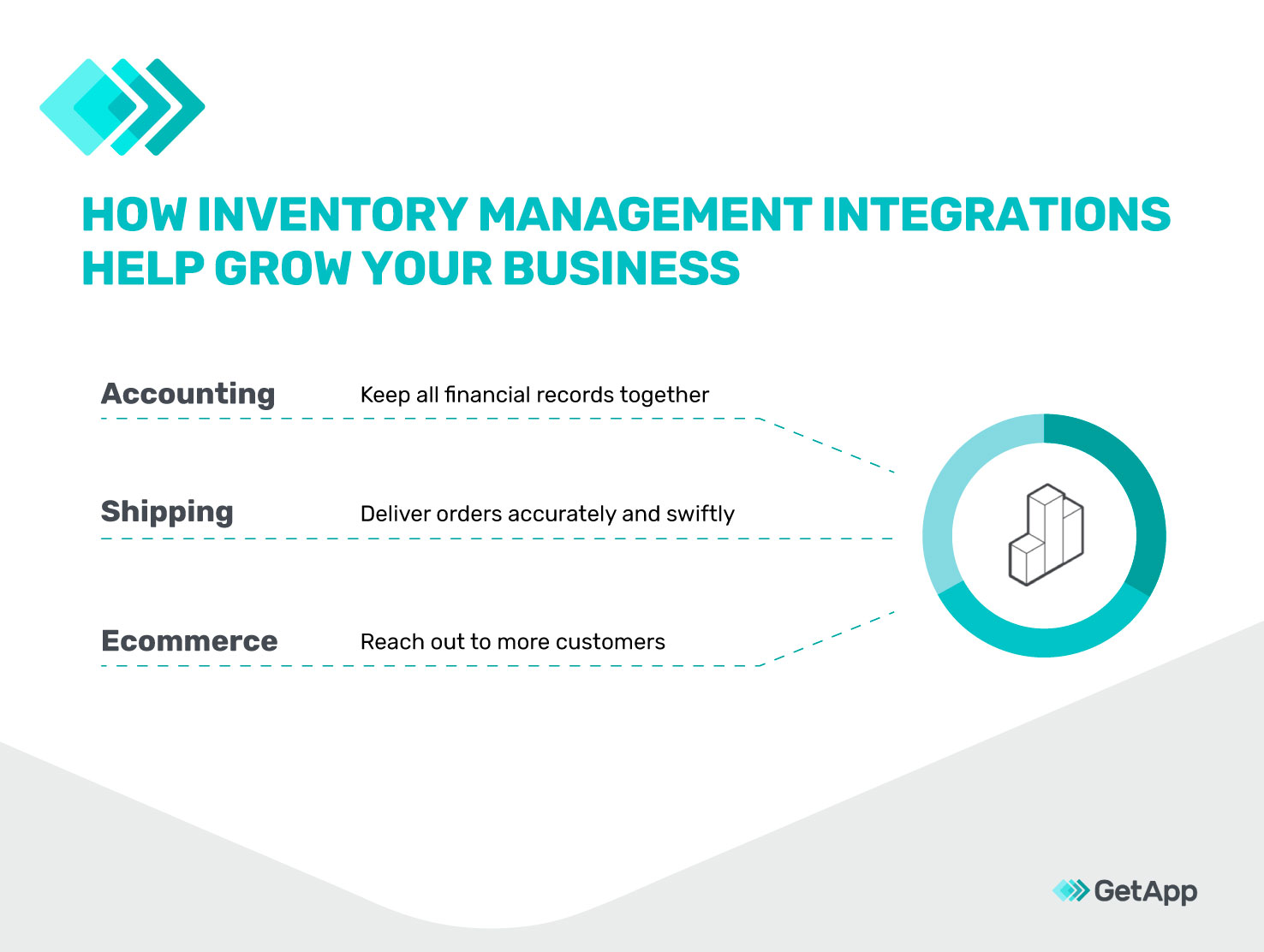
One of the ways to avoid this is to integrate your inventory management system with other business applications. It will consolidate their functions and streamline data exchange.
This article discusses some important integrations that as an inventory management software user you can look out for. We have also provided some useful tips to ensure smooth integration.
Inventory management and accounting software integration enables smooth financial management
Inventory management software helps avoid unnecessary expenditure on overstocking. This enables you to keep your finances in check. But what if all your efforts toward financial management go awry because of erroneous financial records? This can happen if the inventory data and your financial records are not in sync.
To avoid such scenarios, integrating your accounting software with inventory management software is important.
The benefits of inventory management and accounting software integration include:
The integration pools revenue and inventory data from the two disparate systems to help identify products based on their revenue impact. This helps you know which items need to be stocked-up and which ones can be discontinued to avoid losses.
Integrating accounting software with inventory management software ensures that all asset values in the accounting system are automatically tallied with the physical assets available in the warehouse. Automated data reconciliation also saves time.
Inventory management and shipping software integration boosts customer satisfaction
Certain inventory management systems offer shipping management as a built-in feature. However, if your inventory management software doesn’t offer it, you can go for integration with shipping software to manage the order fulfillment lifecycle.
The benefits that you can expect from integrating inventory management with shipping management include:
Integrating inventory management software and shipping software allows businesses to collate all information and updates about orders from multiple warehouses in one place. With accurate shipping labels containing product details, the orders can be packed and dispatched accurately.
The integration enables business owners to get real-time shipping rates and discounts from different carriers at the time of order fulfillment. They are able to choose shipping providers from a variety of options and reduce the cost incurred on shipping.
Inventory management and ecommerce software integration boosts sales
You can manage your everyday sales using spreadsheets but it can get difficult if a customer raises concerns about product quality and seeks returns or replacement. To avoid that, consider integrating inventory management and ecommerce software.
You can read about the benefits of integrating inventory management and ecommerce software in detail below:
The integration facilitates automatic updates to inventory records each time a customer purchases any product from the ecommerce software. It also updates the ecommerce system on inventory status such that if any product is out of stock, it’s unavailable for customers to purchase.
An ecommerce platform offers larger outreach to a business and allows selling products across geographies. Integration can allow users to manage orders as well as track inventory data from anywhere.
3 Essential inventory management software integration tips
The following points offer advice on how to ensure that integrations are smooth and effective.
Set up a testing schedule to assess data transfer and sync between the two systems: Whenever software systems are integrated, the data between the two systems need to seamlessly sync. To ensure that, conduct regular tests throughout the configuration process and document discrepancies to resolve them for smooth functioning.
Integrate software systems in increments instead of doing all at once: It’s essential that you carry out software integrations in phases. Not all the integrations can come through at once and function smoothly. Identify the priorities and analyze resource requirements before planning integrations.
Calculate the total cost of integrations including maintenance and training costs: Before investing, it’s important to determine how much IT support will be needed to implement and maintain the preferred integrations. Also factor in the training cost incurred on helping all users learn how to leverage an integration’s features in their daily work routine.
Further steps
You can explore our inventory management category leaders to evaluate each product against its integration scores.
If you’re looking for inventory management software, visit this GetApp category page.
Ankita Singh