GetApp offers objective, independent research and verified user reviews. We may earn a referral fee when you visit a vendor through our links.
Our commitment
Independent research methodology
Our researchers use a mix of verified reviews, independent research, and objective methodologies to bring you selection and ranking information you can trust. While we may earn a referral fee when you visit a provider through our links or speak to an advisor, this has no influence on our research or methodology.
Verified user reviews
GetApp maintains a proprietary database of millions of in-depth, verified user reviews across thousands of products in hundreds of software categories. Our data scientists apply advanced modeling techniques to identify key insights about products based on those reviews. We may also share aggregated ratings and select excerpts from those reviews throughout our site.
Our human moderators verify that reviewers are real people and that reviews are authentic. They use leading tech to analyze text quality and to detect plagiarism and generative AI.
How GetApp ensures transparency
GetApp lists all providers across its website—not just those that pay us—so that users can make informed purchase decisions. GetApp is free for users. Software providers pay us for sponsored profiles to receive web traffic and sales opportunities. Sponsored profiles include a link-out icon that takes users to the provider’s website.
Decoding the Difference Between a Project Manager and a Scrum Master in an Agile Project
Both appear similar, but they aren’t. Know the difference to avoid costly hiring mistakes!


In an agile project, the role of a scrum master is often confused with that of a project manager. While both roles may seem similar since they ensure the smooth functioning of agile project teams, their job responsibilities are fundamentally different.
Businesses must understand this difference to hire candidates with the right skill sets, clearly define the responsibilities for both roles, and prevent ambiguity of accountability. If they fail to do so, they’re likely to witness project failure and incur losses.
In this article, we’ve uncovered and decoded the difference between the roles and responsibilities of project managers and scrum masters.
Who are project managers, and what do they do?
In agile projects, project managers help initiate, plan, execute, monitor, control, and close projects. They usually manage multiple agile projects at the same time and report to stakeholders on the project board, as well as clients.
Some of their key responsibilities include:
Project scope and activity management
Project managers define the scope of a project and break it down into smaller tasks and subtasks. They also decide and closely monitor the sequence and schedule of these tasks and subtasks.
Time management
Before projects begin, project managers estimate the duration of all tasks and subtasks to set the overall project delivery timeline. During the course of projects, they monitor the actual time spent on tasks to manage both unforeseen and predictable delays, inform team members of related developments, and make adjustments—either pull in resources to compensate for the time lost or extend the project deadline to avoid quality issues.
Project monitoring and change management
Project managers closely monitor the project flow and progress. They are also responsible for managing and accommodating unforeseen project changes caused by resource unavailability or realignment, feedback integration (leading to continuous iterations), and dependency-related delays, among others.
Risk management
Project managers assess and identify potential risks to projects and thereafter employ risk mitigation strategies to minimize time and budget overruns during the project lifecycle.
Team and stakeholder management
Project managers select, develop, and handle project teams. They also manage stakeholder expectations throughout the project lifecycle. Accordingly, they offer guidance on project management tools and motivate team members to ensure that they achieve project goals.
Budget management
Project managers define the budget for projects and create a detailed estimate of costs likely to be incurred before the projects are completed. They also frequently review ongoing project costs to avoid overruns.
Project closure and reporting
Project managers are responsible for timely project closure. They also have to share comprehensive reports and documentation with clients and internal stakeholders upon project closure.
What are the qualities project managers must have?
Besides having technical know-how and an ability to manage projects, here are a few other qualities that project managers must have:
Leadership skills to see projects through completion to achieve desired results.
Good communication skills to communicate project requirements, business objectives, client expectations, feedback, etc., during the project lifecycle.
A detail-oriented approach to address operational challenges during the project lifecycle.
Multitasking skills to manage multiple projects at the same time.
Negotiation skills to effectively manage stakeholder and client demand to avoid scope, time, and budget overruns.
The ability to objectively assess situations to resolve conflicts without losing focus on project goals.
Who are scrum masters, and what do they do?
Scrum masters are responsible for implementing and managing the scrum framework, mostly for software development projects. They are accountable to multiple stakeholders, including product owners and project managers.
Some of their key responsibilities include:
Scrum events facilitation
Scrum masters facilitate scrum events, such as daily scrum meetings, sprint planning, sprint review, and scrum retrospective. They observe the functioning of scrum teams and gather information from team members to understand challenges and offer feedback based on sprint observations.
Scrum coaching
Scrum masters understand agile values and the scrum framework. They educate scrum teams, product owners, managers, development teams, and other stakeholders about the scrum methodology. They also coach them to help overcome any resistance towards adopting the scrum framework, thereby ensuring team members remain productive and are able to contribute to successful project delivery.
Bottleneck management
Scrum masters monitor workflows and capture bottlenecks to resolve them faster and achieve the desired results. For instance, in an eCommerce website, payment gateways have to be integrated before integrating the shipping setup workflow to create a step-by-step order completion process. In such a scenario, a scrum master must ensure that there are no bottlenecks in the step-by-step integration of all required technical elements.
Sprint scope management
Scrum managers help in setting sprint goals during sprint planning sessions with product owners and development teams. They set realistic sprint goals to prevent overcommitment and scope creeps.
What are the qualities scrum masters must have?
Here are some qualities that a scrum master must have:
Organizational skills to organize personal work as well as help team members stay on track.
Technical capabilities to help software development teams minimize roadblocks to productivity. Knowledge of technical concepts, concerns, and processes for managing the same.
The ability to coach team members to help maximize their potential and contribute to team goals.
Good negotiation and communication skills to navigate team members through interpersonal disagreements and keep the team focused on agile values and sprint goals.
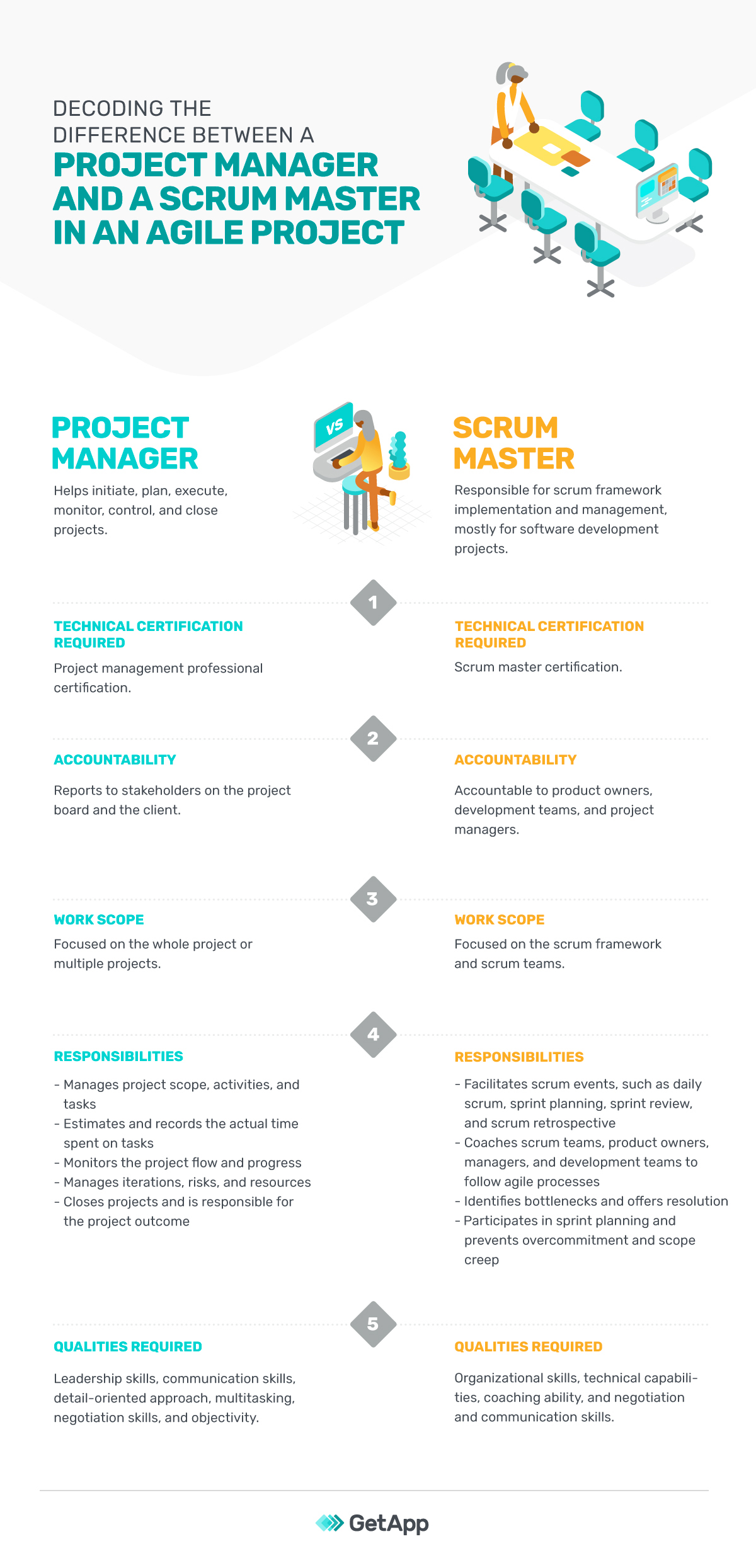
Project managers vs. scrum masters: An infographic comparison
Understanding the difference between the roles and responsibilities of project managers and scrum masters will help businesses invest in the right resources and set the right expectations for them. They’d know what to be accountable for and would therefore contribute to successful project delivery.
Here’s a summary of all that we need to know about the two roles.
Further reading
Here's a resource for you to broaden your knowledge about project management.
Ankita Singh
More on Project Management

May 30, 2024

Jun 11, 2024

May 28, 2024