GetApp offers objective, independent research and verified user reviews. We may earn a referral fee when you visit a vendor through our links.
Our commitment
Independent research methodology
Our researchers use a mix of verified reviews, independent research, and objective methodologies to bring you selection and ranking information you can trust. While we may earn a referral fee when you visit a provider through our links or speak to an advisor, this has no influence on our research or methodology.
Verified user reviews
GetApp maintains a proprietary database of millions of in-depth, verified user reviews across thousands of products in hundreds of software categories. Our data scientists apply advanced modeling techniques to identify key insights about products based on those reviews. We may also share aggregated ratings and select excerpts from those reviews throughout our site.
Our human moderators verify that reviewers are real people and that reviews are authentic. They use leading tech to analyze text quality and to detect plagiarism and generative AI.
How GetApp ensures transparency
GetApp lists all providers across its website—not just those that pay us—so that users can make informed purchase decisions. GetApp is free for users. Software providers pay us for sponsored profiles to receive web traffic and sales opportunities. Sponsored profiles include a link-out icon that takes users to the provider’s website.
Employee Digital Skill Gaps Challenged Small Businesses During COVID; Here's How to Close Yours
The COVID-19 pandemic forced small businesses to change rapidly with little warning. GetApp research shares their biggest challenges, the digital skills gap they face, and tips to thrive through the pandemic and beyond.


For small to midsize businesses (SMBs), the COVID-19 pandemic moved the need for upskilling at work from an abstract idea to an urgent reality.
Recently, Gartner predicted that "nonroutine cognitive work will be where most high-value work is performed by 2028." Employees performing such work will need training that helps them "learn, unlearn, and relearn digital skills (full content available to Gartner clients)." Small businesses won't be immune to this trend, as this year, the spread of COVID-19 forced businesses around the world to close brick-and-mortar stores and sell their products online.
This sudden change thrust many business leaders into the unknown, from to plans for newly remote teams. That made us wonder if the basic digital skills of many employees were enough to manage such changes. If not, did SMBs plan to invest in closing the digital skills gap between what their talent knows, and what they need to learn?
To find out, we surveyed 577 leaders of North America-based small businesses in June 2020 to identify their biggest COVID-19-related challenges and what skills their businesses need now (read about our method at the bottom of this page).
What the digital skills gap looks like for SMBs:
One in five small businesses surveyed cited lack of employee skills as the single biggest challenge they face while pivoting in response to COVID-19. For midsize businesses, nearly one in three saw lack of employee skills as their greatest challenge.
The skill sets required for 84% of SMBs have changed as a result of COVID-19-induced business shifts.
SMBs expect they’ll need these skills most through 2020: Network management, web and app development, and social media marketing.
61% of SMBs are increasing their training budgets in light of COVID-19.
This abrupt skills shortage among their existing workforce caused SMB leaders to reassess their priorities, with six in 10 respondents saying they plan to spend more on employee training. We view this as a positive sign that SMBs plan to invest in employees and upskill them for the long haul.
Done right, investing in skills development can help your business pivot faster and help your employees grow through COVID and beyond.
The digital skills gaps exposed by COVID
Early media coverage of the pandemic mostly focused on two consequences for businesses: store closures and revenue/job losses.
This is particularly applicable to SMBs. Research conducted last year found that six in 10 small-business leaders struggled with cash flow, and nearly one in three reported being unable to pay themselves, employees, vendors, or loans within the previous year.
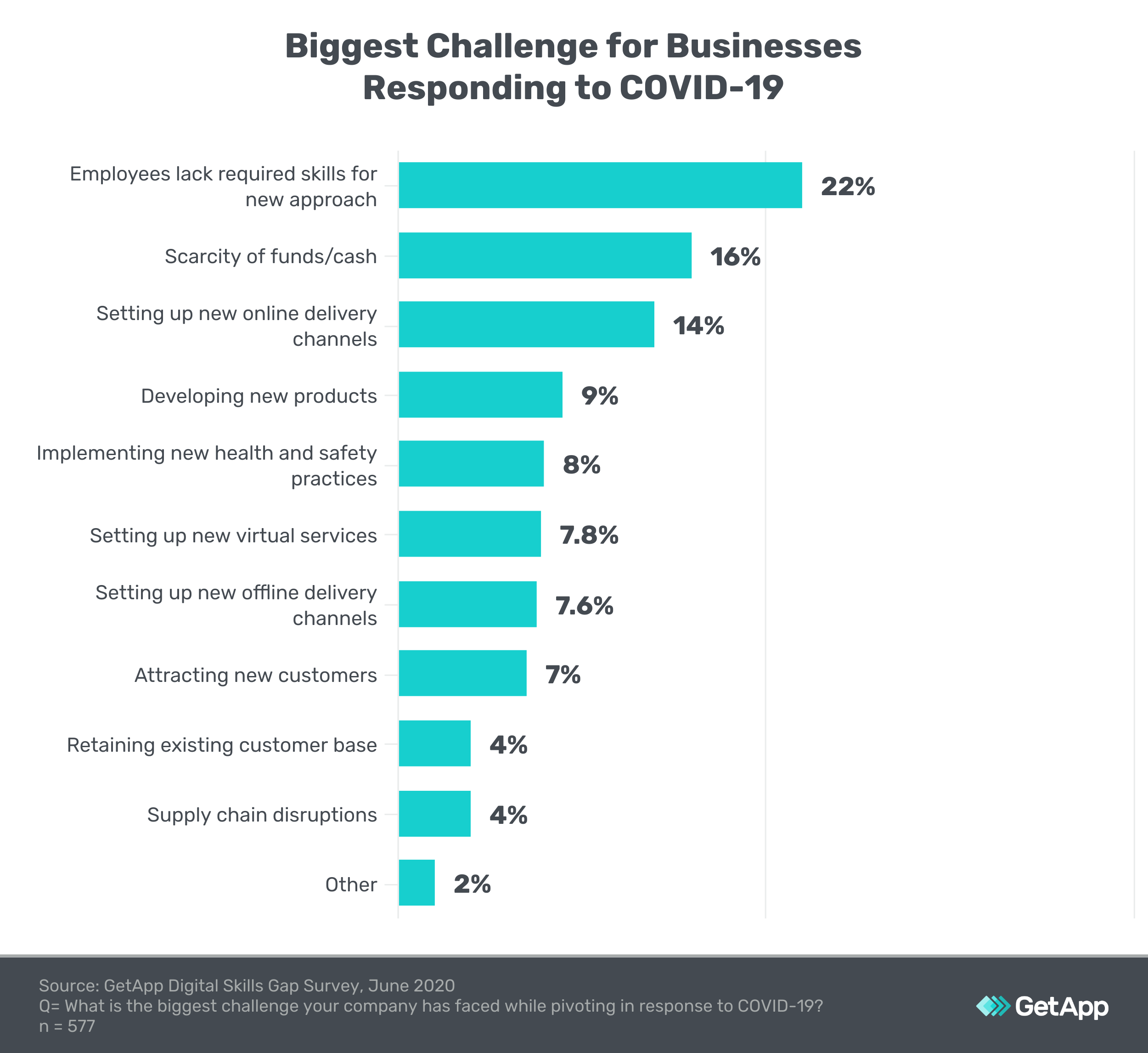
In our own survey, 22% of respondents said that while making COVID-19-induced pivots, their biggest challenge was employees lacking the skills needed to make those shifts. Scarcity of funds/cash came in a fairly distant second, at 16%, while setting up new online delivery channels was third at 14%.
The skills that SMBs need now
The vast majority of small-business leaders surveyed told us that COVID-19 required instant change. Eighty-four percent of those surveyed said that COVID-induced business changes “somewhat” (48%) or “significantly” (36%) altered the employee skill sets their company needs.
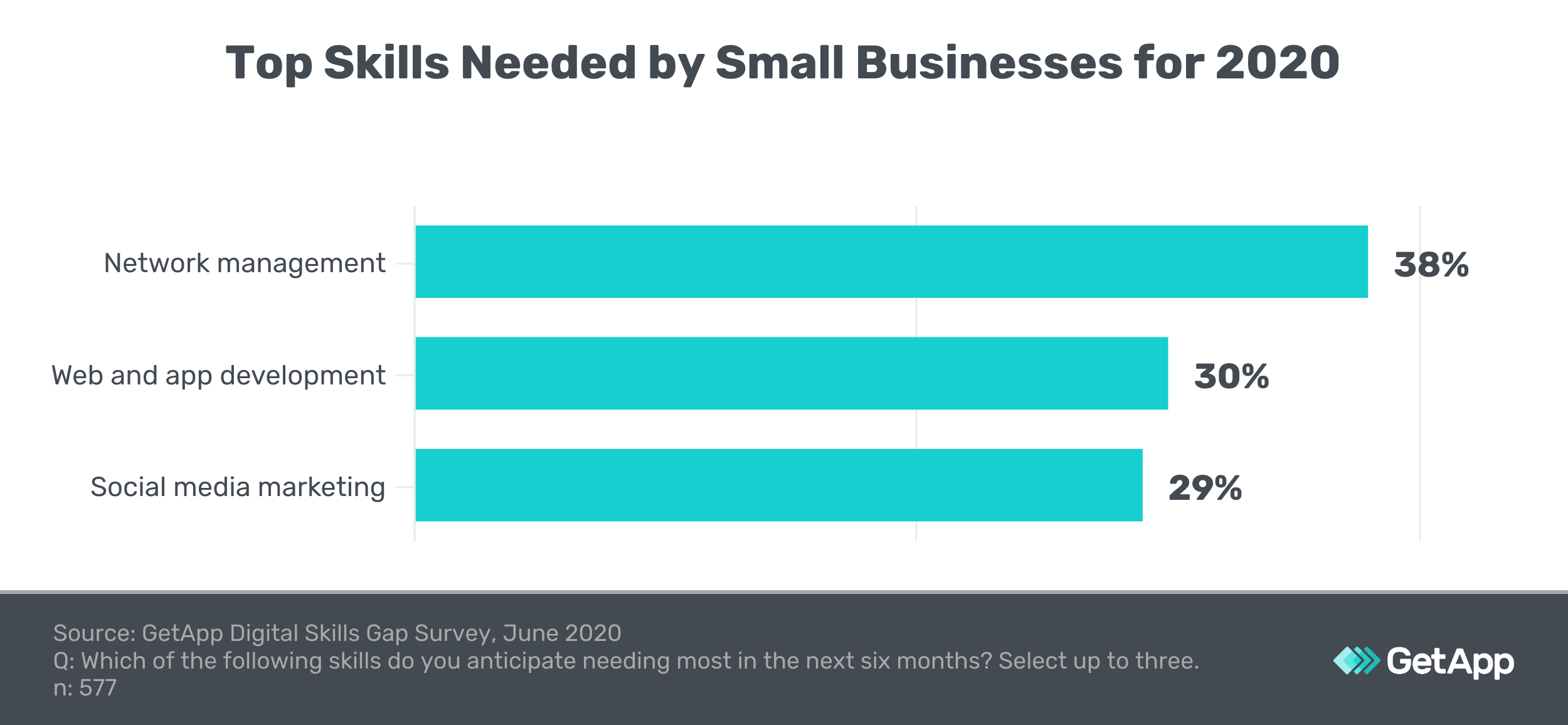
When we asked these leaders which skills they needed to manage such changes, 38% said they anticipate needing network management skills the most over the next six months. Web and app development came in second (30%), and social media marketing skills took third place (29%).
It’s no surprise that these skills are essential. The rise of remote work spurred by COVID-19 has increased reliance on cloud computing solutions rather than on-premise software. With increased reliance on cloud computing comes increased vulnerability. Thirty-one percent of SMB leaders we surveyed saw security threats as their primary concern with employees working remotely. Preventing cyber attacks and phishing means enhancing your team's network monitoring capabilities.
Along with changes to network management, pandemic-spurred business pivots increased reliance on a range of digital skills. Twenty-two percent of respondents reported setting up an eCommerce website from scratch due to COVID, while 66% have used social media to update customers on their business model changes.
Skills gap fixes for your workforce
At this point, you may be thinking about the skills gap in your own organization, and how you can address them to ensure your business survives and even thrives in a post-COVID, digital world.
Here we’ll explain the two actions you can take to address your own skills gap. In the short term, pinpoint and address the specific skills needed right now. Long term, create more cross-functional collaboration to improve skills as a byproduct of the work your teams are already doing. Let’s dig in.
Pinpoint your essential upskilling needs and use microlearning to meet them
The spread of COVID-19 required a rapid response using a range of skills, from crisis communications to fulfilling remote service delivery. Understanding what these needs are is critical, and will vary from business to business. Be sure to compile a list of what your current needs are, and then prioritize them so you can begin to address them with training.
A common challenge is that traditional training programs—if used at all—can’t match the speed at which small businesses need their existing workforce to execute these new skills. However, small-business leaders can use just-in-time microlearning to train employees on specific skills as needed.
Microlearning combines smaller learning units and short-term activities to help learners meet specific learning outcomes. Employees can complete each module in as little as one day, and businesses can source much of the content for free or little cost.
Microlearning provides both immediacy and agility for addressing immediate needs. As a side note, over half of our survey respondents (55%) said they use computer-based online learning, which makes microlearning a logical step.
What this could look like:
Organize: Create a small, multi-disciplinary team across key functions (like IT and human resources) to own microlearning for tasks in their functional areas
Share: Identify a common platform for microlearning that can be shared across teams. Whether these are internally created systems or dedicated software, your team should be able to find learning modules and track tasks as needed.
Measure: Collect feedback from your team on the usefulness of learnings. Track the tasks you’re looking to enhance through upskilling, and identify whether you’re getting more effective at those tasks and how they’re impacting the business.
Take a project-based approach to work and empower employees to work across teams
Whether spurred by a pandemic or more routine changes, these newly crucial skills will only grow in importance. To implement them as needed, your small business must think beyond static roles and encourage employees to work across functions.
Pre-pandemic research estimated that between 81% and 95% of global employees served simultaneously on several teams. And while this approach can help close employee skill gaps, it comes with a high risk of job stress and burnout. During a global crisis? That risk only gets worse.
To avoid burnout while meeting employee needs, team leads and/or small-business leaders should redesign workloads to be flexible so employees own specific tasks that are most essential to company growth, regardless of traditional function. This means some employees will need to expand their skill sets and step into projects that may not have normally been within the scope of their roles.
The benefit, however, is that you’re focusing your team’s efforts on your most pressing business needs while adding problem-solving, cross-functional training, and variety to your team’s daily routine. In the current climate where many businesses have scaled back services or products, this gives SMBs a chance to reprioritize their strategies in a more agile way while helping employees upskill without burning out.
What this could look like:
Measure: Collect ongoing feedback from your employees and adjust your skills training curriculum and assignments as needed to respond to changing business needs, faster.
Empower: Enable employees to split their time across teams in accordance with company goals. This allows them to gain hands-on experience practicing multidisciplinary skills, and allows your business to focus more effort on what’s important.
Ensure: Have the same individuals who lead microlearning modules manage employees on the tasks they’re trained to do. This lets them oversee the full training process, from teaching to doing, and provides a quality check.
The future of work
With or without a pandemic, GetApp’s research shows that small-business leaders can no longer afford to keep de-prioritizing employee upskilling or avoid their workforce skills gap. To thrive in the short and long terms, SMB leaders must prioritize microlearning for key tasks, then empower employees to own and execute those tasks.
Survey Methodology
In June 2020, GetApp surveyed 577 respondents who hold leadership roles at U.S. businesses with between 2 and 500 employees. We asked respondents a range of questions about business model changes, digital skills, and IT management/security in light of the COVID-19 pandemic. Respondents were not required to answer every survey question.
More on Trends

May 07, 2024


Sep 13, 2023