

GetApp offers objective, independent research and verified user reviews. We may earn a referral fee when you visit a vendor through our links.
Our commitment
Independent research methodology
Our researchers use a mix of verified reviews, independent research, and objective methodologies to bring you selection and ranking information you can trust. While we may earn a referral fee when you visit a provider through our links or speak to an advisor, this has no influence on our research or methodology.
Verified user reviews
GetApp maintains a proprietary database of millions of in-depth, verified user reviews across thousands of products in hundreds of software categories. Our data scientists apply advanced modeling techniques to identify key insights about products based on those reviews. We may also share aggregated ratings and select excerpts from those reviews throughout our site.
Our human moderators verify that reviewers are real people and that reviews are authentic. They use leading tech to analyze text quality and to detect plagiarism and generative AI.
How GetApp ensures transparency
GetApp lists all providers across its website—not just those that pay us—so that users can make informed purchase decisions. GetApp is free for users. Software providers pay us for sponsored profiles to receive web traffic and sales opportunities. Sponsored profiles include a link-out icon that takes users to the provider’s website.
Have an Ecommerce Business and Wondering How To Offer Free Shipping? This Free Tool Can Help
Free shipping can help but also eat into your profits if you don’t adopt the right model.


The grim reality of online retail is that approximately 70% of customers who add products to their carts don’t actually purchase them. This issue of high abandonment is pervasive in all eCommerce businesses, ranging from grocery to online fashion. But have you ever wondered what demotivates these customers?
Out of many, here’s the biggest reason: When checking out, there often are extra costs, a sizable part of which is the shipping cost. These extra costs trigger the abandonment in about 50% of customers. And this could be driving customers away from your store to another online retailer that offers the same products at a lower cost.
Now, free shipping could be the key to your cart abandonment problem. It could motivate customers to purchase items they viewed in your store and you’re also likely to attract customers who abandoned other stores due to high shipping costs.
But offering free shipping is not straightforward. Firstly, there are quite a few free shipping models to choose from. Secondly, several resources do explain the different models of free shipping but they don’t help you find the right approach.
That’s why we’ve developed a free tool that will help figure out how to offer free shipping and identify the shipping model right for you. But let’s first understand the different models of free shipping.
Already know what these models are?
Prominent models for free shipping
If you’re planning to implement free shipping in your business, there are a number of models to choose from. Each involves different levels of complexity and has different impacts on buyer experience, sales, and profitability.
1. Free shipping on all orders (unconditional free shipping)
In this model, you offer free shipping on all the products you offer via your website and other eCommerce channels. Since this model requires you to absorb all the shipping costs, you’ll only be able to implement it if your products are light-weight, low-volume, and have a high-profit margin.
2. Free shipping on first-time orders only
As the name suggests, you’ll offer free shipping only to those customers who are ordering from your website or eCommerce platform for the first time. This model serves as an incentive for new customers and can help you grow the customer base.
3. Free shipping as a limited-time offer
In this method, you’ll be offering free shipping on all products but only for a certain period of time. This can help you boost sales during periods of peak demand, such as Christmas or the new year. On the flip side, this model can discourage your customers from ordering during other times of the year when shipping is paid.
4. Free shipping to a region
In this model, you offer free shipping only on orders delivered to certain areas, cities, or states, typically to the ones that are close to your warehouse. By limiting free shipping to nearby areas, you’ll be able to reduce the cost of delivery and encourage customers from these areas to buy from you.
5. Free shipping on select items
In this model, you offer free shipping on profitable products only. By doing so, you’ll be able to boost the sales of highly profitable items and profitably absorb the cost of free shipping. But on the downside, you may end up discouraging customers from buying products for which shipping isn’t free.
6. Free shipping with a minimum threshold
In this model, you’ll set up criteria for a minimum dollar value or quantity of items to qualify for free shipping. This approach encourages buyers to purchase more items, which helps improve the average order value. However, customers may abandon the cart altogether if they can’t find enough products to complete the free shipping threshold.
For this reason, we recommend an iterative process for determining the minimum threshold. Set an initial minimum order threshold, measure its impact on overall sales, and revise the threshold accordingly.
7. Free shipping to your store
This model is suitable if you have hybrid operations—i.e., you have an online as well as brick-and-mortar presence. In this model, you’ll need to provide buyers with the option to get their orders delivered to the nearest store free of cost.
This model lets you take last-mile delivery out of the equation, which is the costliest component of the overall cost of shipping. As an additional advantage, this method increases footfall in your stores, which increases customer visibility into your entire product line and thus the possibility of selling more items.
8. Free shipping with a loyalty/membership program
If your primary goal is to increase customer loyalty and reduce attrition, this model can be your ideal choice. In this model, you’ll need to implement a customer loyalty, rewards program, or membership program, and offer free shipping to all the participants.
9. Raise your product price
This is a popular but controversial approach. In this model, you’ll need to bake the shipping fee into your product price, thus giving buyers an impression of free delivery. This model can work well for products that don’t have a market-standard price, such as furniture, artwork, or refurbished phones.
However, it can also be counterproductive: If you bump up prices, your products could become more expensive than competitors’, and customers may move to another seller to purchase the same product at a lower price.
10. Free shipping on return orders (free return)
This approach entails significant shipping costs. Firstly, on delivering a product from store/warehouse to customer; then on shipping the product back from customer to warehouse.
However, since a return order means the customer is not satisfied, free shipping on the return orders helps you protect damages to your brand image.
Confused about which free shipping model to adopt? Here’s a tool for you!
Selecting which free shipping method to implement is confusing. In this article alone, we’ve stated 10 different models for implementing free shipping! We’ve created a tool that helps you prioritize free shipping models based on your business objectives, orders, and competition.
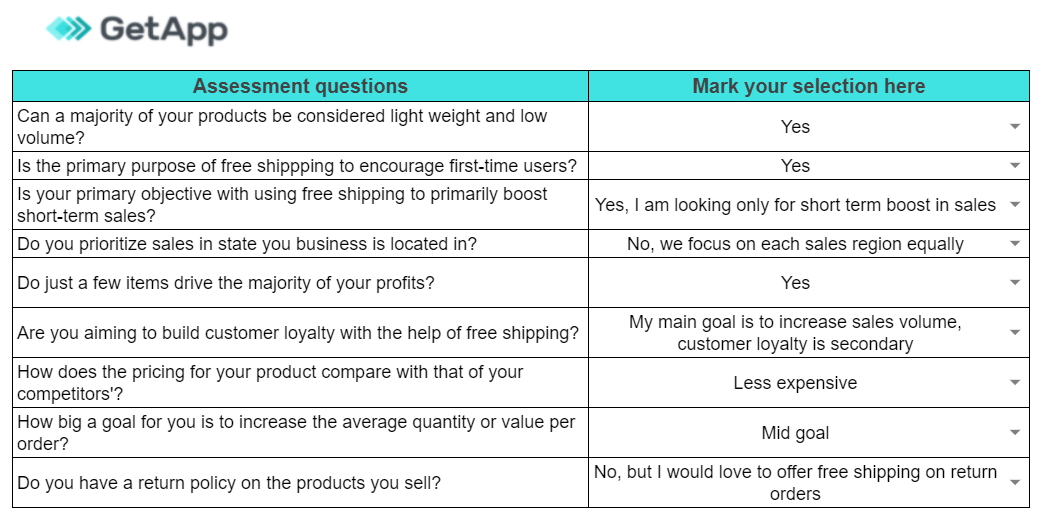
GetApp Tool: Free Shipping Model Predictor
Give the tool a try. It’s free.
Which free shipping model is right for you?
Ensuring profitability when offering free shipping
Free shipping is a costly affair. It’s important that you assess the impact of free shipping on your business profitability, before making any decision related to free shipping. Make a note of the following points before starting with the implementation process:
Define your objectives: Before planning free shipping, you need to have clarity on the goals you wish to achieve with the program. This understanding is vital for determining the right free shipping model based on your needs. For example, if your goal is to encourage new customers to try your products, you can look at offering free shipping on the first order.
Do competitor research thoroughly: One of the primary reasons why businesses offer free shipping is to combat competition. However, we recommend a counter approach. Don’t think of free shipping as giving in to the market competition, but as an opportunity to create an edge over your competitors.
Offering free shipping in a manner that sets your brand apart from your competitors can boost your brand reputation. Understand how your competitors are going about their free shipping policies and opt for a model that gives you an advantage over them.
Don't rush things: Implementing free shipping is a complex decision: while it helps you attract new customers and increase average order quantity, it also eats into your profit margin. For this reason, we advise not to rush into implementing free shipping. Pilot multiple free shipping models, compare their performance, and select the one that performs the best.
If your shipping operations are costing you too much, this article mentions some smart approaches for reducing shipping costs by leveraging the fundamental differences between residential and commercial shipping models. Moreover, if you want to explore delivery models to optimize business profitability, read our in-depth analysis on the different eCommerce delivery models.
Harshit Srivastava
More on eCommerce


Sep 02, 2022
Aug 05, 2024
Jun 13, 2024

Sep 20, 2021