GetApp offers objective, independent research and verified user reviews. We may earn a referral fee when you visit a vendor through our links.
Our commitment
Independent research methodology
Our researchers use a mix of verified reviews, independent research, and objective methodologies to bring you selection and ranking information you can trust. While we may earn a referral fee when you visit a provider through our links or speak to an advisor, this has no influence on our research or methodology.
Verified user reviews
GetApp maintains a proprietary database of millions of in-depth, verified user reviews across thousands of products in hundreds of software categories. Our data scientists apply advanced modeling techniques to identify key insights about products based on those reviews. We may also share aggregated ratings and select excerpts from those reviews throughout our site.
Our human moderators verify that reviewers are real people and that reviews are authentic. They use leading tech to analyze text quality and to detect plagiarism and generative AI.
How GetApp ensures transparency
GetApp lists all providers across its website—not just those that pay us—so that users can make informed purchase decisions. GetApp is free for users. Software providers pay us for sponsored profiles to receive web traffic and sales opportunities. Sponsored profiles include a link-out icon that takes users to the provider’s website.
What is Network Marketing? A Comprehensive Overview
The benefits of network marketing tend to outweigh the disadvantages—how can you harness the power of this marketing technique for your business?


With the challenges of capturing market share and attracting clients, entrepreneurs and small-business owners are considering leveraging different marketing strategies and business models in order to build stable businesses with sustainable revenue streams. One such alternative business model that many entrepreneurial-minded professionals are turning to in order to diversify their growth options is network marketing. Driven by market instability as well as flexible and remote work models, the network marketing niche has experienced rapid growth in recent years, reaching $65 billion in 2022, up $8 billion from 2020. [1]
If you are an aspiring small-business owner looking to create a business from the ground up through network marketing, it’s worth exploring what benefits and challenges you would experience by embracing network marketing as a business growth strategy. You can also learn different methods you can leverage to mitigate those challenges in order to successfully grow your business through partnership with a direct sales company.
What is network marketing?
Network marketing, when properly structured and executed, is a business model that focuses on building a team of independent representatives referred to as distributors. These independent distributors, often working in the field or from home, are responsible for assisting in lead generation and closing sales, with the overall goal of maximizing person-to-person sales.
With an entrepreneurial mindset, a single distributor can attach themselves to a direct sales-based business and build a small business from the ground up. Depending upon the form of network marketing, distributors can even strengthen their own revenue stream by partnering with other capable salespeople to create a multi-stream source of revenue for themselves and the parent brand.
How does network marketing work?
Direct sales businesses are structured around an intermediary purchasing products directly from the parent company and then selling those products directly to customers. Direct sales companies leverage network marketing arrangements to empower distributors to engage with clients directly. Distributors are expected to build sales and their client base using their own strategies, resources, and marketing tactics.
These distributors are independent sales-focused specialists who will either order and maintain their own inventory, usually at a discount, or order inventory as needed to fulfill customer orders. In either case, they receive commission and bonuses based on the retail sales they generate. Network marketing arrangements help both the distributor build a profitable small business and help the parent company achieve revenue growth goals.
The kinds of network marketing structures
There are two primary models of network marketing structures, with distributors playing different roles in each.
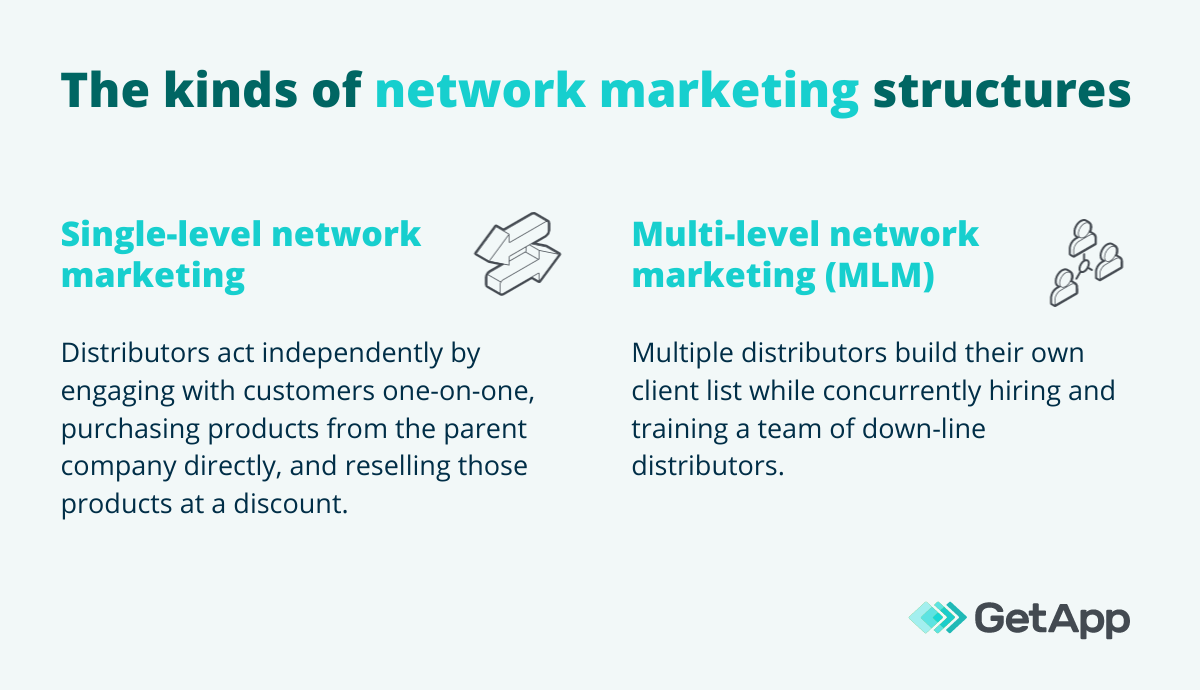
Single-level network marketing
In a single-level network marketing strategy, distributors act independently. They engage with customers one-on-one, purchase products from the parent company directly, and resell those products at a discount. A distributor’s income in a single-level network is usually commission-based and determined solely by their own sales efforts. Car dealerships are considered single-level direct sales businesses, with the sales staff working under a contractual arrangement to carry out sales.
Multi-level network marketing (MLM)
Direct sales businesses that leverage multi-level network marketing hire multiple distributors. While building their own client list, distributors are concurrently expected to hire and train a team of down-line distributors. This sub-layer of distributors, in turn, are each expected to do the same, and so forth.
Each distributor becomes the pinnacle of a pyramid of like-minded entrepreneurs. In order to avoid being categorized as an illegal pyramid scheme, the pay, bonuses, and incentives in a legal MLM must be based on the sale of products or services and not on the recruitment of more members into the funnel. However, recruitment is often a necessary component of most legitimate MLM networks in order to make the effort profitable, as the pinnacle of each sales team receives additional income based on the sales activities of those working beneath them.
Advantages and disadvantages of network marketing
For entrepreneurial-minded individuals looking to start a business, network marketing can provide a wide array of opportunities and benefits to help new business owners focus on growth and achieve initial sales goals. However, there are also a number of drawbacks to be aware of before embracing network marketing as a business model.
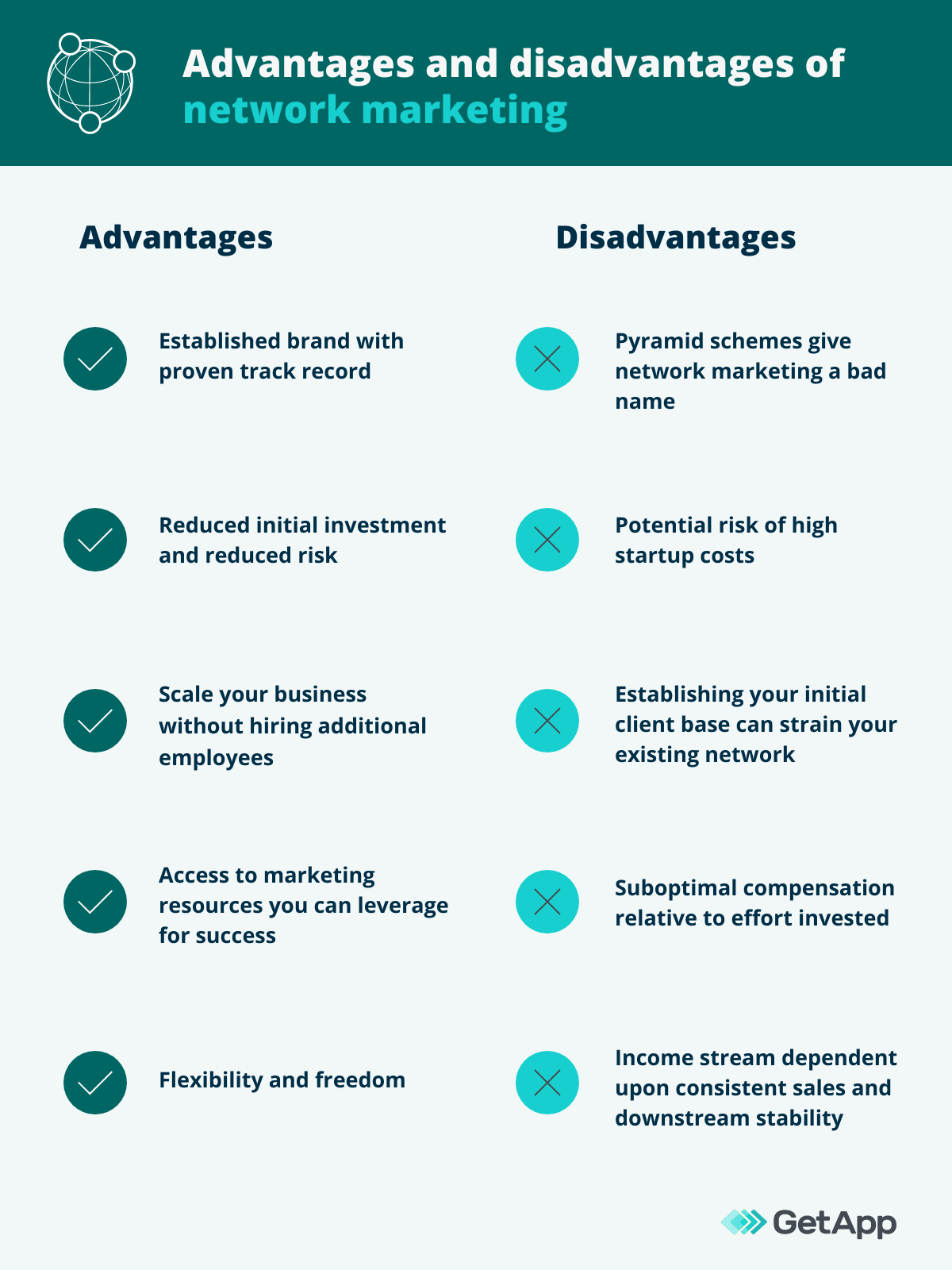
How network marketing benefits a growing organization
If you’re someone looking to buy into a product- or service-based business, network marketing is a business model that allows you to build sales and expand your brand presence without investing in marketing costs and sales staff. Using this model to grow your business eliminates many of the obstacles traditional businesses face.
Established brand
Network marketing opportunities often come with established brands and services that have a proven track record for quality and service, so your small business immediately benefits from the brand recognition and reputation of the parent company.
Many direct sales companies offer reduced initial investment
The initial investment to start a business is greatly reduced when you partner with an existing brand that hires distributors to grow their business. In some cases, because the brand has established products, distribution, and logistics in place, there are even opportunities to start a lucrative sales-based business with zero investment.
Reduced risk
Because small businesses based on network marketing are often grown off established products and services, there is significantly less risk. Your low level of initial investment allows you to scale the brand quickly, and if you find that the brand isn’t profitable, there’s often less cost to disengage and pivot.
Downstream distributors are not employees
It’s important to remember that downstream distributors do not work for you, but rather work under the same agreements you do as a distributor. Recruiting distributors below you becomes a powerful growth tactic that allows you to easily scale your small business and increase your revenue without having to hire traditional employees.
Access to marketing resources you can leverage for success in your own way
Because many direct sales brands are well-established, they often have a marketing kit their distributors can use to ensure consistent messaging and a strong online brand presence. While brands will often have basic rules for use, distributors are encouraged to establish their own budgets for marketing and leverage the channels that work best in their markets for their target audience. This frees distributors to decide the best way to maximize their advertising investments.
Flexibility and freedom
Network marketing arrangements allow distributors to set their own hours, providing entrepreneurs with significant levels of flexibility to set their own schedules and determine best practices to engage with clients. This allows distributors to leverage network marketing as a side hustle and passive income stream or be more aggressive in their focus to grow their network into a full-fledged business.
Drawbacks of network marketing as a business model
Network marketing isn’t without its risks and drawbacks, and it’s important to understand what risks are associated with becoming involved with brands by doing your due diligence in understanding what’s expected as a distributor.
Pyramid schemes give network marketing a bad name
While they might present themselves as legal enterprises, there are many network marketing brands that only incentivize membership growth, with fees collected for joining, rather than focusing on actually building sales. In order to be considered a legal, legitimate network marketing endeavor, 70% of total sales must be made to non-distributors. [2] This threshold forces distributors to focus not on expanding their team but instead on growing their client base.
Some brands do have high startup costs
While some brands do provide a host of startup resources, there are other direct sales brands that require their distributors and consultants to spend their own money on building a website from scratch and keeping significant amounts of inventory on hand.
Some brands even require regularly scheduled inventory purchases, which often outpace your ability to sell the product and can overburden you with excess inventory and storage costs. Getting up and running and remaining in business can cost thousands of dollars with the wrong brand.
Establishing your initial client base can strain your existing network
While pyramid schemes can especially strain your existing network, even legitimate network marketing companies can damage your existing professional relationships, especially retail-focused business-to-client (B2C) brands. A full one-third of MLM participants enter into network marketing as a result of a friend or family member, showing how crucial it is to protect and maintain your network of connections. [3]
Suboptimal compensation relative to effort invested
Even with well-established network marketing brands that provide marketing kits and backend support, the costs and efforts associated with getting your personally branded channel of an existing product off the ground can be significant. Unfortunately, the commission per sale isn’t always enough to cover the costs of maintaining your own infrastructure, and building your network to a scale large enough to cover costs can be a daunting undertaking.
Income stream dependent upon consistent sales and downstream stability
Business ownership often looks attractive to individuals who might not have the acumen and experience to be successful. Turnover in the network marketing industry is extremely high, so if you are dependent upon the revenue stream generated by distributors down the line, such high turnover can greatly impact the stability of your income.
Similarly, an inconsistent demand for the products or services you’ve chosen to sell can cause great instability in your income stream and ability to achieve your marketing and client engagement goals.
Tips for network marketing
Network marketing for a direct sales brand can be a rewarding experience if approached with the right entrepreneurial mindset. Many of the drawbacks and disadvantages can be mitigated with discipline and forethought.
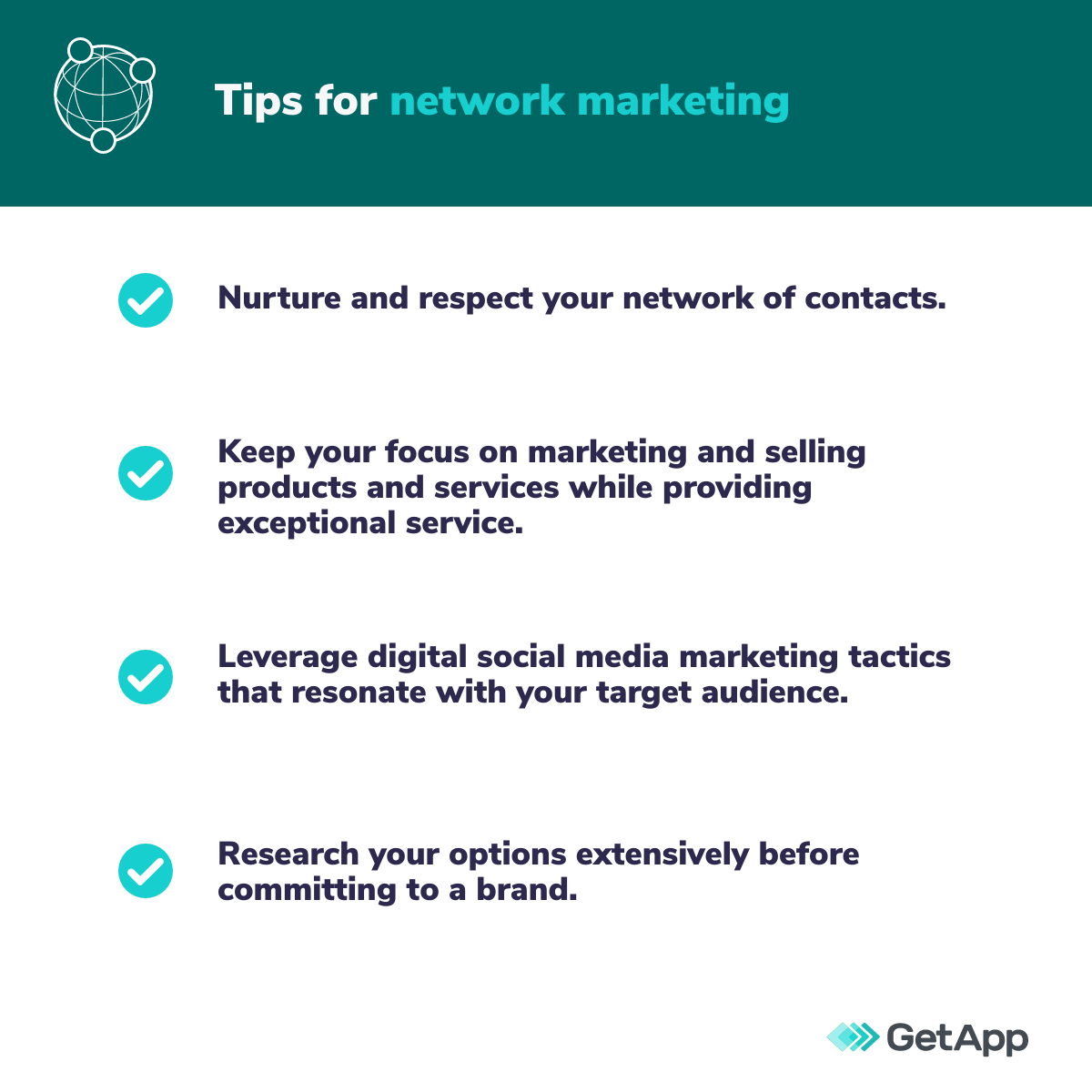
Nurture and respect your network of contacts. Even as you lean heavily on close peers and family members in the beginning, be cognizant of how much you engage over time, and ensure you treat any referrals with care and concern in order to maintain long-term relationships.
Remember that even as you build out your network, your focus is to market and sell products and services to your clients and to provide exceptional service. Showing that you take your chosen brand seriously will go a long way at helping to build your revenue stream.
Leverage digital social media marketing tactics that resonate with your target audience. You don’t have to have a presence on every social platform, but it’s important to understand how to engage with your audience and manage social media marketing on their preferred channels.
Research your options extensively before committing to a brand, and once you have committed, identify a mentor within the company who can help deepen your understanding of the brand. Understanding the products or services you have chosen to sell, anticipated sales volume and demand, as well as the target audience will go a long way at allowing you to establish a reputation for authenticity and providing consistent service to clients.
Discover software tools designed to support the growth of your new direct sales business
Like any small business or start-up business, new distributors starting their own direct sales channel have limited resources to tackle a massive workload to get the business off the ground in a sustainable way. And like most small businesses, network marketing professionals can benefit from the automation tools and digital marketing software platforms that other small-business owners depend upon to build long term success. Explore GetApp’s marketing software directories to find the right tools for managing your CRM, digital marketing, and any other business processes necessary to help grow your direct sales client base.
Grow your new business with network marketing tools and strategies designed for success
While the network marketing industry is growing annually, there’s no guarantee that you will make money as a distributor. After startup investment and the costs to build out digital assets, it can be difficult to turn a profit.
If you’re looking at the growth opportunities that becoming a distributor for a direct sales-focused brand might make possible for your business, it’s important to have the right resources and tools at hand to avoid being a statistic in the cut-throat network marketing industry. In addition to a broad set of digital tools, knowledge will be key to your success, and GetApp has just the information you might need to help you engage with more of your target audience and grow both your own bottom line and that of your direct sales-focused parent company.
Sources
David J. Brin