GetApp offers objective, independent research and verified user reviews. We may earn a referral fee when you visit a vendor through our links.
Our commitment
Independent research methodology
Our researchers use a mix of verified reviews, independent research, and objective methodologies to bring you selection and ranking information you can trust. While we may earn a referral fee when you visit a provider through our links or speak to an advisor, this has no influence on our research or methodology.
Verified user reviews
GetApp maintains a proprietary database of millions of in-depth, verified user reviews across thousands of products in hundreds of software categories. Our data scientists apply advanced modeling techniques to identify key insights about products based on those reviews. We may also share aggregated ratings and select excerpts from those reviews throughout our site.
Our human moderators verify that reviewers are real people and that reviews are authentic. They use leading tech to analyze text quality and to detect plagiarism and generative AI.
How GetApp ensures transparency
GetApp lists all providers across its website—not just those that pay us—so that users can make informed purchase decisions. GetApp is free for users. Software providers pay us for sponsored profiles to receive web traffic and sales opportunities. Sponsored profiles include a link-out icon that takes users to the provider’s website.
What is an Operations Manager?
An operations manager can make or break a business. So what makes an operations manager great? Here are the top 7 skills, and how to develop them.


Operations managers are the ultimate jugglers: they are leaders, people and process managers, and above all, multi-taskers. An operations manager has to be intimately acquainted with workflows, budgets, and resources for at least one team, sometimes more. The goal? To keep costs down while consistently delivering high-quality product.
As if keeping track of so many moving parts of the business wasn’t enough, operations managers must also always keep the company-wide big picture in mind to make sure every piece is moving cohesively toward the same goal.
What is operations management?
Operations management involves planning, implementing, and supervising the production of goods or services. Businesses must manage and allocate resources, which could include labor, equipment, and vehicles, among others, to ensure the delivery of the final product.
https:/www.google.com
What skills do operations managers need?
As a business function, operations management is applicable to a broad range of industries—including retail, supply chain, and logistics to name a few— and therefore specific job functions vary accordingly.
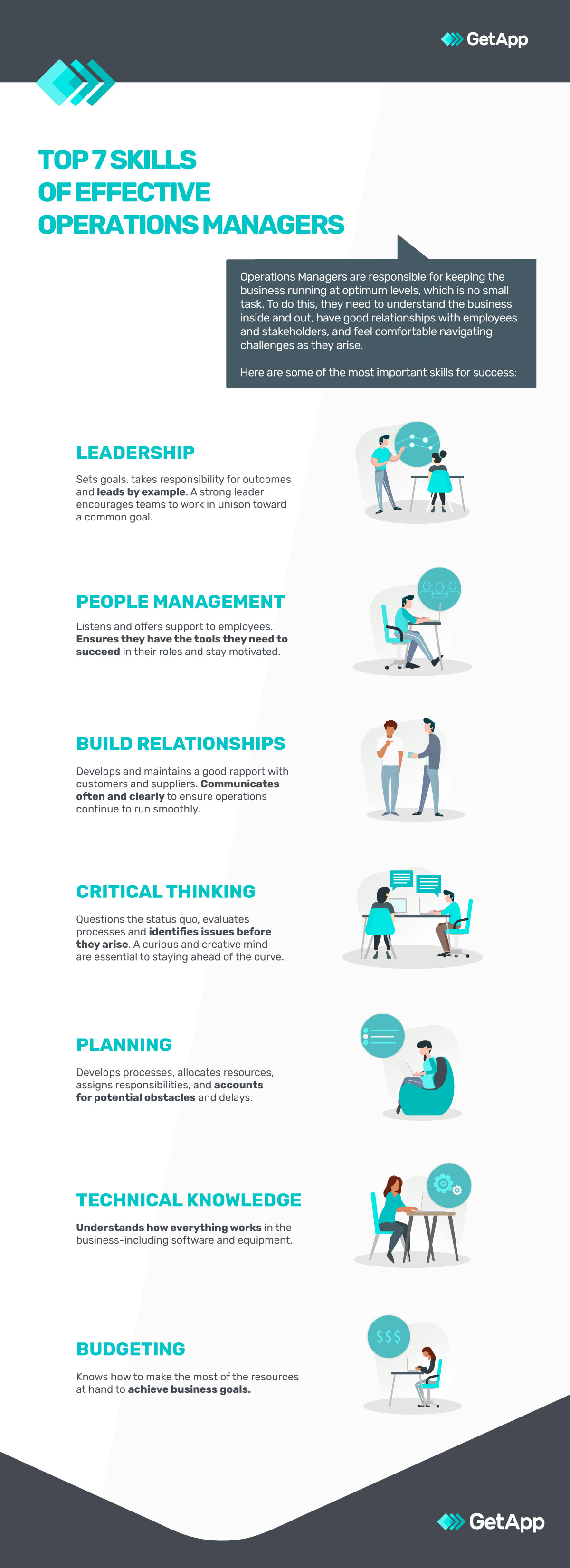
Still, there are many commonalities even when the final product differs. Here is a list of the top 7 skills for operations managers.
Leadership
Setting goals, taking responsibility for the outcome, and leading by example are all essential to guiding teams toward their objectives with ease. Getting teams to work well together, toward the same goals, is effective leadership.
People Management
Operations managers will often manage several people, sometimes across different departments. An effective operations manager is able to effectively support employees as well as get teams and individuals to work together. Encouraging teams and providing them with the tools they need to succeed keeps your employees motivated and ensures you keep talent in your business.
Build relationships
Operations managers will often interact with stakeholders, internal and external, over the course of running operations. The ease with which your operations function will depend heavily on your ability to work well with your customers and suppliers. The strength of those relationships depend on clear and direct communication and consistent delivery—your business is counting on it.
Critical thinking
To be an excellent operations manager means constantly looking to improve systems, evaluate assumptions, and make changes when necessary. Solving ever arising problems is a key function of any operations manager. As Brad Dunlap, Operations Manager at Capitol Nutrition, put it: “you have to be able to be creative [...] and figure out why things go wrong.”
Planning
Planning is the key to seamless execution. Whether your organization is delivering goods or services, you will have to be able to outline a workflow, allocate resources, assign responsibilities, and account for potential obstacles and delays. Adding forecasting to your planning process will help quantify the probabilities of certain events, making planning a more data-driven process.
Technical knowledge
Operations managers will need to be acquainted with the software systems and tools needed for the job. For those managers in the manufacturing, supply chain, or other technical industries, managers will also need to understand the inner workings of the production process from the equipment to stakeholders.
Budgeting
Resource efficiency—keeping costs down and quality high—is a balancing act. Operations managers should have a good understanding of the business’ finances and be able to budget to maximize resources and return on investment. A budget that balances priorities effectively is essential to business success.
How to develop and improve your skills
Some jobs require university degrees in business, finance, or operations, and may go as far as requiring advanced degrees or certifications in project management or supply chain management. But this isn’t always the case. In fact, some positions do not require advanced degrees at all.
In operations, experience and mentorship go a long way. Dunlap explained: “I learned most of my skills by working alongside 3 other managers in a large department (30+ people) where things needed constant supervision. Starting off managing in a role like that is ideal so that you get all of the skills necessary right off the bat.”
Even if you do not work for a large department immediately, there are ways to gradually build on your experience:
Seek out other managers for advice
Ask to be part of different areas of the business
Listen to employees in a variety of roles
Be ok with making mistakes along the way.
Want to read more about operations management?