

GetApp offers objective, independent research and verified user reviews. We may earn a referral fee when you visit a vendor through our links.
Our commitment
Independent research methodology
Our researchers use a mix of verified reviews, independent research, and objective methodologies to bring you selection and ranking information you can trust. While we may earn a referral fee when you visit a provider through our links or speak to an advisor, this has no influence on our research or methodology.
Verified user reviews
GetApp maintains a proprietary database of millions of in-depth, verified user reviews across thousands of products in hundreds of software categories. Our data scientists apply advanced modeling techniques to identify key insights about products based on those reviews. We may also share aggregated ratings and select excerpts from those reviews throughout our site.
Our human moderators verify that reviewers are real people and that reviews are authentic. They use leading tech to analyze text quality and to detect plagiarism and generative AI.
How GetApp ensures transparency
GetApp lists all providers across its website—not just those that pay us—so that users can make informed purchase decisions. GetApp is free for users. Software providers pay us for sponsored profiles to receive web traffic and sales opportunities. Sponsored profiles include a link-out icon that takes users to the provider’s website.
Service desk vs. help desk: What's the difference?
Knowing the difference between service desk and help desk can prevent you from buying too much software or overstating your IT capabilities.

Service desk versus help desk: Tomāto, tomáto or apples and oranges?
In the past, the two terms were used interchangeably, and in many cases they still are. However, they can connote two different ideas depending on who you’re talking to. Knowing the ways in which they are different can prevent businesses from buying too much software or overstating their capabilities.
Ask your IT staff about it and they’ll probably call it the “service desk,” but when employees have a problem, they’ll probably say “call the help desk.”
To add some anecdotal evidence, I asked two friends, each of whom have spent their entire careers in IT management, to give me their first reactions to the question:
“What’s the difference between a help desk and a service desk?”
-“Well, honestly I’d expect a service desk to be more useful. Help desk has picked up negative connotations. Helpless desk …”
-“I’m not even sure what the difference is … here at ‘Big Box Retailer’ we call our help desk the Technology Support Center.”
Well that clears that up.
The service desk as an evolved help desk
What is a service desk?
An IT service desk, as defined by
, includes products ranging "from simple call tracking/trouble ticketing (aka 'help desk' products) to broad suite solutions encompassing call management, incident management, problem management, IT change management, configuration/inventory repositories, request fulfillment and self-service portals."
Notice that help desk products are described as “simple call tracking” or “trouble ticketing” products and as part of the greater whole that is the service desk. The term help desk can also refer to an external technical support operation. For this reason, help desk products are sometimes cataloged under customer service.
In some ways, a service desk is an evolved help desk, but it’s more than that. The service desk is the supportive environment that has grown up around the original help desk concept. In that way, whether you need help desk or service desk software is a matter of evaluating the maturity of your IT organization.
So, service desk vs. help desk - what
A service desk is, in part, a help desk, but a help desk is not necessarily a service desk. Accordingly, products marketed as help desk software might not be sufficient for a service desk, whereas service desk software might be overly complicated for a help desk. For these reasons, discerning the difference between the two terms can ease the search for relevant software.

IT Service Management (ITSM) brings it all together
The service desk concept originated from the Information Technology Infrastructure Library (ITIL) framework. ITIL is most widely adopted set of best practices for IT service management (ITSM). The ITIL strategy is to treat the business as a customer and deliver service in a manner that achieves the best outcome.
In ITIL speak, service is the name of the game and the basis for its Service Lifecycle Model. The model sees IT service strategy surrounding service design, service transition, and service operation. The ITIL service desk sits within the model’s service operation segment. Running throughout the entire ITIL Service Lifecycle Model is “Continual Service Improvement” which focuses on perpetually improving processes and making operations more efficient.
ITIL Service Lifecycle Model

This is a simplified explanation of ITIL’s densely comprehensive framework. And while the full ITIL model can only be adopted to its fullest by large enterprises, smaller businesses can choose which elements best suit their needs. Rather than service desk or help desk, we are talking about degrees of IT service management, whether its most basic components or its most comprehensive strategies.
Selecting ITSM software for your business
ITSM vendors tend to market toward more comprehensive options that appeal to the greatest number of customers. There’s a good chance that many ITSM software options go above and beyond needs of many small and midsize businesses.
This could be a good thing because you might begin to take advantage of more advanced features as your IT needs evolve. ITSM products are often cloud-based and have monthly subscriptions plans so that they can scale as your company grows.
However, buying a product that is difficult to implement or too complicated for your needs is likely to end in failure.
A small business with 25 employees-and one or two IT people who do it all-might only need ticketing software that organizes IT requests more efficiently than email. A business with 100-200 employees and an IT staff of 4-10 probably needs something more robust that includes problem, change, and asset management, along with a self-service portal.
Larger businesses often require a full suite customizable product that incorporates the full spectrum of IT service management needs for hundreds or thousands of employees spread across multiple locations.
Here at GetApp, we regularly update our Category Leaders for IT Service Management (ITSM) software. Rankings are based on a composite of reviews, integrations, functionality, and security. The latest edition, published in January, 2019, includes a top 4 of Freshservice ServiceDesk, Jira Service Desk, Samanage, and ServiceNow.

Freshservice ServiceDesk
Freshdesk ServiceDesk is a full featured ITSM application that takes cues from ITIL best practices. Pricing is per-user and available in four incrementally more robust packages. It also includes asset management (per-asset fees might apply) and gamification options.

Service requests in Freshservice ServiceDesk (Source)
Jira Service Desk
Jira Service Desk is a highly customizable ITSM solution that offers full integration with other Atlassian software. Pricing is per-agent and is offered at a special rate for small businesses with only 1-3 agents.

SLA creation in Jira Service Desk (Source)
Samanage
Samanage is a comprehensive ITSM product that can also be used for external customer service needs. Pricing is per-agent and available in three different packages. Asset management is also available for an additional per-asset fee.
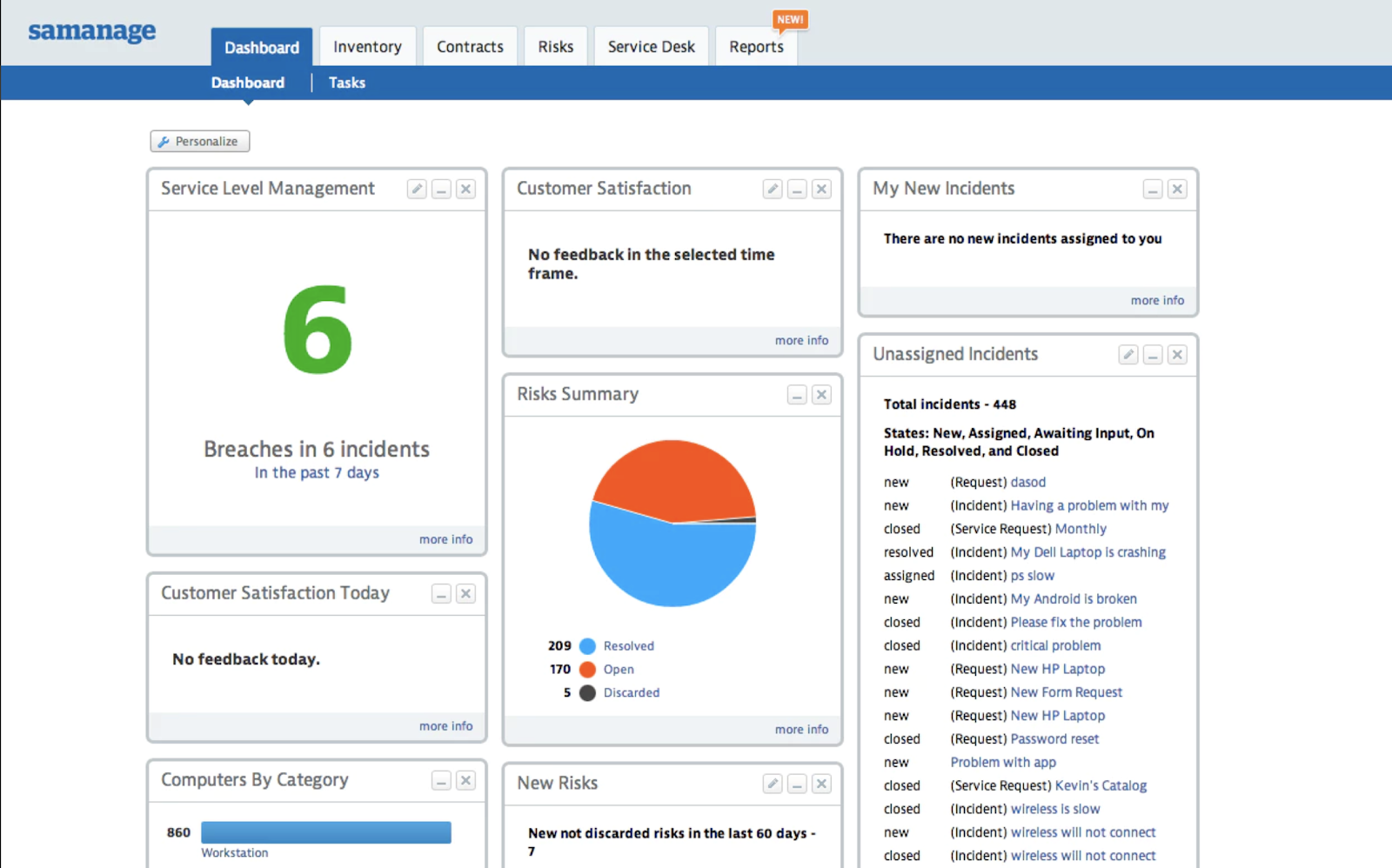
Dashboard in Samanage (Source)
ServiceNow
ServiceNow is among the most commonly used ITSM products at large enterprises and is aligned with ITIL best practices. And while it can be used by mid-size businesses, it is not appropriate for small business use (although the pared down ServiceNow Express is marketed toward small businesses). Pricing is based on the number of IT process users and is generally determined on a case-by-case basis.
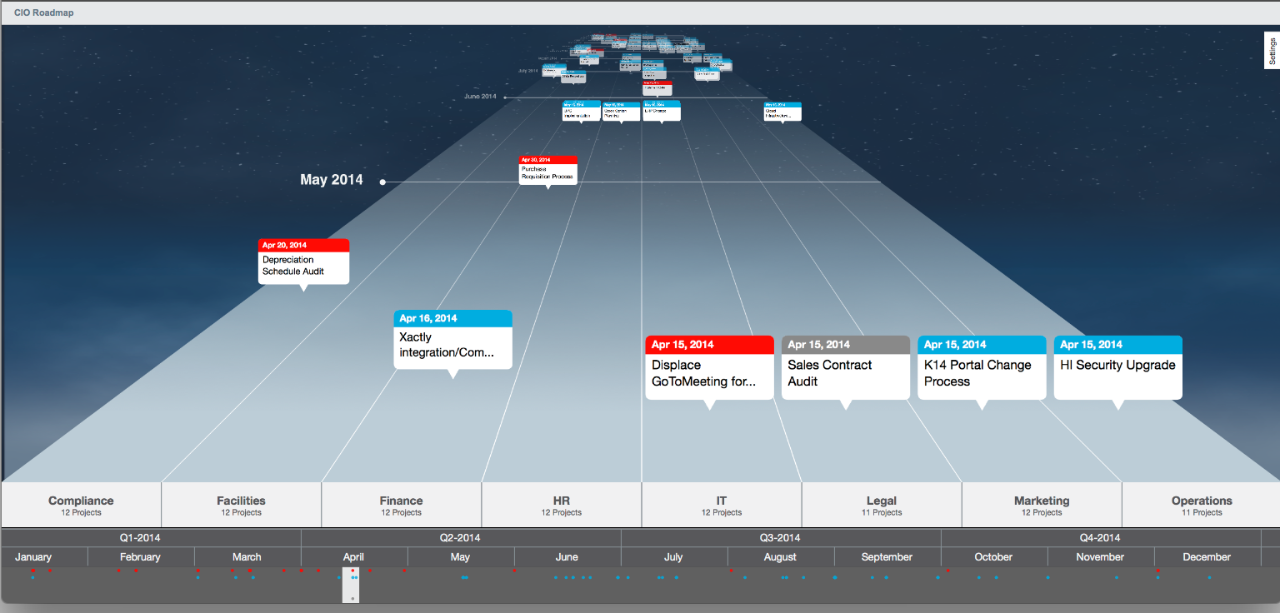
Project roadmap in ServiceNow (Source)
Next steps
Ultimately, thinking in terms of service desk versus help desk isn’t useful for your company. Instead, evaluate the maturity of your IT organization and consider where you want it to be in the future. Then you can adopt the IT service management strategies and products that will be the most valuable to your business.
This article is part of an ongoing series about the business value of IT
Note: The information contained in this article has been obtained from sources believed to be reliable. The applications selected are examples to show a feature in context and are not intended as endorsements or recommendations.
More on Help Desk



Aug 28, 2024

Nov 29, 2023


Mar 29, 2023