

GetApp offers objective, independent research and verified user reviews. We may earn a referral fee when you visit a vendor through our links.
Our commitment
Independent research methodology
Our researchers use a mix of verified reviews, independent research, and objective methodologies to bring you selection and ranking information you can trust. While we may earn a referral fee when you visit a provider through our links or speak to an advisor, this has no influence on our research or methodology.
Verified user reviews
GetApp maintains a proprietary database of millions of in-depth, verified user reviews across thousands of products in hundreds of software categories. Our data scientists apply advanced modeling techniques to identify key insights about products based on those reviews. We may also share aggregated ratings and select excerpts from those reviews throughout our site.
Our human moderators verify that reviewers are real people and that reviews are authentic. They use leading tech to analyze text quality and to detect plagiarism and generative AI.
How GetApp ensures transparency
GetApp lists all providers across its website—not just those that pay us—so that users can make informed purchase decisions. GetApp is free for users. Software providers pay us for sponsored profiles to receive web traffic and sales opportunities. Sponsored profiles include a link-out icon that takes users to the provider’s website.
Place Your Strategy on a Single Page Using This Template
Learn how to write a business strategy plan and download GetApp’s strategy on a single page template.


When your team is working together toward clear priorities, it can help everyone better understand their role and put your organizational goals within reach.
With a simple, defined business strategy, you can prioritize and refine a business strategy plan that meets your current focus.While defining a business strategy may sound like a daunting exercise, we're here to help. In this article, we'll walk you through seven simple steps to create your strategy and provide a free, downloadable small business strategy template.
What is a business strategy plan?
A business strategy plan assesses the current environment of a business—internally and externally. It establishes future goals and targets, and describes the metrics they will be graded on. It can also help clarify where your organization fits in the market, and what trends have driven change in your industry.
A defined business strategy plan can also clearly communicate your business's value to facilitate more B2B and/or B2C sales.
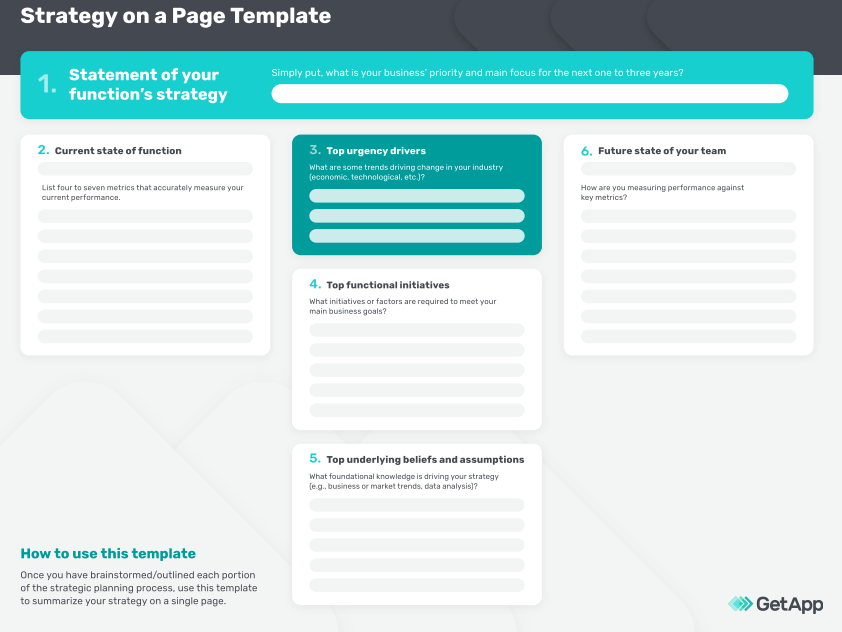
Download this free, strategy on a page template to refine your business goals
Our strategy on a single page template is a sheet where you can fill in details about your business’ priorities. It helps put important factors and considerations in perspective while keeping them front of mind as you plan your next moves.
GetApp’s strategy on a single page template captures all the details you need for your strategy.
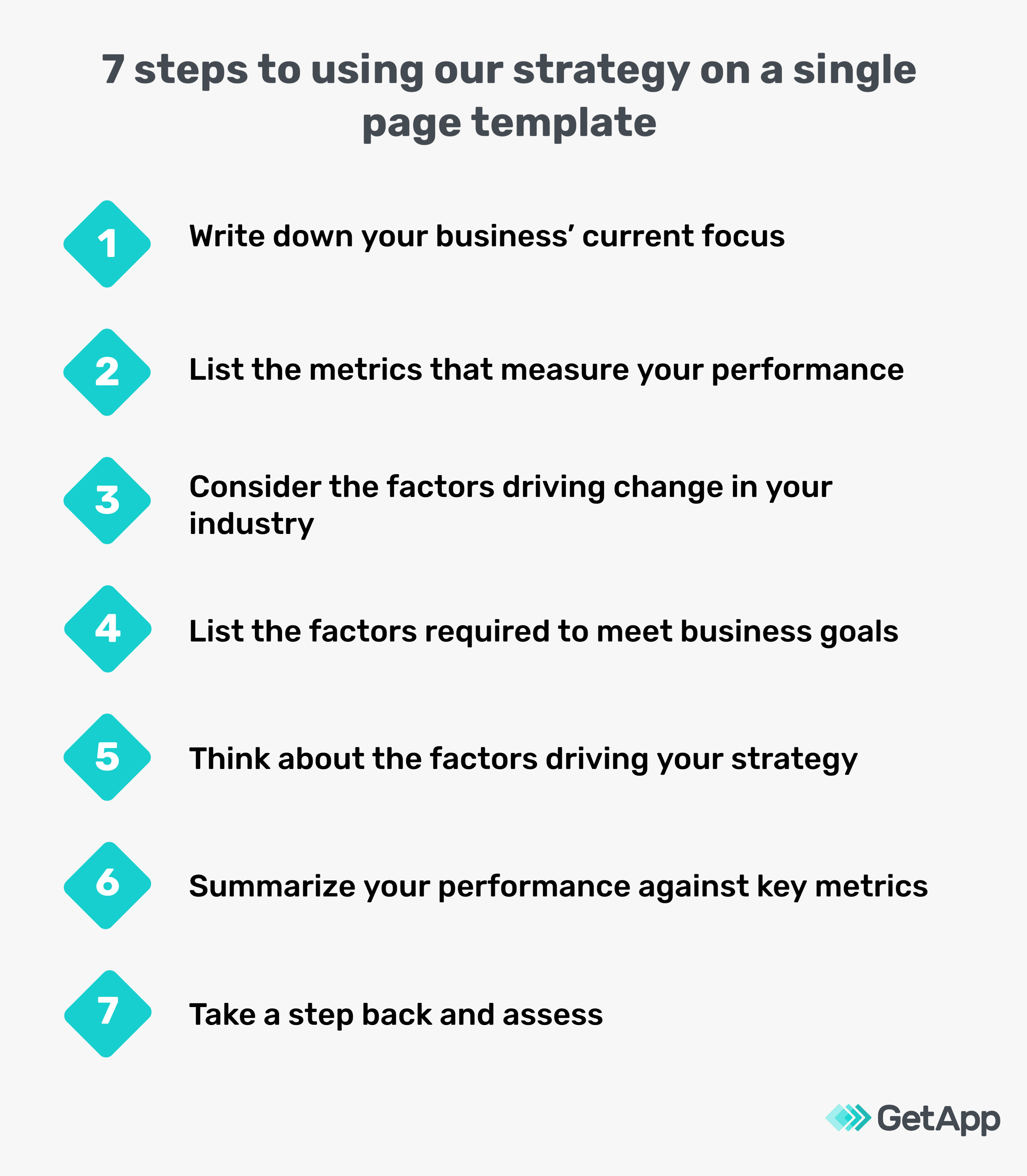
7 steps to defining your strategy on a single page
Use these seven steps to define your business strategy on a single page. For each step, let’s discuss what it entails and how you can get closer to refining your single page strategy.
1. Write down your business’ current focus
To get started, list your business’ top priority and focus for the current year or the next few years. Think bigger than just listing objectives and refine your current capabilities, values, and mission to come up with a single statement that can sum up your goals and can help get you there.
2. List the metrics that measure your performance
Take this opportunity to look at some of the analytics that measure your performance and list them on the template. See what metrics other businesses in your industry and of a similar size are using to determine what best measures your progress.
Tip
For a deeper dive into assessing analytics and even using this data to predict the future, take a look at the following articles.
3. List the factors driving change in your industry
By taking a look at the overall landscape of your industry, you can prepare to adapt elements of your strategy in response to new trends, technologies, and other outside factors (e.g., economic changes, supply chain delays).
4. List the factors required to meet business goals
Staying in line with your defined metrics, spell out what is required from you and your team when it comes to reaching those defined goals. What do you need to succeed, and how can you get there? What needs to work? What can’t go wrong?
5. Consider outside factors that drive strategic goals
Before you define your current strategy, determine what foundational knowledge about current market conditions or the economy will play a part in building that strategy. Did these factors help you determine your business goals? How will they impact success? Consider your business’ current market position and other underlying beliefs and assumptions about your industry.
6. Summarize your performance against key metrics
Simply put, how has your business performed based on the metrics you’ve put in place? Have you surpassed them or fallen short?
7. Take a step back and assess
The point of this strategy on a page template isn't to totally revamp your business' mission but to put everything in perspective. By collecting everything your business is working toward in one place, you can keep your goals more easily within reach and use it as a reminder of what’s really important.
Download your free business strategy template
Defining your single-page strategy doesn’t have to be a complicated endeavor.
Our template can be used by different stakeholders and decision-makers throughout your company, and can easily be shared to help your team work toward a shared vision.
Download our free, easy-to-use template here.
More on Tech 101




Nov 03, 2023

Dec 18, 2023

Oct 31, 2023