GetApp offers objective, independent research and verified user reviews. We may earn a referral fee when you visit a vendor through our links.
Our commitment
Independent research methodology
Our researchers use a mix of verified reviews, independent research, and objective methodologies to bring you selection and ranking information you can trust. While we may earn a referral fee when you visit a provider through our links or speak to an advisor, this has no influence on our research or methodology.
Verified user reviews
GetApp maintains a proprietary database of millions of in-depth, verified user reviews across thousands of products in hundreds of software categories. Our data scientists apply advanced modeling techniques to identify key insights about products based on those reviews. We may also share aggregated ratings and select excerpts from those reviews throughout our site.
Our human moderators verify that reviewers are real people and that reviews are authentic. They use leading tech to analyze text quality and to detect plagiarism and generative AI.
How GetApp ensures transparency
GetApp lists all providers across its website—not just those that pay us—so that users can make informed purchase decisions. GetApp is free for users. Software providers pay us for sponsored profiles to receive web traffic and sales opportunities. Sponsored profiles include a link-out icon that takes users to the provider’s website.
5 Steps To Build Your Annual Growth Strategy
A well-designed growth strategy will help your business meet the challenges of today as well as the future. Here’s a step-by-step guide to getting started.


Having a growth strategy makes it easier for small business owners to streamline operations and execute their vision of achieving continuous growth. Without a growth strategy framework, your small business could be at the mercy of market fluctuations and an inconsistent consumer base.
When planning and executing an annual growth strategy, you should analyze different parameters specific to a financial year. These parameters could include previous years’ achievements and budget estimates, and a vision statement for the year ahead. While the entire process may get a little overwhelming at times, guidance is all you need to sail through.
In this article, we explain five simple steps to help build your annual growth strategy. But before we dive into the specifics, let’s first understand what a growth strategy is all about.
What is an annual growth strategy?
As defined by Gartner, a growth strategy is a plan companies design to overcome current and future business challenges and realize their expansion goals. An annual growth strategy defines strategic guidelines and goals for the 12 months in a financial year. Annual strategies are more measurable in terms of tracking performance and results.
Acquiring assets, enhancing market reach, increasing market share and revenue, and improving products or services are a few examples of business growth strategies.
Four types of growth strategy frameworks
| Market penetration | Increasing sales of products and services in an existing market. It can be achieved by a price drop or increase in promotional activities. |
|---|---|
| Market development | Increasing sales of products and services in a previously unexplored market. It can be achieved by targeting different customer segments. |
| Product development | Launching a new product or service in an existing market. This can be done by investing in the research and development of new products, target market, etc. |
| Diversification | Launching new products and services in a previously unexplored market. It is further divided into horizontal, vertical, concentric, and conglomerate. |
Step #1: Map out your business goals
Your business needs goals to keep moving forward, stay motivated, and ensure continuous growth. Therefore, set up realistic—and not inflated—goals to supercharge your strategic planning for the next 12 months.
The process of defining goals requires you to brainstorm and identify relevant business objectives based on the industry you cater to. To ensure your goals are clear, adopt the SMART approach—i.e., make each goal Specific, Measurable, Attainable, and Timely.
S - Specific: Simple to understand and significant to your business
M - Measurable: Proves that you are making progress toward your growth goals
A - Attainable: Can be reasonably accomplished within a set time frame
R - Relevant: Aligns with the long-term objectives and values of your business
T - Timely: Has a deadline to motivate team members working toward achieving a set goal
Step #2: Build an action plan to achieve defined business goals
Successful goal setting gives you the direction to develop a strategic plan of action and helps identify how to make a move in that direction. For instance, if your goal is to generate more leads, then your plan of action should be trying things such as social media marketing, rich-media advertising, and content marketing.
To build your action plan right, you should have the following:
Action items/tasks that you need to take care of and complete
Deadlines for each action item within the action plan
Defined responsibilities for the teams or individuals responsible for the different tasks within the action plan
Resources for completing the tasks and attaining your growth goals
Step #3: Find tools to support your action plan
In this stage, you need to experiment and identify tools and resources that will work best to build your growth strategy. For instance, you can use project management and project planning software to track and manage the various action items you’ve defined.
Besides proper management, these software tools also help identify the pros and cons of taking up a project based on insights such as defined outcomes, deadlines, and scope of work.
Things to consider when selecting tools to support growth-strategy building:
What key processes do you have in place?
Which of these processes can be improved by the identified tools?
Which features do you need to meet the business goals and grow?
What tools do you already have and do they require integration with the new tools?
How would you integrate the present tools and solutions with the new ones?
How much will be the cost of employing and integrating the tools?
Step #4: Measure performance of the action plan and tools
Now that you have an action plan ready, along with the supporting tools, the next step is measuring impact. You can do this by running a trial-and-error method, which includes testing, identifying problems, fixing the problems, fine-tuning them to align with business values and objectives, and obtaining performance reports and insights for optimization.
The 5 Ps of measuring performance are:
Precise: Clarity on goals without leaving anything open to interpretation
Perceptible: Measurable steps and tactics that are easily understood
Pertinent: Every tactic/goal should help the business grow
Practical: Alignment of the growth team with the mission statement, vision, and values
Punctual: Setting a time frame for every goal to ensure timely execution
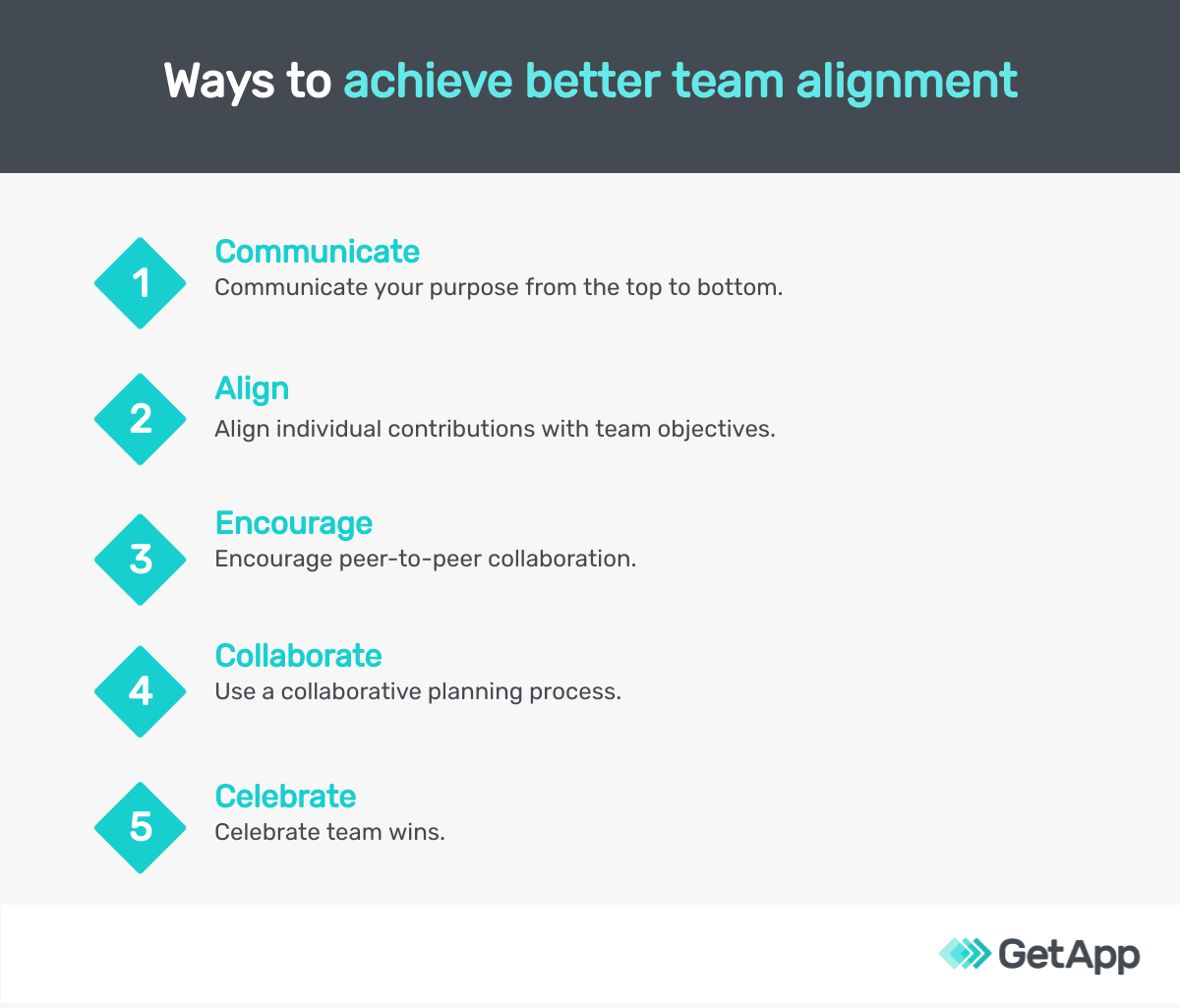
Step #5: Align your team with the set goals
In the final step, you need to build a team and allocate tasks to team members based on their skills and knowledge. Ensure your team members understand the work they are doing and add value to it.
According to Gartner’s 2020 Execution Gap Survey, roughly 40% of executive leaders say that their enterprise accountability and leadership are not aligned on strategy execution. That is because most businesses lack a coherent plan to align team members with business goals and objectives. So, plan for team alignment to accomplish the goals of your growth strategy.
Use software to strengthen your annual growth strategy
You can use various software tools to build and align your annual growth strategy with the goals of your small business. Software solutions help create and share business goals, mission, and values; track performance; and manage charts to create hiring plans.
One such tool is strategic planning software, which allows you to effectively plan your strategy by centralizing goals and enabling communication among teams. It offers transparency across the planning process. Additionally, its capacity and financial planning capabilities let you set up plans, define roadmaps, and measure progress.
More on Project Management


May 30, 2024

Jun 11, 2024

May 28, 2024