GetApp offers objective, independent research and verified user reviews. We may earn a referral fee when you visit a vendor through our links.
Our commitment
Independent research methodology
Our researchers use a mix of verified reviews, independent research, and objective methodologies to bring you selection and ranking information you can trust. While we may earn a referral fee when you visit a provider through our links or speak to an advisor, this has no influence on our research or methodology.
Verified user reviews
GetApp maintains a proprietary database of millions of in-depth, verified user reviews across thousands of products in hundreds of software categories. Our data scientists apply advanced modeling techniques to identify key insights about products based on those reviews. We may also share aggregated ratings and select excerpts from those reviews throughout our site.
Our human moderators verify that reviewers are real people and that reviews are authentic. They use leading tech to analyze text quality and to detect plagiarism and generative AI.
How GetApp ensures transparency
GetApp lists all providers across its website—not just those that pay us—so that users can make informed purchase decisions. GetApp is free for users. Software providers pay us for sponsored profiles to receive web traffic and sales opportunities. Sponsored profiles include a link-out icon that takes users to the provider’s website.
3 Methods To Reengage Cold Leads
Keep prospects in your sales funnel with these top three methods from a recent GetApp Survey.


As a B2B sales professional, you’ve likely been trained to channel your energy into high-potential or warm leads or into generating new leads altogether. But a cold lead is also an untapped reserve to boost sales, if you have the right approach.
In our 2023 Business Structure Survey*, we asked 244 sales leaders how their companies reengage cold leads and share their top three methods with you below. We also spoke to two sales professionals [1-2] to provide a real-world perspective of what it takes to move a cold prospect through your pipeline. Our survey data and interview insights aim to give you the confidence you need to convert cold leads.
What is a cold lead vs. a warm lead vs. a hot lead?
A cold lead is a type of lead that has stopped engaging due to lack of interest, funding, or other factors. Leads are classified as cold, warm, or hot based on their likelihood of conversion.
Warm and hot leads are easier to convert because they’re interested in your brand. They may follow you on social media, subscribe to your newsletter, or even have experience with your product through a sample or trial. While a warm lead has yet to commit to a purchase, a hot lead has been in contact with a sales rep and has the funding to buy in the near future.
#1: Provide incentives to warm up reluctant leads
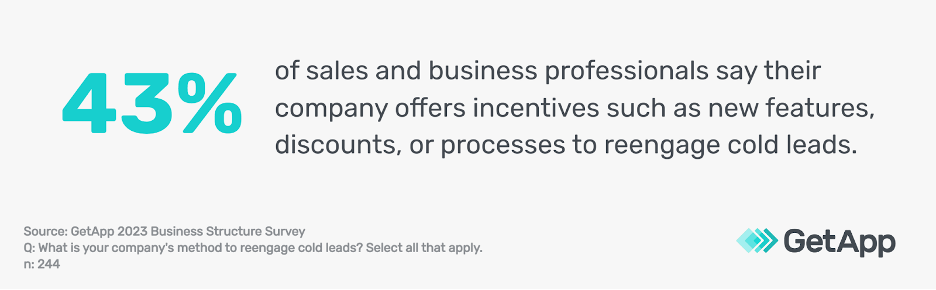
Our first method to reengage a cold lead is to provide new features, discounts, or processes. This is the most popular reengagement method per our survey* results—selected by 43% of respondents.
Incentives such as discounts can be attractive to leads who are hesitant to commit due to cost. A recent Gartner survey [3] found that B2B leads are 38% less likely to close a sale if they’re facing moderate-to-high uncertainty in the workplace, which can include economic difficulties. But what happens when the price of a product or service isn’t within your control as a sales rep?
Bobby DeSeyn [1], who has 14 years of experience in technology and beverage sales, recommends being prepared with nonfinancial incentives to warm up cold prospects: “You might not be able to change pricing or give away free products, but what can you do that your competitors can’t?”

Bobby DeSeyn, Sales professional [1]
Of course, that answer will vary depending on your business and industry. If possible, DeSeyn recommends offering a trial version of your product or service. Another option he suggests is to offer complimentary staff education or training on your offerings: “Differentiating yourself can go a long way toward building a relationship with a prospect who’s otherwise reluctant to engage.”
Tech spotlight
DeSeyn uses a customer relationship management (CRM) platform to identify sales opportunities and nurture relationships with prospects and customers. These tools also segment customers based on specific criteria, including their preferences or recent spending, and schedule targeted email marketing campaigns. Click here for CRM tools that offer a free trial.
#2: Take the pressure off the purchase decision by working within the lead’s timeline
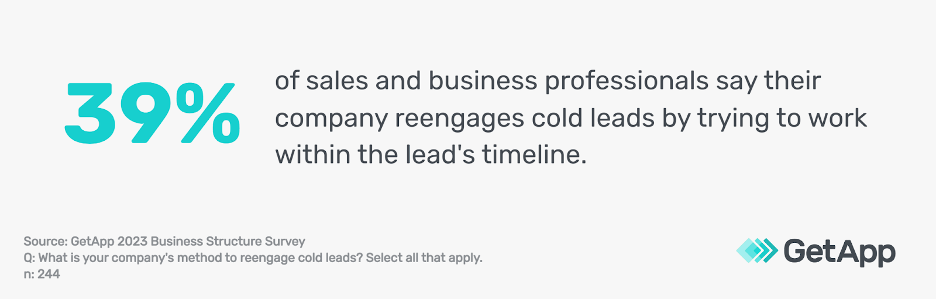
If a lead says it's not the right time for them to buy, chances are they’re not just brushing you off. B2B buyers can take 103 hours, on average, to assess whether a purchase will drive revenue, lower costs, and improve operations [4]. You can take the pressure off this process by following the 39% of sales professionals* who reengage cold leads by trying to work within their timeline.
Playing the long game in sales can have its benefits. Anne Claire Brewer [2], a sales representative for wine and craft spirit distributor Maverick Beverage Company, says it’s easier for her to sell when she takes the time to invest in a relationship with a potential client rather than stress about the timing of the purchase decision.

Anne Claire Brewer, sales representative at Maverick Beverage Company [2]
For Brewer, this means checking in with leads on a weekly basis and keeping those attempts conversational rather than sales-focused. “If I’m selling to a restaurant, I’ll text my contact, ‘I saw on Instagram that you’re offering a new special. How’s it selling? I’m excited to try it!’ Once the business aspect has been put to the side, it’s a lot easier to figure out what an account needs.”
Tech spotlight
If one of Brewer’s leads doesn’t respond in more than 90 days, she takes that as a sign to put them on the back burner. But she’ll also stop reaching out if a lead explicitly says they’re not interested. Email management tools make it easy to remove a lead from your email list and archive old threads. Click here to view our list of vendors who offer a free trial.
#3: Find out why the lead has stopped engaging
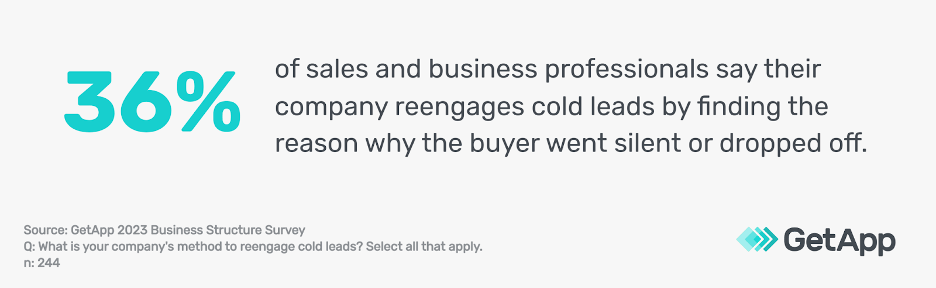
Finding out why a sales lead has stopped engaging can provide both your marketing and sales teams with valuable insights. Thirty-six percent of sales professionals* say they try to find the reason behind a lead’s silence so they can start strategizing ways to reengage them.
One way to do this is to assess the current level of engagement of an otherwise qualified lead [5]. Whether you haven’t engaged with a cold lead in months or are waiting for a response, you can adjust your messaging accordingly. See the table below for examples.
| Level of engagement | Outreach suggestion |
|---|---|
| Lead is inactive or hasn’t engaged for an extended period. | Check CRM data to find the underlying issues, and try to retarget the lead by resolving those issues. For example, if they stopped engaging due to irrelevant content, start sending content that’s more relevant to their pain points. |
| Lead didn’t finish an activity they started (e.g., abandoned their cart, clicked on a link but didn’t fill out the form). | Send reminder messages that are worded in a way that sounds urgent: “You forgot something!” or “We’d hate for your team to miss out.” |
| Lead expressed interest but had to check with stakeholders first. | Give them time to consult with stakeholders, then follow up and see if the stakeholders have any questions you could answer or further incentives you could provide. |
Both DeSeyn and Brewer acknowledge that a prospect can stop engaging due to communication preferences as well. “Some salespeople value in-person interactions above all other forms of contact, but I know that’s not going to work for all of my accounts,” says Brewer.
Meanwhile, DeSeyn recalls an account that preferred to use Snapchat to submit their orders. “Some people communicate differently; this is especially true if you’re working with a younger generation of buyers. You’re going to have to adapt in order to keep certain accounts engaged.”
Tech spotlight
To find out a lead’s communication preferences, we recommend a couple of tools:
Customer satisfaction software lets your small business collect, organize, and manage customer feedback. It’s a great prospecting tool to conduct polls and surveys to solicit feedback from current clients, which you can use to approximate what prospective clients will and won’t appreciate.
Survey software is another way to collect feedback from both current and prospective customers. Both tools offer integration with your CRM so your insights can be organized and exported as reports.
Try different approaches to keep your sales pipeline moving
Providing incentives, working within the lead’s timeline, and finding out the reason behind a lead’s silence are all effective ways to keep your sales funnel moving. But what’s most important is that you use a variety of methods to reengage leads. Other methods that our survey respondents* use are as follows:
Implementing retargeting (35%). Retargeting is the use of website trackers to target leads elsewhere—for example, with display ads or email marketing—and lure them back to complete the conversion.
Crafting value-based communication for reengagement (25%). Value-based communication focuses on what matters to your customer base, such as a cause or social movement.
Creating a multichannel reengagement strategy (22%). Multichannel reengagement refers to the use of multiple channels, such as text, email, and social media, to reengage cold prospects.
Aligning the reengagement strategy to the buyer journey (20%), or the series of connected experiences that customers want and need from your company.
Trying these different tactics can help you discover new customers, capture leads attention, and more effectively manage their needs and expectations.
Looking for more resources on lead generation? Check out these related articles:
Note: Questions and responses have been edited for brevity and clarity.
Survey methodology
*GetApp’s 2023 Business Structure Survey was conducted in April 2023 among 244 U.S. respondents to learn more about sales strategy and framework, and challenges faced by sales leaders. Respondents were screened for a business development or sales role in a business with 1,000 or fewer employees.
Sources
Lauren Spiller