GetApp offers objective, independent research and verified user reviews. We may earn a referral fee when you visit a vendor through our links.
Our commitment
Independent research methodology
Our researchers use a mix of verified reviews, independent research, and objective methodologies to bring you selection and ranking information you can trust. While we may earn a referral fee when you visit a provider through our links or speak to an advisor, this has no influence on our research or methodology.
Verified user reviews
GetApp maintains a proprietary database of millions of in-depth, verified user reviews across thousands of products in hundreds of software categories. Our data scientists apply advanced modeling techniques to identify key insights about products based on those reviews. We may also share aggregated ratings and select excerpts from those reviews throughout our site.
Our human moderators verify that reviewers are real people and that reviews are authentic. They use leading tech to analyze text quality and to detect plagiarism and generative AI.
How GetApp ensures transparency
GetApp lists all providers across its website—not just those that pay us—so that users can make informed purchase decisions. GetApp is free for users. Software providers pay us for sponsored profiles to receive web traffic and sales opportunities. Sponsored profiles include a link-out icon that takes users to the provider’s website.
The New Water Cooler: How to Encourage Innovation and Creativity in the Workplace Remotely
Need a spark to inspire your teams? Check out these 3 tips to encourage innovation and creativity in the workplace remotely.


Whether you love or hate working from home, the number of people working on a remote team (also known as a distributed team) is likely to increase in the coming years as businesses are reinventing themselves in the midst of COVID-19.
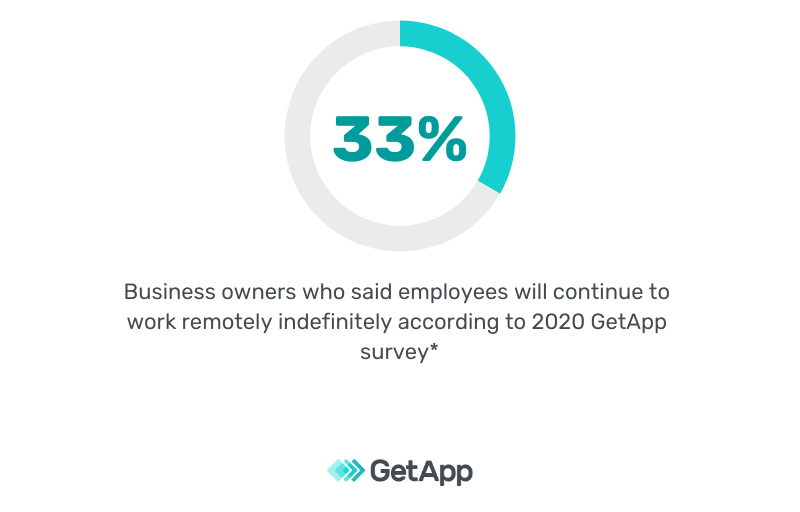
In a June 2020 survey of 577 business owners, 33% said their employees will continue to work remotely indefinitely, but one in five business owners say limited collaboration is their number one concern with employees working from home.
Even if your office is planning to bring people back in permanently, you may still not be able to collaborate like you used to. In our survey, 45% of business owners said they’re planning to alter their business layout to encourage social distancing. Thus, gathering around a shared whiteboard over pizza and passing dry erase markers after licking your fingers (gross!) may be a thing of the past.
Regardless of whether you have plans to work remotely forever or get back into the office, if employees or managers don’t feel like they can collaborate effectively, it can tank productivity for a team, which could have a big financial impact on your business.
While many of us are most comfortable collaborating face-to-face, it’s a myth that meeting in person is a requirement for creativity. Many companies were working on a distributed model before COVID-19—like the open source developer collaboration company GitLab, for instance. Although collaborating remotely may require new skills and a different mindset, GitLab believes it’s more helpful for encouraging diverse thinking and ensuring dominant personalities don’t take over collaboration meetings.
Why is remote collaboration important for your business?
It encourages diversity of ideas for those who may not feel comfortable speaking out in a larger group dynamic.
It allows people to get their thoughts out quickly without having to wait their turn.
It’s easier to copy and paste the ideas to iterate on the ones that rise to the top.
No one needs to transcribe notes or take pictures of the white board.
To help your company foster this spirit of creativity and innovation remotely, below are some tips on how to facilitate creative collaboration from the comfort of your home office.
Tip #1: Host asynchronous creative whiteboard sessions
You can use a form of collaboration software called whiteboard or prototyping software to host virtual ideation sessions.
With whiteboard software, your team can do things like create mind map diagrams, use digital sticky notes to post ideas on a virtual whiteboard and can even “dot vote” to choose the ideas that rise to the top.
Prototyping software is usually used for design and development teams to share an early vision of a product, but it often also has whiteboard or creative collaboration capabilities.
One thing to keep in mind is that if you’re going to host asynchronous creative ideation (meaning people are not all collaborating at the same time), you’ll likely need to build more time into your schedule to give people longer blocks of time to participate. While a normal brainstorm may take an hour or two, an asynchronous ideation session might comfortably take a week to give people a few days at a time to make their contributions as well as build on others’ ideas across time zones.
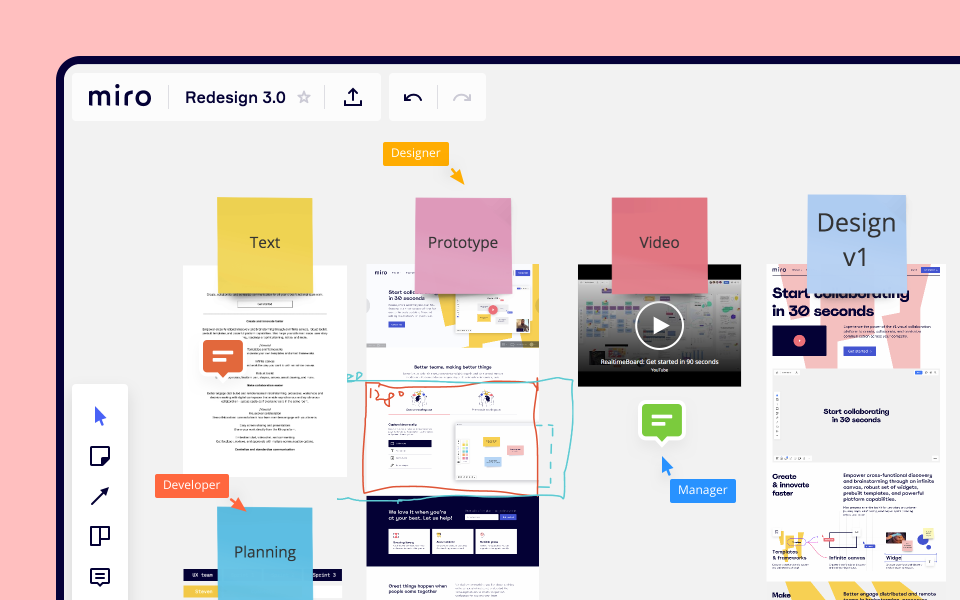
Ideation in Miro, with digital sticky notes and multiple file format options (Source)
Tip #2: Writestorming instead of brainstorming
Instead of brainstorming, try writestorming or brainwriting for your next creative ideation session.
You can do this either asynchronously, i.e., people doing this on their own within a set amount of time, or synchronously, with a scheduled meeting where people contribute at the same time.
To writestorm asynchronously, simply share a Google doc with instructions and ask people to contribute whenever they have time, by a certain deadline. To writestorm synchronously, you can set a meeting then break into small groups and have partners editing a single Google doc at the same time to build on one another’s ideas.
For either approach, it’s important to introduce the problem you’re trying to solve and set brainstorm “rules” just like you would during an in-person session to discourage negative judgment and encourage collaborative thinking.
Tip #3: Schedule informal coffee chats or polls
As a writer and introvert, I’m particularly well-suited to working remotely, but one thing I do miss about the office is jumping into a random conversation about vacation plans or new recipes. These types of conversations don’t happen naturally in virtual environments, and are really important for culture and team-building, so they need to be mindfully added to your remote working routine.
One way to do that is through scheduling informal coffee chats with colleagues on your company’s video conferencing platform.
When I attend these with coworkers, sometimes I’ll have a cup of coffee nearby—or if it’s happy hour, a ranch water—but these conversations often leave me inspired. I can float new ideas, or something might come up in conversation that sparks a connection and leads me to think of an idea in a new way. Although not as truly informal as running into someone in the hallway, these coffee chats can be valuable sources of new ideas.
In addition to informal coffee chats, you could also look at hosting informal polls on your company’s chat software of choice.
In a group chat or channel, you can ask an oddball question like “If you could shoot any liquid from your finger, what would it be?” Then, share the results of the poll using a graph at the end of the week on your chat platform. This could spark fun conversations and help foster team building through creating a sense of community with a virtual team. These types of interactions can even give team members the same warm feeling you get from having a good in-person conversation with a colleague.
Remote collaboration is here to stay, so make these tips part of your company culture
Whatever field you’re in, from software to manufacturing to retail, creative ideas are important for growing your small business. Employees have proven they can work remotely, and based on our study findings, remote work will likely continue to increase over time, and physical offices may truly never be the same.
Here are some takeaways to keep in mind :
Even though more than a third of us may be working remotely for the long-term, you can still foster creative collaboration with your team in many ways—you just have to get creative about how to do this, and plan ahead to give yourself more time.
You can use whiteboard and prototyping or development tools to host brainstorms, try writestorming techniques, use video conferencing software to have informal meetups with coworkers, or host fun polls on chat software.
Team members won’t be held back by different time zones or busy schedules because collaboration can happen asynchronously in many of these tools.
45% of the business owners we surveyed said they’ll be altering their business layout to encourage physical distancing, which will likely lead to permanent changes. It’s possible getting everyone together in the same room may no longer be a reality even when people go back to the office.
With the right software tools, you can find creative ways to collaborate virtually. To come up with your own process, check out GetApp’s catalogs on whiteboard tools, development platforms, video conferencing, and chat so you can start planning your next creative session.
Methodology
The business model survey referenced in this article was conducted by GetApp from June 18 to June 23, 2020 among 577 respondents who reported executive leadership roles at small businesses with 500 or fewer employees.
Note: The applications selected in this article are examples to show a feature in context and are not intended as endorsements or recommendations. They have been obtained from sources believed to be reliable at the time of publication.
Amanda Kennedy
More on Trends

May 07, 2024


Sep 13, 2023