GetApp offers objective, independent research and verified user reviews. We may earn a referral fee when you visit a vendor through our links.
Our commitment
Independent research methodology
Our researchers use a mix of verified reviews, independent research, and objective methodologies to bring you selection and ranking information you can trust. While we may earn a referral fee when you visit a provider through our links or speak to an advisor, this has no influence on our research or methodology.
Verified user reviews
GetApp maintains a proprietary database of millions of in-depth, verified user reviews across thousands of products in hundreds of software categories. Our data scientists apply advanced modeling techniques to identify key insights about products based on those reviews. We may also share aggregated ratings and select excerpts from those reviews throughout our site.
Our human moderators verify that reviewers are real people and that reviews are authentic. They use leading tech to analyze text quality and to detect plagiarism and generative AI.
How GetApp ensures transparency
GetApp lists all providers across its website—not just those that pay us—so that users can make informed purchase decisions. GetApp is free for users. Software providers pay us for sponsored profiles to receive web traffic and sales opportunities. Sponsored profiles include a link-out icon that takes users to the provider’s website.
Marketers Are Raising Their Software Spend: Here’s How To Make That Investment Count
Marketers are looking to make 2025 a year of software investment. How can they make sure that money is spent effectively and that they select the best tool for their firms?


Almost four out of five marketers are expecting to raise their software spending by at least 5% in 2025. This is a key finding of GetApp’s 2025 Tech Trends Survey, which studied the responses of 1,116 marketing decision-makers across 9 countries.*
By raising their investments in marketing software, companies seek to gain efficiencies, facilitate more focused email marketing, manage social media marketing more effectively, and run SEO or SEM campaigns more successfully. However, to make sure the investment gets the best return on investment (ROI), choosing the right platform is crucial.
Our research identifies some of the key challenges marketing software buyers will face in 2025 and explains how they can avoid common pitfalls and increase their chances of success. We’ve also pinpointed the trends used by marketing decision-makers to understand how they approach choosing a system that maximizes ROI.
Key insights
57% of marketing decision-makers are most concerned that technological advancement will affect the performance of their businesses during 2025.
Software spending is set to rise by at least 5% among the majority (79%) of marketing decision-makers, above the average of our cross-industry global sample (75%).
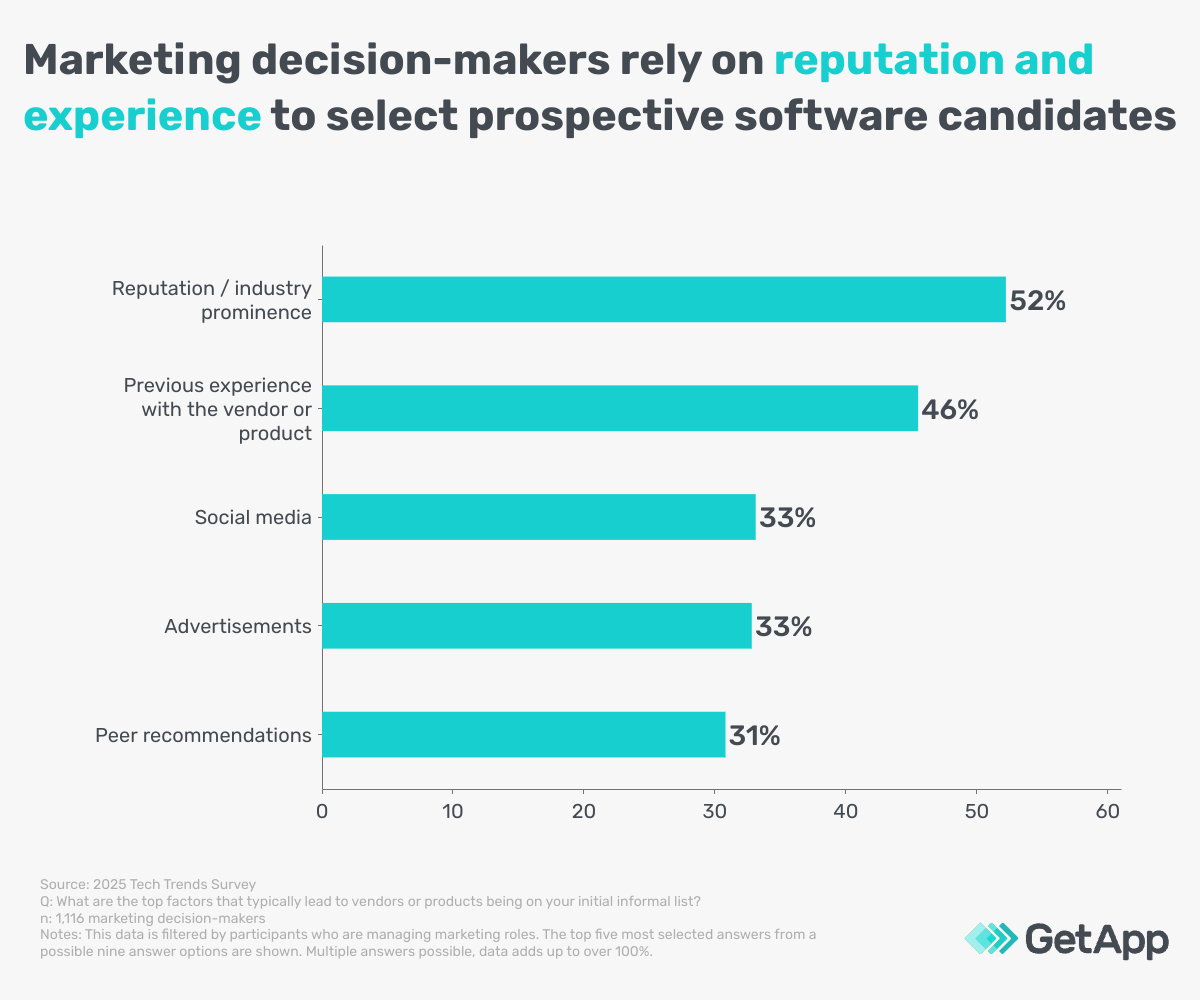
Over half (52%) of marketing decision-makers consider software vendors based on industry reputation primarily.
44% of marketing decision-makers use customer reviews to research their listed options in more depth.
Technical advancements are prompting marketers into action
As technology evolves and changes, so does the marketing landscape. The past year brought with it a number of important changes that will have affected how marketers strategize and approach their work. A major development was a rise in the availability of generative AI software, which is leading marketers to increasingly plan their innovation strategies around the technology. [1]
Another key shift is the ongoing possibility of a ban on TikTok [2], which is seriously disrupting social media marketing plans. These both have major implications for how companies may approach their software needs.
Adaptation to technological shifts is also reflected in our marketing decision-maker data when looking at external challenges facing stakeholders. Technological advancements are highlighted as the biggest factor when planning business goals ahead of more conventional issues such as competition and labor availability.
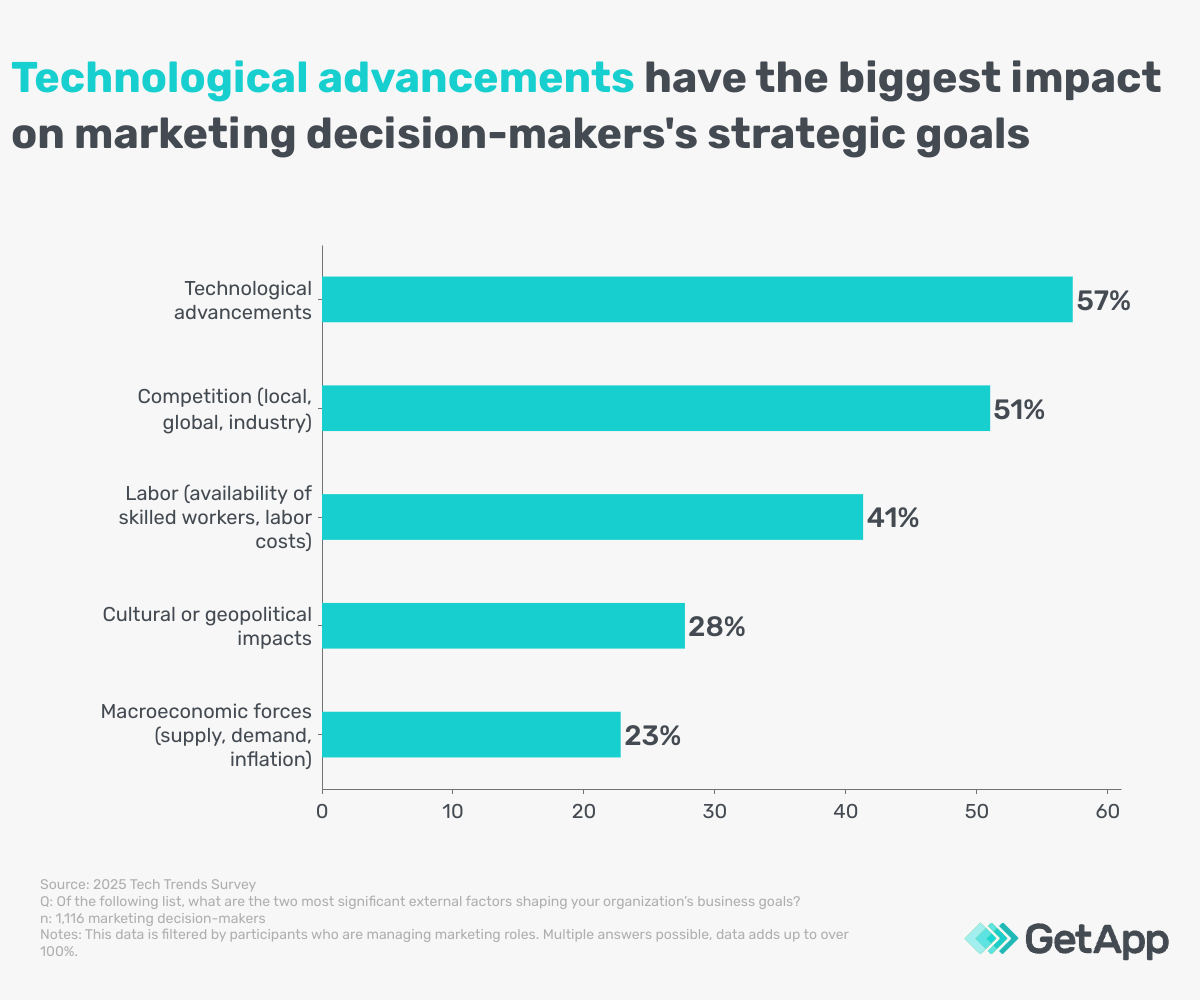
Not only this, we found that many of the key headwinds expected by marketers in the months ahead involve adaptation to new technology. Our sample highlighted the following top five challenges they expect to experience in 2025:
Identifying the right technologies (39%)
Finding new customers or clients (39%)
Implementing technologies effectively (38%)
Finding qualified talent (38%)
Training and upskilling employees (36%)
These challenges highlight a real conundrum for businesses as technology moves forward. Not only do stakeholders need to keep up with the trends to stay competitive, but choosing the technological solution has to be effective and definitive. Nevertheless, as we’ll see in the following section, budgets are being allocated accordingly for this goal.
Lowering friction to boost customer retention
Our data shows that acquiring new customers is expected to be a key challenge for marketers in 2025; however, it’s also important to work on keeping current customers in your database.
In our 2024 Marketing Preferences Survey, we observed that over-engaging customers is having negative consequences. Consumers are responding to this inbox overwhelm by simply tuning out. For example, 40% of U.S. consumers unsubscribe weekly from digital marketing communications, significantly more than the global average of 25%.
From this research, we highlighted four valuable tips encouraging marketers to maximize quality over quantity, identify incentives for audiences to share data, and enhance content to that end.
Marketing decision-makers’ plans for spending in 2025
There is a priority for investment right now in new technology among marketers, and companies are demonstrating their commitment to this in their budgets. Across our sample of marketing decision-makers, the vast majority are planning significantly higher spending on new software over the coming year.
Spending is expected to rise by at least 5% among 79% of our respondents. In fact, just over one in five (21%) anticipate an increase of over 15% compared with 2024.
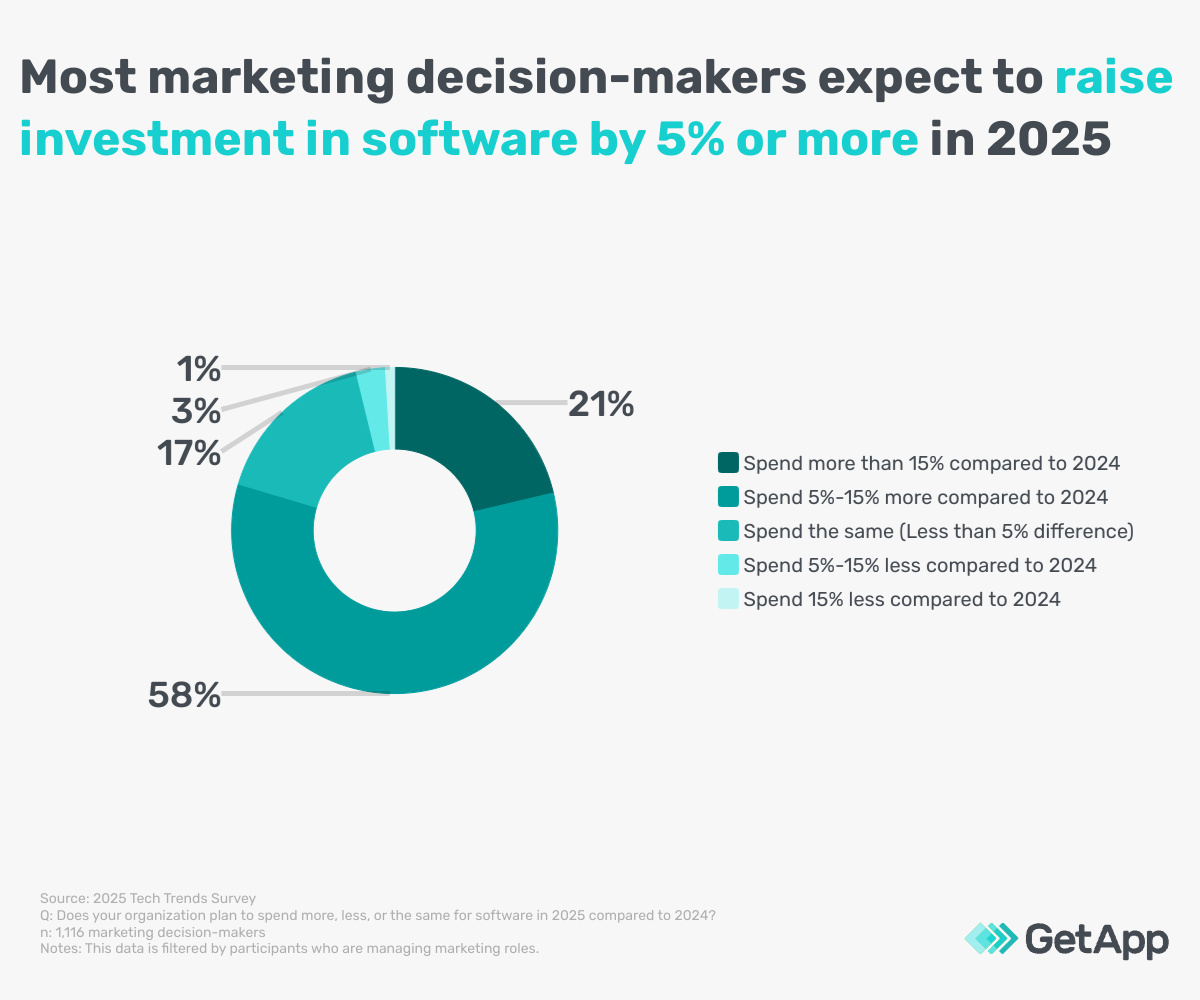
Marketing-focused decision-makers are putting money behind their desire to capitalize on software in 2025. However, this investment looks set to be concentrated on a few key software categories.
The five biggest software investment priorities among marketers are the following:
Marketing software - 41%
IT security software - 37%
Artificial Intelligence (AI) - 32%
IT management software - 31%
Sales management software - 27%
Many of these selections broadly fit marketers' industry focus. Naturally, marketing software stands out as the top choice. IT security also features highly, which fits a global trend: IT security is the top priority across our full sample (selected by 37% of global participants across all industries). There is also a tendency towards adjacent software that helps the flow of sales.
However, AI also features prominently among the priorities. This, to an extent, is also to be expected as AI tools for marketers have expanded widely this year, especially Generative AI (GenAI). In fact, our 2024 GenAI for Social Content Survey found that over half (55%) of PR and marketing respondents surveyed say they currently create 10% to 50% of social media content using generative AI. This use is expected to rise in the next 18 months with most (58%) respondents expecting to use AI to create 25% to 70% of their social content during this time.**
Identifying the right software product is a top concern for marketing stakeholders
Our findings indicate that marketers are prioritizing marketing, IT security, and AI-focused software for 2025. However, choosing the most appropriate system for a company requires careful consideration. There are thousands of systems available, and making a selection that provides positive long-term ROI is vital to ensuring investment is used effectively.
There are many concerns that can come up during the process of selecting a viable software system for use in marketing. In our own sample, we saw five common issues highlighted:
Identifying the right technology or product (37%)
Security concerns (37%)
Compatibility with existing systems (36%)
Data management (36%)
Staff acceptance and onboarding to the new tech (31%)
Many of these issues noted by our sample emphasize the importance of identifying a suitable product, taking into account essential factors such as compatibility with other platforms, and the skill sets available internally. These offer starting points to consider when embarking on a software buying process. Understanding these factors can improve focus on the likely needs and roadblocks that could arise if a system is selected too hastily, or without care.
Time is another factor to account for. Choosing and purchasing a system can take months. While over half of marketing decision-makers in our sample (53%) find this can be completed in about 4 months, most (81%) expect it to take up to 6 months.
We’ve already seen some of the factors to think about before starting the process of procuring a new software system. This involves realistic expectations about the timings of the procurement and setup processes and also awareness of potential pitfalls, such as not selecting a system that merges well with the organization. However, what are the best ways to ensure that the process of selecting a software system runs smoothly?
How to approach a marketing software selection process
Draw up an initial list of candidate platforms
Once internal criteria have been defined, the process can move forward with the shortlisting of software candidates. Our research indicates that many of these initial contenders are usually identified based on the industry status and experience of a product or company.
Just over half of our sample uses reputation and industry prominence as their top information source, followed by actual experience using a specific product or another one from a vendor’s range of tools. In both cases, these methods are more prominent than more traditional forms of promotion, such as advertising, and also stand above peer recommendations.
Generally, we find that decision-makers will collate up to four possible products for their starting list. Among our sample, 58% say they choose between one and four options for their initial list before doing more in-depth research.
This can remain consistent with these initial choices, although in most cases it will change after more focused analysis. When asked how much their initial informal list evolves between starting out and after formal research is completed, half (53%) of marketing decision-makers say they only change their choices slightly, 23% change their lists significantly and 8% change them completely.
Dig a little deeper into the options
Once the initial candidate software list is completed, it will often undergo revisions as in-depth research reveals the suitability or unsuitability of the proposed options. Marketing decision-makers usually investigate their options in a few ways.
For most (44%), customer reviews are a key source of information when researching software providers. Although, other common forms of knowledge gathering include consulting Google or asking professional peers or experts for more details about the listed options.
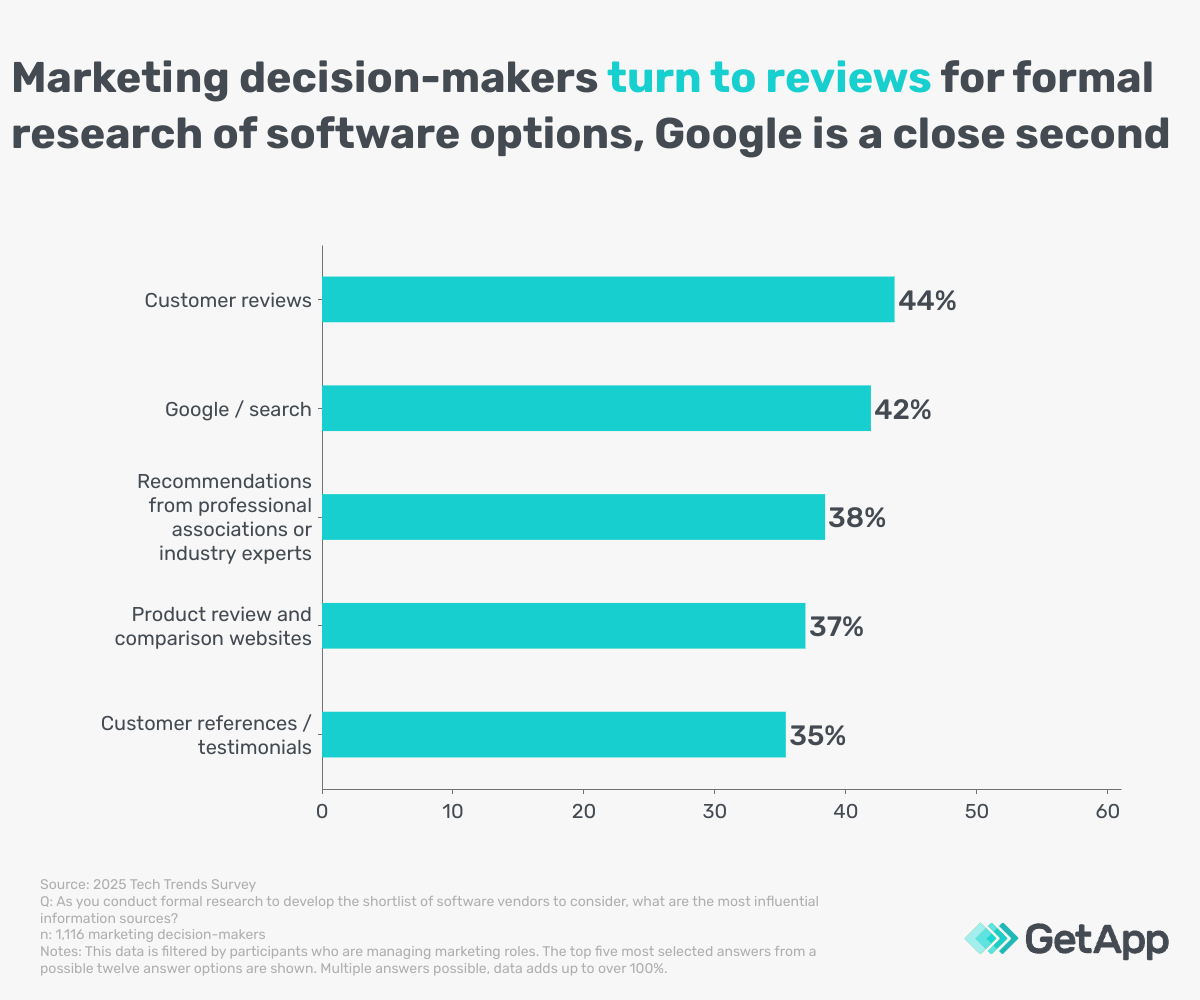
However, when assessing particular elements of a possible platform, we observed that an objective source of reviews can prove decisive when evaluating customer satisfaction. In our sample, over half (58%) of marketing decision-makers found reviews from comparison sites, rather than the vendor’s own site, to be the most trustworthy source of information to determine how customers feel about the experience of using a platform.
Boosting authenticity in reviews
Our findings show that marketing decision-makers value the authenticity of reviews on comparison sites when evaluating customer sentiment. However, what makes reviews more or less trustworthy inherently?
In a recent Gartner study, confidence factors such as uniqueness, the volume of reviews collected, or their recentness are highlighted as key elements that create a positive impression of review authenticity. [3]
Narrowing down the final options
Once the research is completed, there should be only a few options left to choose between. Naturally, how many remain will depend on how the products selected previously fared during the research phase. This may require options to be dismissed or added as more information is gathered. However, in our data, most marketing decision-makers (61%) usually get the list down to between one and three choices for the final shortlist.
From this point, it’s important to assess how the potential platforms work in practice. Here, most decision-makers (59%) will usually only engage with up to two vendors directly, either through sales calls or demos.
However, what is notable is that hands-on interaction with the tools being assessed is very common. The most popular way to differentiate between products is through free trials, with 63% of previous buyers naming this as crucial in their final choice.
This final step is important. It confirms whether the candidate software really fits the criteria set out initially and allows possible future users to test whether the system delivers the best experience for the organization.
Buying marketing software better in 2025
Marketing leaders plan to rapidly increase software investments this year as technological change continues. Therefore, having a solid acquisition plan is particularly important to get the best ROI.
A methodical approach that allows a company to move steadily and strategically toward a suitable software platform is vital to increasing the chances of maximum ROI on a purchase. As our data shows, this is achieved by carefully defining the purchase goals, using industry expertise and experience to select possible candidates, using reviews, research, and recommendations, and lastly, using hands-on tests to assess those choices.
Methodology
*GetApp’s 2025 Tech Trends Survey was conducted online in August 2024 among 1,116 respondents in the U.S. (n=212), U.K. (n=96), Canada (n=117), Australia (n=126), France (n=103), India (n=139), Germany (n=106), Brazil (n=124), and Japan (n=93), at businesses across multiple industries and company sizes (5 or more employees). The survey was designed to understand the timeline, organizational challenges, adoption & budget, vendor research behaviors, ROI expectations, and satisfaction levels for software buyers. Respondents were screened to ensure their involvement in business software purchasing decisions and that they manage staff with a marketing responsibility.
**GetApp's 2024 GenAI for Social Content Survey was conducted in May 2024 among 1,680 respondents in the U.S. (n=190), Canada (n=108), Brazil (n=179), Mexico (n=199), the U.K. (n=197), France (n=135), Italy (n=102), Germany (n=90), Spain (n=123), Australia (n=200), and Japan (n=157). The goal of the study was to learn more about the impacts of generative AI on social media marketing strategies. Respondents were screened for marketing, PR, sales, or customer service roles at companies of all sizes. Each respondent indicated their use of generative AI to assist with their company's social media marketing at least once each month.
Sources
David’s research and analysis is informed by more than 150,000 authentic user reviews on GetApp and nearly 3,000 interactions between GetApp software advisors and software buyers.
His thought leadership work has been featured in TechRadar, Startups Magazine, and Raconteur.