GetApp offers objective, independent research and verified user reviews. We may earn a referral fee when you visit a vendor through our links.
Our commitment
Independent research methodology
Our researchers use a mix of verified reviews, independent research, and objective methodologies to bring you selection and ranking information you can trust. While we may earn a referral fee when you visit a provider through our links or speak to an advisor, this has no influence on our research or methodology.
Verified user reviews
GetApp maintains a proprietary database of millions of in-depth, verified user reviews across thousands of products in hundreds of software categories. Our data scientists apply advanced modeling techniques to identify key insights about products based on those reviews. We may also share aggregated ratings and select excerpts from those reviews throughout our site.
Our human moderators verify that reviewers are real people and that reviews are authentic. They use leading tech to analyze text quality and to detect plagiarism and generative AI.
How GetApp ensures transparency
GetApp lists all providers across its website—not just those that pay us—so that users can make informed purchase decisions. GetApp is free for users. Software providers pay us for sponsored profiles to receive web traffic and sales opportunities. Sponsored profiles include a link-out icon that takes users to the provider’s website.
A Beginner’s Guide to Sales Forecasting Methods
Sales forecasts enable data-driven budgeting and resource allocation. Use this primer to build a sales forecasting strategy for your own business.


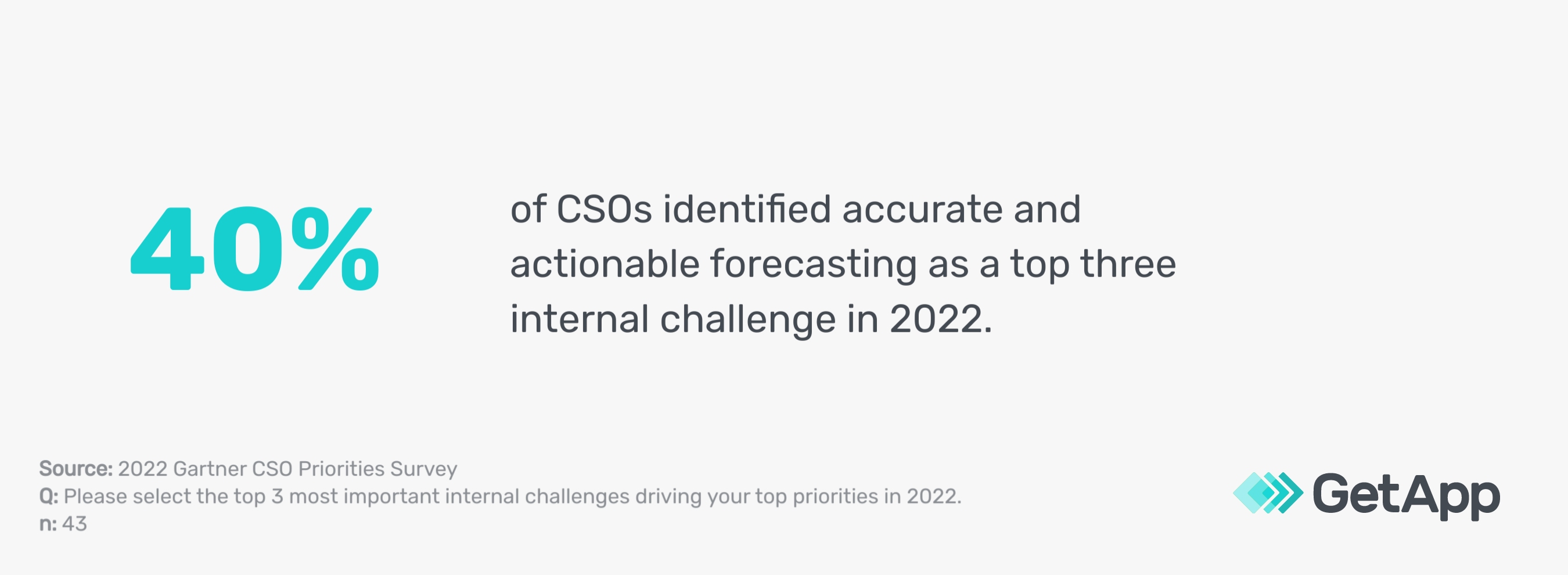
Sales leaders often need help accurately forecasting sales outcomes, especially as market conditions and product portfolios change. In fact, 40% of chief sales officers (CSOs) surveyed in Gartner’s 2022 CSO Priorities Survey ranked accurate and actionable forecasting among the top three internal challenges in 2022. [1]
If you’re a new sales leader or manager establishing a forecasting process for your team, this guide will help you prepare for upcoming quarters and create a more accurate forecast for stakeholders. Even better? Our recommendations are backed by insights from Gartner research, [1-3] so you can feel confident implementing them into your forecasting process.
What is sales forecasting, and why is it important?
Sales forecasting is a process that enables sales organizations to estimate how much sales revenue they can expect to close in future periods. There are several reasons to implement a sales forecasting strategy:
It allows for more accurate budgeting. Sales forecasting aids in understanding how much revenue you’re likely to generate in the coming months, quarters, or years.
It enables data-driven decisions. A sales forecast can help your marketing team decide whether or not to focus on a new target audience or launch a new product or service.
It shows where to allocate resources. For example, a forecasted increase in demand can help determine how many seasonal hires to bring on before the holidays.
It aids in goal setting. Being able to see your expected future revenue allows you to adjust your sales target as needed and set more realistic goals for your sales team.
What are some common sales forecasting methods?
There are several different approaches to sales forecasting. The one you choose will depend on the data you have available and what you’re looking to measure. The table below lists five common sales forecasting methods:
| Sales forecasting method | Description |
|---|---|
| Length of sales cycle forecasting | This sales forecasting technique considers the average time a lead takes to make a purchase. If your average sales cycle is six months and a sales rep has been working on a lead for three, there’s a 50% chance that the sales rep will close the deal. |
| Opportunity stage forecasting | Opportunity stage forecasting uses your current sales pipeline data and open opportunities to predict future sales. It looks at factors such as customer sentiment and market trends to get a better sense of which products customers might be purchasing soon. |
| Intuitive forecasting | Intuitive forecasting looks to your sales reps for guidance on the deals in their pipeline and how they feel about them. This forecasting model is based on the idea that since sales reps are the closest to the deals, they’ll be most able to estimate whether or not they’ll close the sale. |
| Historical forecasting | Historical forecasting uses past sales data to set a precedence for current sales. This forecasting method also helps companies determine conversion rates for customers and the potential value of each deal. |
| Multivariable forecasting | Multivariable sales forecasting uses multiple business data points to forecast your future sales, the length of your sales cycle, the win rate of each opportunity type, and your seller’s win rates, among others. |
What are the common mistakes to avoid when forecasting sales?
Ensure your sales team doesn’t make these common mistakes when forecasting sales:
Not maintaining accurate sales data: Even the most advanced machine learning-based forecasting will be ineffective if the sales data it relies on isn’t consistent and accurate. As a sales leader, you can hold your sellers accountable for forecast accuracy by having them track metrics such as conversion rate, initial pipeline value, and slippage rate. [2]
Relying too much on qualitative data: Qualitative data, or data that relies on opinions as in intuitive forecasting, can lead to biased or overly optimistic projections. Make sure to pair qualitative forecasting techniques with quantitative data for the most accurate sales forecast.
Overlooking qualitative data entirely: Numbers can’t explain everything, and qualitative data is useful for filling in the gaps. Customer surveys and focus groups, for example, can give insights into the popularity of particular products or services or explain unpredicted increases in sales.
Not cleaning your data: Accurate sales forecasting requires clean data. Data cleaning, cleansing, or scrubbing is the process of checking your business data for inaccuracies, duplicates, and outdated or incomplete entries. It’s tedious, but that’s why there’s software for it.
What do you need to build a sales forecasting strategy?
Gartner recommends the following actions if your organization is looking to design or redesign a sales forecasting process: [3]
Document what metrics are currently used as leading indicators for sales outcomes. Sales effectiveness, customer metrics, and product pricing indicators are good KPIs to track if you aren’t already doing so.
Identify which roles will oversee your sales forecasting process. Sales managers and analysts are typically the ones responsible for sales forecasting.
Discuss the benefits of sales forecasting with leadership, and demonstrate how a new or revamped strategy would boost your sales process. Get support from leadership to launch your sales forecasting strategy.
How software can help with your sales forecasting strategy
Having the right tech tools is key to building your sales forecasting strategy. Here are a few you should consider adopting if they’re not already part of your tech stack:
Sales forecasting software: Sales forecasting software tools can help your company plan, budget, and forecast expenses and revenue with advanced modeling and analysis tools.
Customer relationship management (CRM) software: Your CRM system’s sales forecasting feature can help make objective, informed decisions about which accounts to pursue by using historical and current numbers as well as patterns in sales activity.
Sales force automation (SFA) software: These tools help manage and automate sales processes, including contact management, customer relationship management, and sales activity tracking. SFA systems may also provide insights for pipeline management, opportunity management, and forecasting.
Whichever tool you choose, ensure your sales team is diligent about entering sales data. Research shows that both managers and sellers document deal progress in CRM and SFA systems inconsistently, [1] which ultimately reduces the quality of sales pipeline data, increasing the likelihood of errors in sales performance forecasting.
Looking for more information on sales strategies? Check out the following articles:
Lauren Spiller