GetApp offers objective, independent research and verified user reviews. We may earn a referral fee when you visit a vendor through our links.
Our commitment
Independent research methodology
Our researchers use a mix of verified reviews, independent research, and objective methodologies to bring you selection and ranking information you can trust. While we may earn a referral fee when you visit a provider through our links or speak to an advisor, this has no influence on our research or methodology.
Verified user reviews
GetApp maintains a proprietary database of millions of in-depth, verified user reviews across thousands of products in hundreds of software categories. Our data scientists apply advanced modeling techniques to identify key insights about products based on those reviews. We may also share aggregated ratings and select excerpts from those reviews throughout our site.
Our human moderators verify that reviewers are real people and that reviews are authentic. They use leading tech to analyze text quality and to detect plagiarism and generative AI.
How GetApp ensures transparency
GetApp lists all providers across its website—not just those that pay us—so that users can make informed purchase decisions. GetApp is free for users. Software providers pay us for sponsored profiles to receive web traffic and sales opportunities. Sponsored profiles include a link-out icon that takes users to the provider’s website.
Ultimate Guide for Creating a Rewards and Recognition Program
Use this 3-step approach to create a new or revise your existing employee recognition program.


To keep your employees motivated, it’s essential that you recognize and reward their achievements. Recognition not only makes employees feel appreciated but also creates a collaborative work culture wherein teammates are happy to help each other.
Appreciated employees also tend to have higher job satisfaction and stay longer with their organization. A 2018 study found that 21.5% of employees who didn’t feel recognized when they did an exceptional job interviewed for another job, compared to 12.5% of employees who felt recognized. In other words, recognizing employees could curb your attrition rate significantly.
To help you create an employee recognition program for your business, we’ve put together this guide that describes the different aspects of the process. We’ve also recommended some employee recognition tools that you can use for developing and implementing a robust program.
3 types of employee rewards and recognition
Not all companies follow the same rewards and recognition process. How you choose to appreciate your employees solely depends on your business setup and activities. Email appreciation, gift cards, informal acknowledgment—all are means of appreciating your team members. Performance awards, peer-to-peer (P2P) recognition, and milestone awards are the three common types of rewards and recognition used by organizations. Let’s read more about them.
1. Performance awards
Performance awards are for employees who demonstrate exceptional performance in their area of business. These awards recognize the top performers as well as encourage other employees to achieve more. For instance, the salesperson of the year award can motivate your sales staff to achieve or even surpass their targets. Similarly, workplace safety awards can encourage workers to remain more alert while performing their daily tasks.
2. P2P recognition
In P2P recognition, coworkers appreciate each other’s hard work and assistance. This type of recognition has a dual purpose—recognizing employees for their good work and fostering inter-team collaboration and communication. P2P recognition is generally of two types: thank you notes and peer awards. Both options are explained below.
Thank you notes: Also known as praise cards, these are formal written cards that employees can give to their co-workers for recognizing their dedication and guidance.
Peer awards: These are cash awards that employees can give to their peers for appreciating their work. Companies allocate a predefined budget for peer awards. Usually, peer awards involve low cost per recognition, allowing companies to reach a large number of employees.
3. Milestone awards
These are service awards that companies give to appreciate their employees on reaching a specific employment tenure, such as 5-year work anniversary or 10-year work anniversary.
Economics of a rewards and recognition program
One of the biggest challenges while implementing an employee rewards and recognition program is justifying its return on investment. To understand this challenge better, we’ll explore a conducted by employee recognition software provider Redii.
In this study, Redii has created a sample annual rewards and recognition program for a business with 200 employees and a budget of $64,000. The different costs associated with the sample plan are explained in the table below:
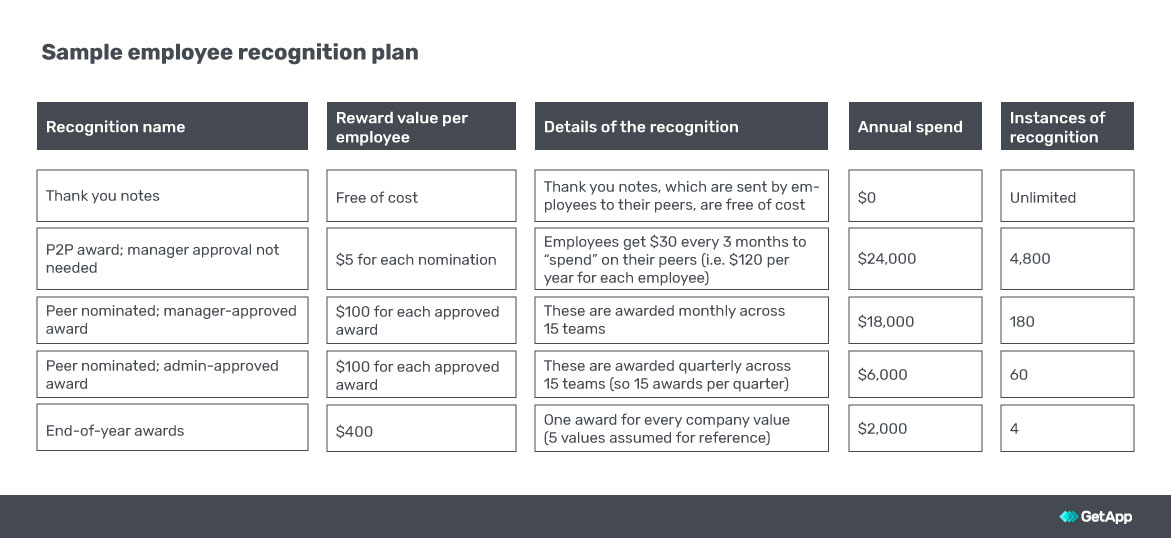
What’s interesting to note is that this recognition program will entail ~5,000 instances of recognition. The study also suggests that the optimal annual spend for rewards is $250–$300 for each employee.
3 steps to creating a rewards and recognition program
Building a successful employee rewards and recognition program isn’t a complex process. It simply requires attention to certain key aspects that we’ve covered in this section. Follow this three-step approach to create an engaging rewards and recognition program for your employees.
Step #1: Set a budget
The first step is to assign an annual budget for employee rewards and recognition. Your allocated budget would depend on your business objectives and values. Having a budget will help manage recognition-related costs more efficiently.
To help you budget your rewards and recognition program, we’ve created a spreadsheet that you can use for calculating associated costs. Click here to access the sheet. Please make a copy of this spreadsheet and edit only the cells highlighted in yellow.
Here’s a glimpse of what the spreadsheet looks like:
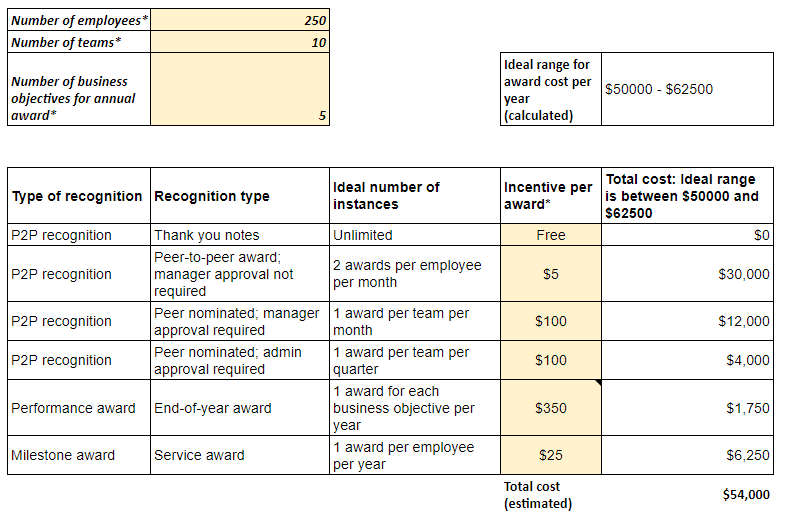
According to Gartner’s "Optimizing Reward and Recognition Programs" report (full report available to clients), the optimal amount for performance awards is about $315 per award. Accordingly, we recommend that the reward value of each end-of-year award should be in the $300–$350 range.
Step #2: Select the right tool
The next step is to select a rewards and recognition solution that’ll suit your business requirements. A software solution will help you manage rewards for all employees through a single centralized platform. The solution will also assist in measuring the actual costs of implementing a program so that rewards-related expenses don’t exceed your allocated budget.
We’ve evaluated all employee recognition software featured on GetApp to arrive at our top three recommendations (listed alphabetically). You can read our complete product selection methodology at the bottom of this article.
Awardco
Awardco is a cloud-based rewards and recognition solution for businesses of all sizes. It offers a points-based peer reward system that lets you assign points for milestones, distribute bulk points to employees, and conduct voting for peer-nominated awards.
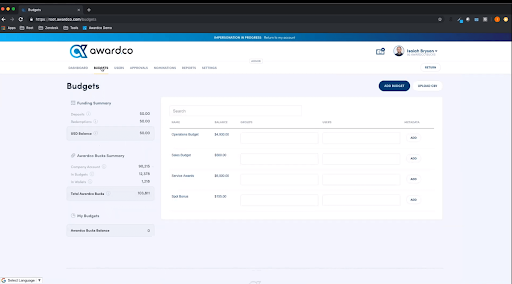
Types of recognition supported: Thank you, P2P (without manager approval), reward points, milestones, and more.
Key functionality: Amazon partnership that lets employees use points to purchase any product on Amazon. Other reward options include event tickets, hotel booking vouchers, and e-gift cards.
For more information on Awardco, you can read user reviews here.
Motivosity
Motivosity is a cloud-based solution for businesses of all sizes. This tool supports P2P recognition wherein you can assign a fixed amount to each employee for distributing to peers. Besides P2P recognition, it also allows you to implement spot bonuses, milestone awards, and thank you notes.
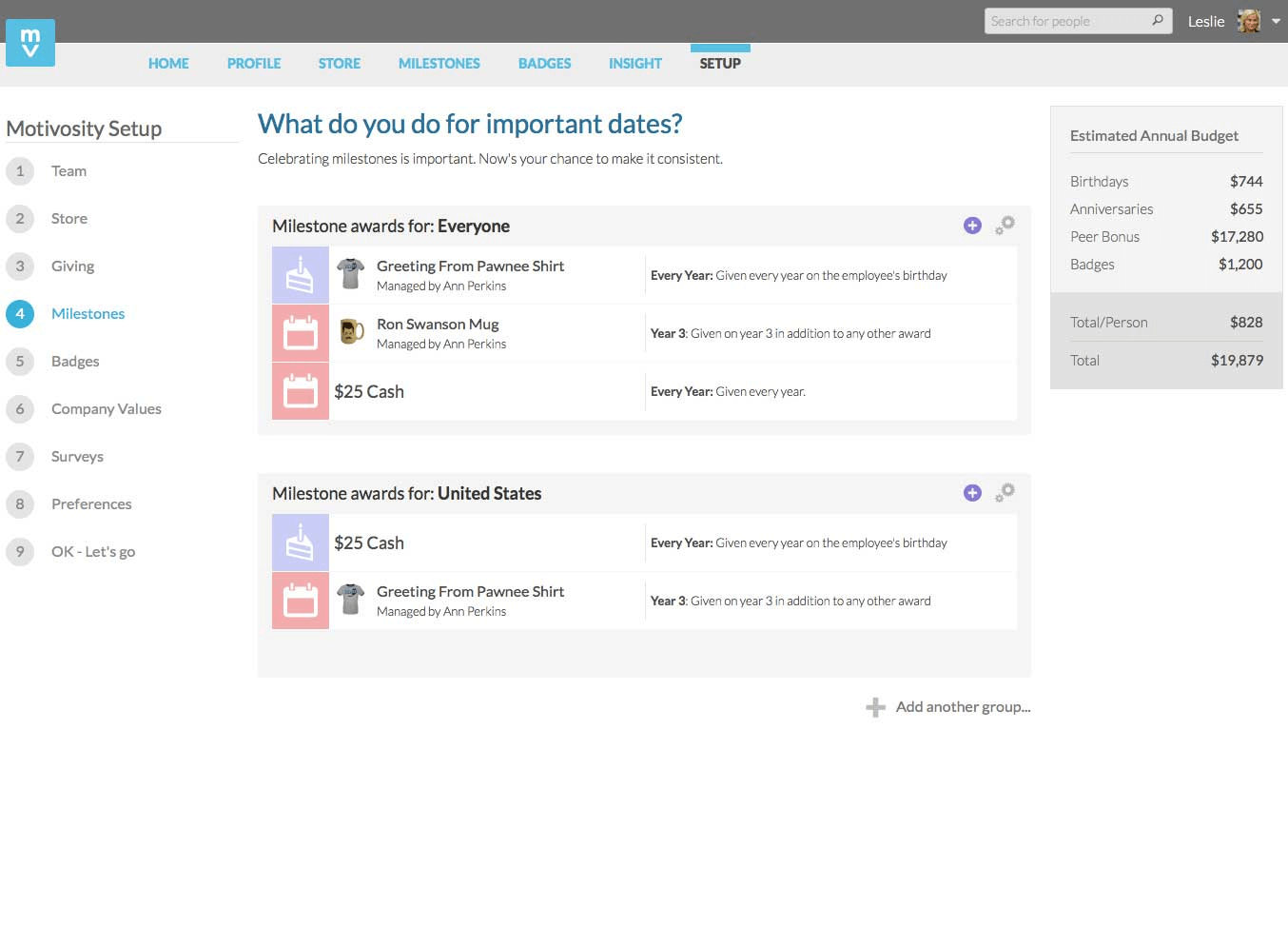
Setting milestones in Motivosity (Source)
Types of recognition supported: Thank you, P2P (with and without manager approval), and milestones.
Key functionality: The community builder feature not only helps maintain a peer community but also creates a “personality map” of each employee based on logical and emotional engagement during peer interactions.
For more information on Motivosity, you can read user reviews here.
Redii
Redii is a cloud-based solution for small and midsize businesses. It supports P2P awards, manager awards, team-level awards, and milestone awards, among others. It also features a “recognition wall” where employees can post their award wins. Employees can also share their achievements on different internal channels, such as Slack and Yammer.
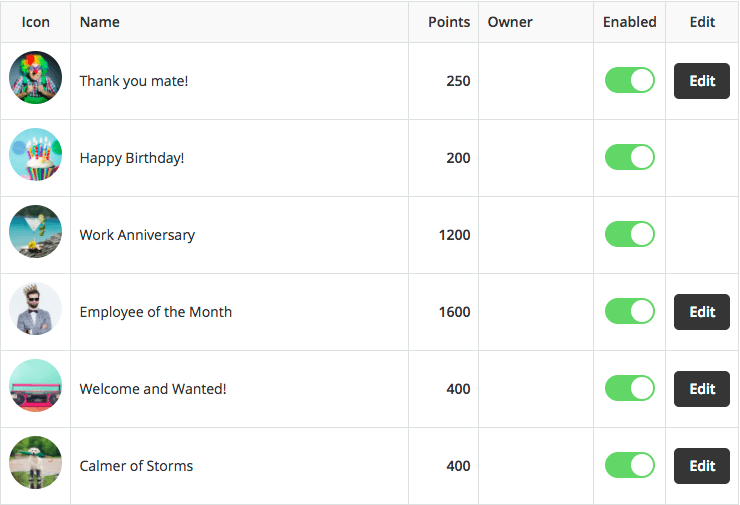
Types of recognition supported: P2P (with and without manager approval), milestones, and thank you.
Key functionality: Strategic awards is a key feature that allows you to define multiple awards based on your business values.
For more information on Redii, you can read user reviews here.
Step #3: Manually manage awards not covered by software
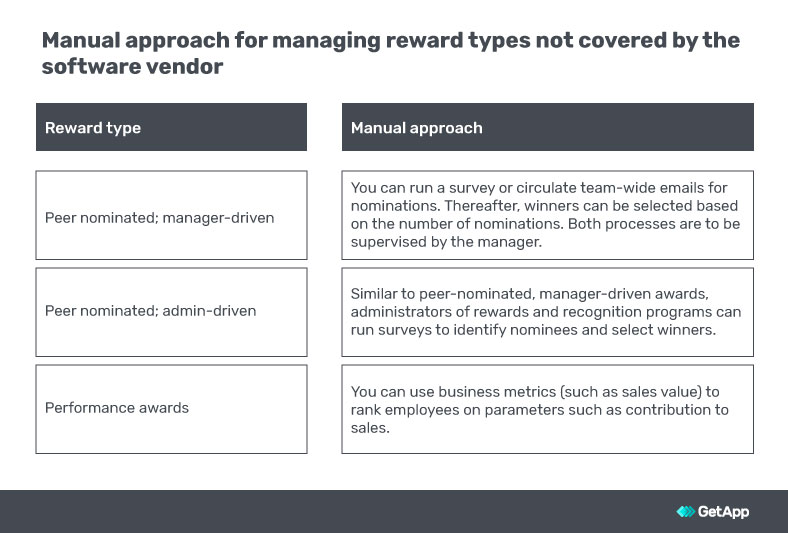
All recognition software won’t necessarily support the different recognition types discussed in this article. For overseeing such awards, you can adopt a manual approach. For instance, if end-of-year awards are not supported by your preferred software, you’ll have to manage them manually.
We recommend using the following manual approach for the various recognition types we’ve discussed in this guide:
Considerations for ensuring long-term success of a rewards and recognition program
Our three-step approach will help you get started with an employee recognition program of your own, but there are some important considerations that you’ll need to keep in mind to ensure long-term success for your program. Let’s learn more about these key considerations.
Designate the right personnel for program management: Select the right people in the HR team to run your rewards and recognition program. The role involves administering software solutions, deciding on a budget, coordinating with managers for formulating and updating recognition policies, and measuring improvement in employee engagement.
Track engagement metrics at both team and organization levels: Rewards and recognition solutions that offer built-in engagement surveys can help monitor employee engagement levels. However, if your rewards and recognition solution doesn’t offer the survey functionality, you may have to consider using a survey solution separately. You can find some free survey tools .
Promote your rewards and recognition program: While it’s important to create an optimal program, it’s equally important to educate your employees about the program. Ensure thorough participation by advising HR managers, team managers, and senior management to encourage their teammates to participate in these programs.
Gather employee feedback regularly: Run company-wide surveys to understand employee sentiments on your existing program and take feedback on how the program can be improved. We recommend conducting these surveys once every six months.
Product selection methodology
Harshit Srivastava
More on Human Resources

Jul 09, 2024
Jan 17, 2024