GetApp offers objective, independent research and verified user reviews. We may earn a referral fee when you visit a vendor through our links.
Our commitment
Independent research methodology
Our researchers use a mix of verified reviews, independent research, and objective methodologies to bring you selection and ranking information you can trust. While we may earn a referral fee when you visit a provider through our links or speak to an advisor, this has no influence on our research or methodology.
Verified user reviews
GetApp maintains a proprietary database of millions of in-depth, verified user reviews across thousands of products in hundreds of software categories. Our data scientists apply advanced modeling techniques to identify key insights about products based on those reviews. We may also share aggregated ratings and select excerpts from those reviews throughout our site.
Our human moderators verify that reviewers are real people and that reviews are authentic. They use leading tech to analyze text quality and to detect plagiarism and generative AI.
How GetApp ensures transparency
GetApp lists all providers across its website—not just those that pay us—so that users can make informed purchase decisions. GetApp is free for users. Software providers pay us for sponsored profiles to receive web traffic and sales opportunities. Sponsored profiles include a link-out icon that takes users to the provider’s website.
What Is a Workplace Well-Being Program? Find Out With This Comprehensive Guide
When we hear “employee well-being program” we think fitness classes & nutrition coaching, but today’s wellness initiatives need to take a more holistic approach to include support for employees’ physical, mental, social, financial, and professional health.


As an HR professional, part of your job is to improve the employee experience. A positive employee experience helps retain top talent, promote employee engagement, and make for an overall happier workplace. One of the most impactful initiatives you may not have considered is a workplace well-being program.
What is a workplace well-being program?
At their core, workplace well-being programs (also known as employee well-being programs or wellness programs) promote healthy lifestyles for your employees.
Launching (or updating) a workplace well-being program is a great way to improve the employee experience at your organization. But in order for your program to be successful, you’ll need to understand what these initiatives typically include and how you can optimize yours to meet the unique needs of your employees.
The most effective well-being programs are holistic, which means they offer resources to support employees in five different areas: mental health, physical health, career development, financial support, and community well-being.
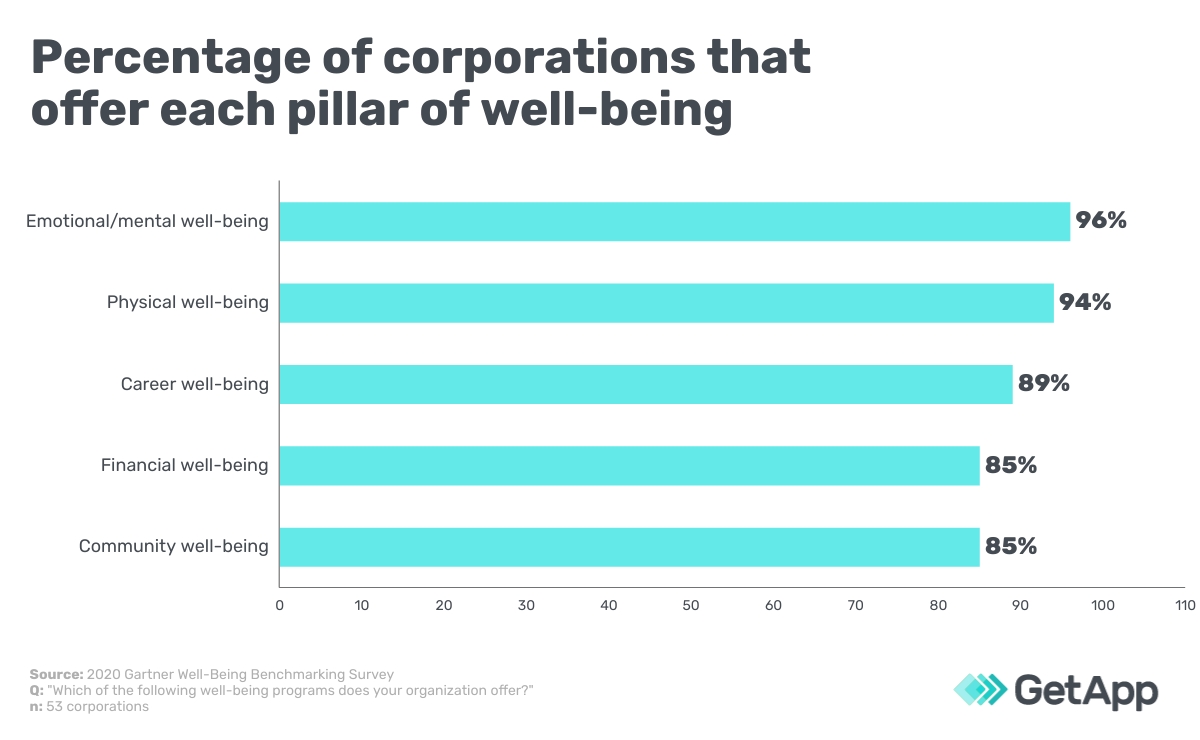
Research from Gartner shows that a majority of corporations with employee wellness programs include offerings that address each of these pillars. And while the makeup of your organization’s program may look different than what’s on the graph, these pillars (along with your employees’ feedback) provide a solid foundation to build your well-being program from.
In this guide, we’ll walk you through each of the pillars that make up a holistic workplace well-being program and provide recommendations that will help you prepare to launch your own.
The 5 pillars of an effective workplace well-being program
1. Mental and emotional health
For the first time, mental health has replaced physical health as the most commonly offered employee well-being program. In fact, a survey from Gartner found that 96% of organizations currently offer a program in this pillar (full content available to clients).
When you look at the numbers, it’s no wonder why mental well-being has become a top priority for businesses. Nearly one in five adults in the United States lives with a diagnosable mental illness, and depression and anxiety disorders alone cost the global economy $1 trillion a year in lost productivity.
Of course, the best mental well-being benefit you can offer is health insurance that covers treatment for mental illnesses. Even still, providing additional resources helps break through the stigma that surrounded conversations about mental health in the past, and it also conveys that the mental well-being of your employees is a priority for you as an employer.
With that, here are some examples of mental health benefits you can offer as part of a holistic well-being program:
Employee assistance programs (EAPs)
Counseling services
Mental health education or classes
Mental health self-care tools
Support groups
In fact, wellness support in the form of virtual offerings is becoming more and more accessible. For instance, wellness software, such as LifeWorks, makes it easier for employees to seek help in a convenient manner.

2. Physical health
According to Gartner’s survey, physical well-being programs are now the second-most commonly offered category of well-being programs, with 94% of organizations offering them (full source available to clients).
When employees aren’t well, they’re more likely to show up to work and be disengaged (presenteeism) or have an unscheduled absence (absenteeism). Both of these circumstances are bad for business, but offering programs that improve physical well-being can help minimize how frequently they happen.
On-site gym or exercise classes
Nutrition/healthy diet promotion
On-site vaccinations
Ergonomic support
Exercise competitions
Tobacco cessation programs
Fitness-related reimbursements or subsidiaries
Health education
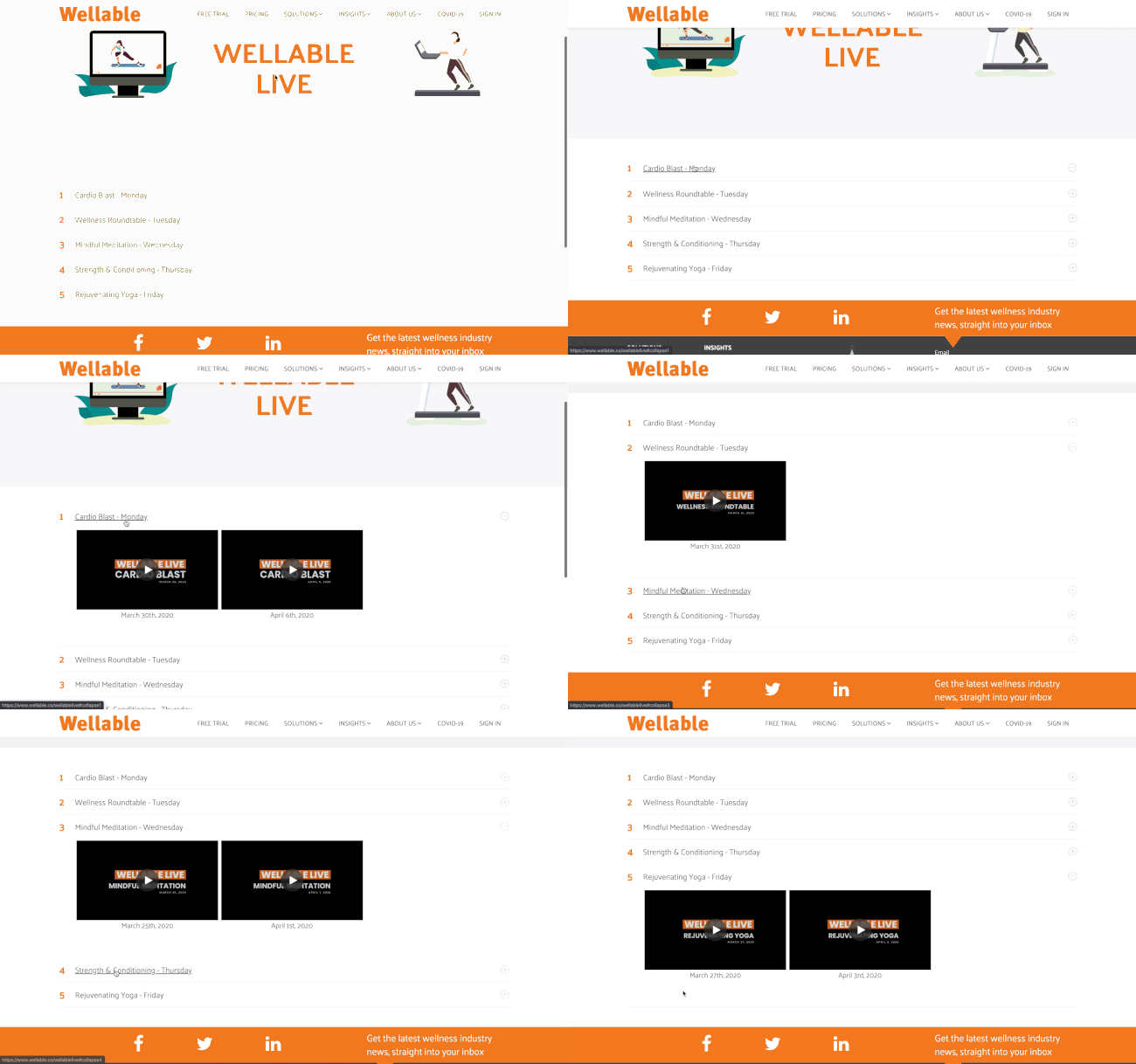
Here are some examples of initiatives related to physical health you can invest in as a part of a holistic well-being program:
It’s worth mentioning that these perks do not replace providing quality health insurance to your employees—they are just extra benefits that make living a balanced lifestyle more accessible to your employees.
3. Career development
After physical and mental well-being programs, Gartner’s survey found that career development is the most commonly offered pillar by corporations (full source available to clients). This makes sense; at the end of the day, employee wellness programs are about improving engagement, and offering development opportunities is a very effective way to do that.
In a survey conducted by GetApp this January, we asked small-business employees what will be the most important factors they consider when evaluating a new job after the pandemic. Thirty percent of respondents chose learning and development (L&D) opportunities.
It doesn’t end there: Employees are also 12 times more likely to leave a company that doesn’t offer them learning, development, and career-growth opportunities. So, investing in career development as part of your overall employee well-being program will help you reduce turnover and improve employee engagement.
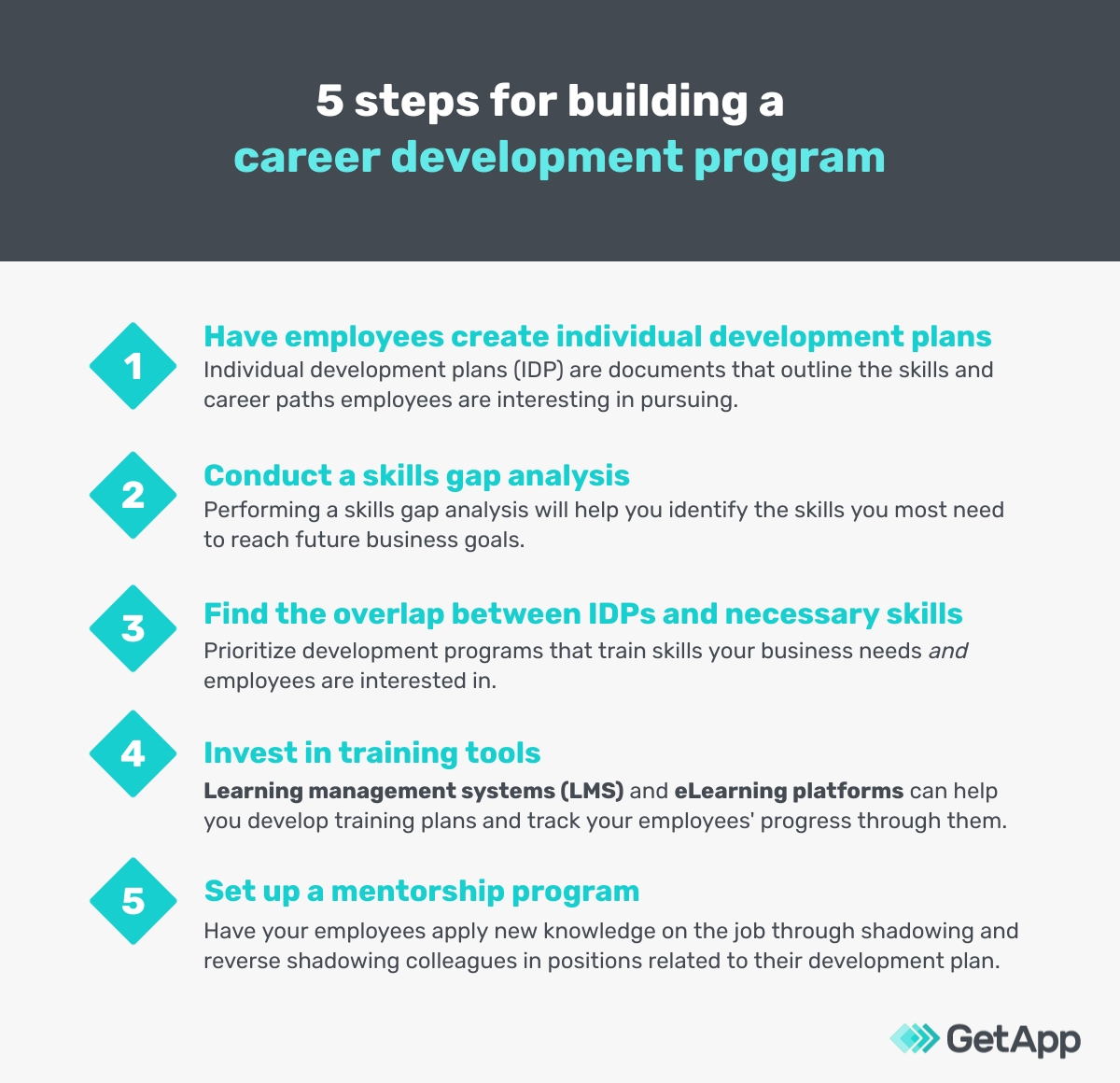
Here are 5 steps you should take to put a career development program into action:
Learn more about our survey methodology at the end of this article.
4. Financial support
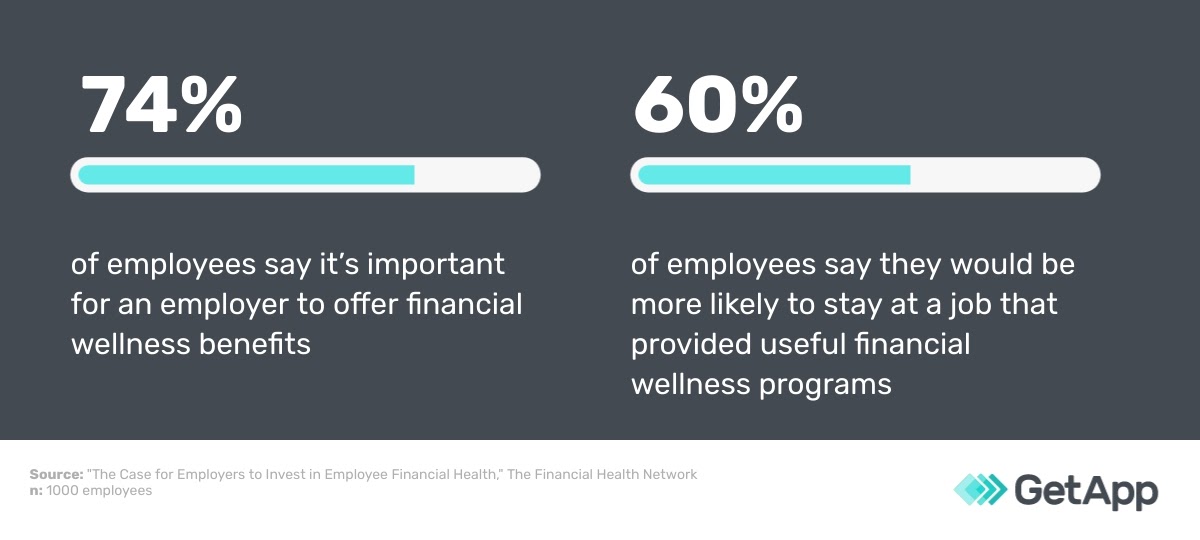
Gartner’s survey revealed that financial well-being is the fourth most commonly offered pillar of wellness programs at corporations, and with nearly one in every two U.S. employees worried about money, there’s definitely a need for it.
A financial well-being program can also help attract millennial and Gen Z employees who have faced more financial challenges, like student debt and an increased cost of living, than prior generations.
Here are some examples of financial well-being benefits you can offer as a part of a holistic well-being program:
Tuition reimbursement
Childcare reimbursement
Financial counseling/coaching
Employee assistance programs (EAPs)
Employee relief funds
5. Community involvement
Lastly, Gartner’s survey found that community well-being is the fifth most commonly offered pillar of corporate wellness programs. However, that doesn’t mean that it’s an unimportant aspect of a holistic well-being program. A majority of employees feel that it’s important to them to work in a culture that embraces community involvement.
America’s Charities Snapshot Employee Research revealed that 71% of employees feel that it’s either imperative or very important to work where culture is supportive of giving and volunteering.
As an employer, the benefits of community involvement and corporate philanthropy are numerous. For starters, these efforts can boost your reputation and employee morale, and attract quality talent to your organization.
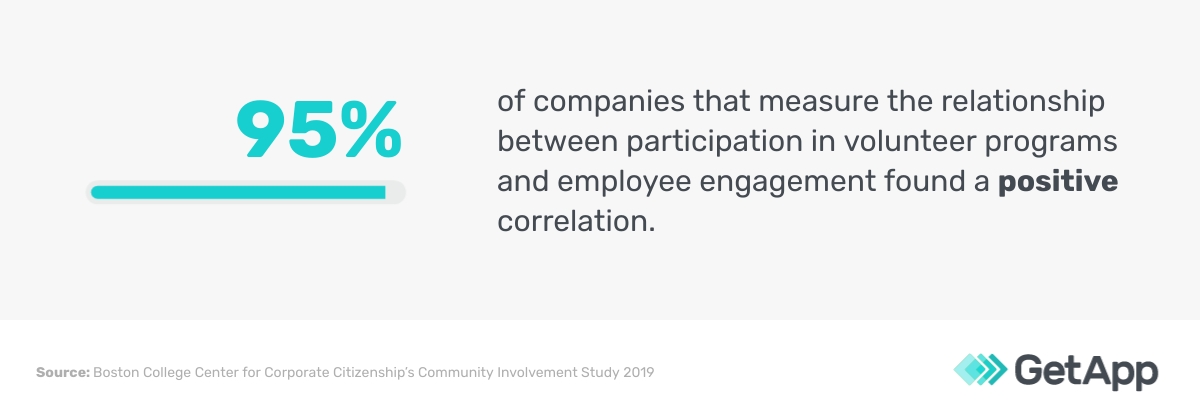
Here are some examples of community involvement programs you can offer as a part of your well-being program:
Employee volunteer days
In-kind and financial donations
Donation matching programs
Non-profit partnerships
Before you go: Check out these tips for implementing a successful employee well-being program
Investing in your employees’ well-being is a worthy cause; 48% of employees who utilize well-being programs report being highly engaged, compared to 30% of employees who do not (full content available to clients).
Hopefully this guide gave you a better understanding of what a workplace well-being program is, but before you start investing in on-site exercises classes or financial coaching, you need a plan for implementing and maintaining a wellness program.
We’ve put together eight tips that will help you start out on the right path:
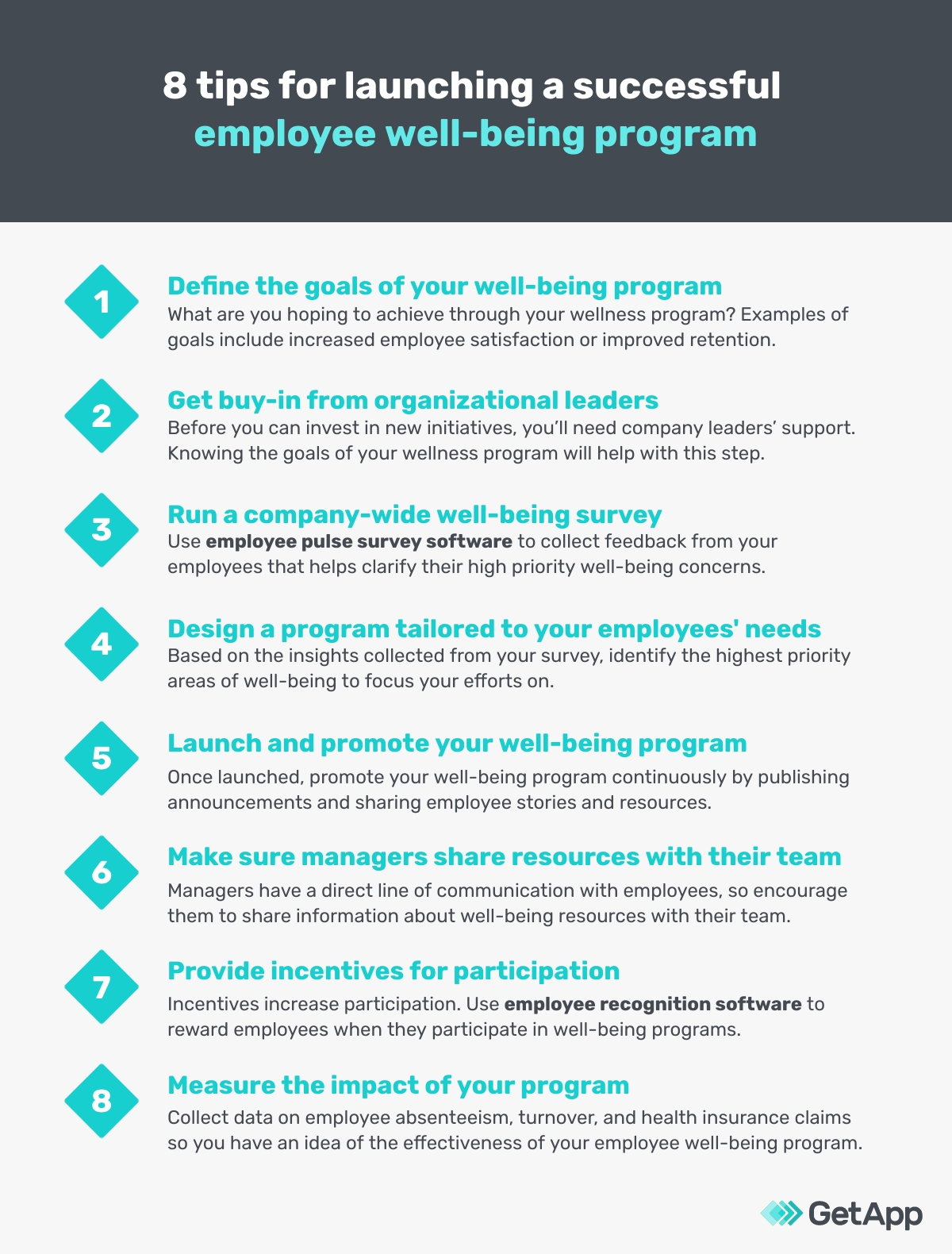
Throughout this guide, we mentioned a few tools that can help you plan, launch, and promote your well-being program.
Here’s a recap of the specific kinds of tools we mentioned and how you can use them:
Survey tools allow you to poll your employees about what kind of wellness programs they’d most likely participate in
Corporate wellness software makes it easy to launch company-wide programs related to physical or mental well-being
eLearning tools and learning management systems help you create and manage upskilling programs for your employees
Employee recognition software can incentivize participation in well-being programs by giving your employees praise and rewards
Survey methodology
The GetApp HR in the New Era Survey 2021 was conducted in January 2021. We surveyed workers at U.S. small businesses with two to 500 employees. The responses are a representative sample (by age and gender) of the U.S. population. We worded the questions to ensure that each respondent fully understood the meaning and the topic at hand.
Note: The applications selected in this article are examples to show a feature in context and are not intended as endorsements or recommendations. They have been obtained from sources believed to be reliable at the time of publication.
mentioned in this article

More on Human Resources

Jul 09, 2024
Jan 17, 2024