

GetApp offers objective, independent research and verified user reviews. We may earn a referral fee when you visit a vendor through our links.
Our commitment
Independent research methodology
Our researchers use a mix of verified reviews, independent research, and objective methodologies to bring you selection and ranking information you can trust. While we may earn a referral fee when you visit a provider through our links or speak to an advisor, this has no influence on our research or methodology.
Verified user reviews
GetApp maintains a proprietary database of millions of in-depth, verified user reviews across thousands of products in hundreds of software categories. Our data scientists apply advanced modeling techniques to identify key insights about products based on those reviews. We may also share aggregated ratings and select excerpts from those reviews throughout our site.
Our human moderators verify that reviewers are real people and that reviews are authentic. They use leading tech to analyze text quality and to detect plagiarism and generative AI.
How GetApp ensures transparency
GetApp lists all providers across its website—not just those that pay us—so that users can make informed purchase decisions. GetApp is free for users. Software providers pay us for sponsored profiles to receive web traffic and sales opportunities. Sponsored profiles include a link-out icon that takes users to the provider’s website.
6 Top-Rated Affordable eCommerce Software
Explore affordable eCommerce software to efficiently carry out online store processes.


Starting an online store can be exciting. However, ensuring a professional and feature-rich online store while balancing budget limitations can be difficult for eCommerce business owners, especially those who are just starting out or have limited technical expertise. An affordable eCommerce solution solves these problems by providing a comprehensive set of tools—from product listing and inventory management to secure payment processing, without breaking the bank.
Despite all the benefits an affordable eCommerce solution has to offer, finding the right tool can be confusing, given all the options available in the market.
To help you with your search, this article lists six top-rated affordable eCommerce software based on verified user reviews and the base or standard pricing found on vendor websites. Per our research, we’ve considered products priced less than $23.89 per month as affordable software and arranged them in ascending order of their prices.
The tools listed below have been grouped into two categories—dedicated eCommerce software and other types of software (such as a business operating system or website builder) with eCommerce capabilities. Nonetheless, all products offer website and order management as common features.
What is a base software plan?
A base plan is the most affordable pricing tier offered by a software provider. Besides having the lowest price, base plans provide access to all core software features. However, they may have limitations compared to higher-tier plans in terms of the available functionality, storage capacity, number of user seats, support options, etc.
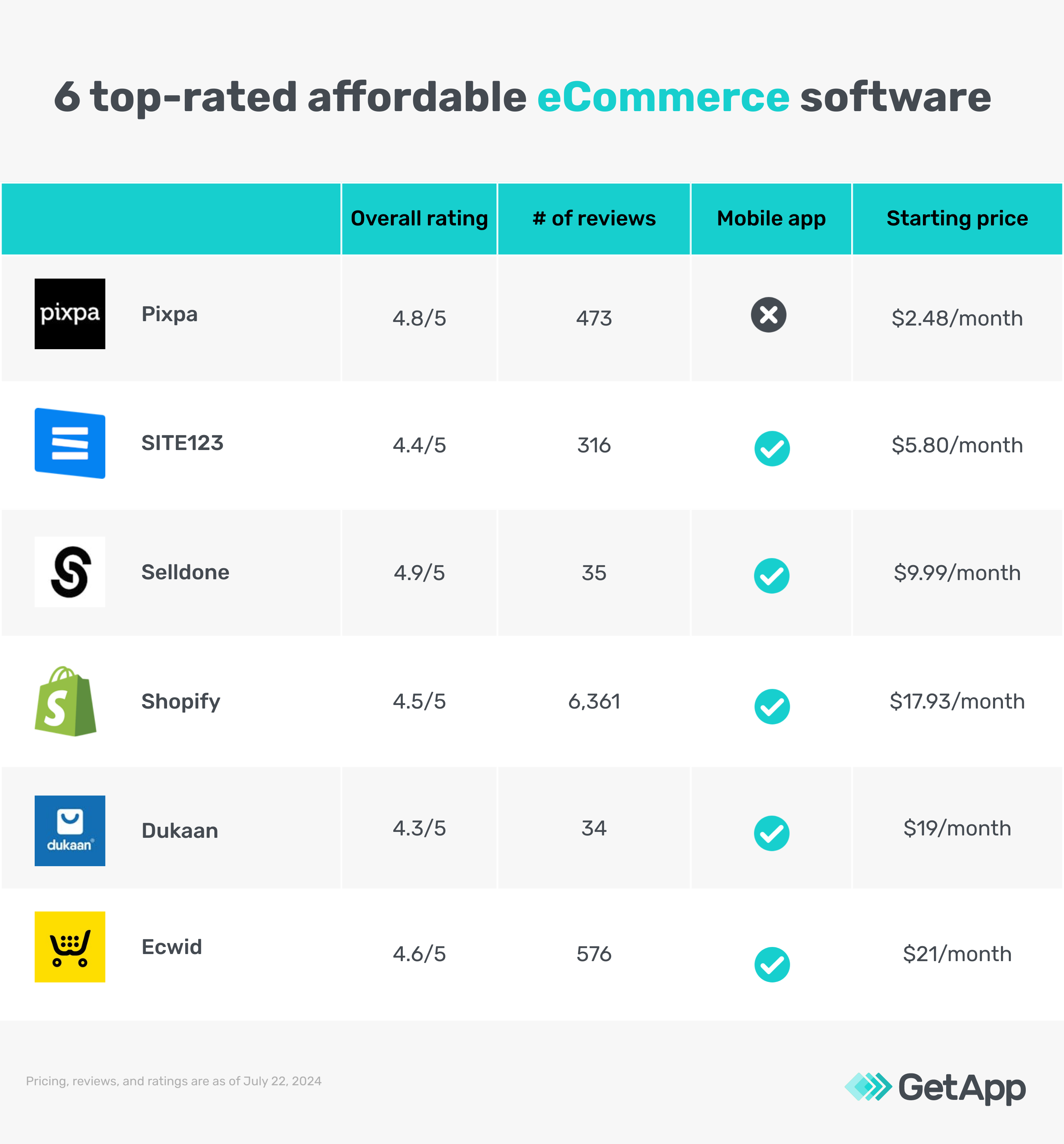
We selected products for this article based on their average ratings between July 2022 to July 2024, which may differ from their current overall average ratings.
1. Pixpa
Pixpa is an online website builder that also allows you to create digital stores and sell products online. You can leverage the tool to create and manage discount codes for customers in their online store. The software allows you to create three different types of discounts—percentage discount, flat amount discount, and free shipping discount. Additionally, you can set a minimum cart value for customers who are making use of these discounts and even define the validity period for the discount.
The base plan of Pixpa allows you to sell up to three products online and offers up to 3GB storage for images and files. You need to upgrade to the higher-priced plan if you need to sell more products or need additional data storage capacity.
Base plan features:*
Guest checkout: Provide a faster checkout experience by allowing customers to purchase without creating or logging into a store account. With Pixpa, you can enable/disable customer accounts on your store, making it either optional or mandatory for customers to create a store account for checkout.
Product options: Create product variants based on different parameters, such as size, shape, and color. The feature allows you to provide the full range of product options to customers and set individual prices for each variant, letting customers see and choose what they need.
Shipping management: Manage taxes and shipping rates for different countries and states/regions. You can leverage the feature to apply tax inclusive or exclusive of the product price, and even specify whether the tax would apply to digital downloads/services or not.
Starting price: $2.48 per month**
Cost to upgrade: $3.73 per month
Billing cycle: Annual
Customer support options: Chat, email, and online inquiry form
**Converted from INR to USD on July 22, 2024 using xe.com
Who should consider Pixpa?
Small-business owners looking to increase their online sales can consider Pixpa to run promotions and sales in their store. The software allows users to create various discount codes without any coding knowledge or any prior eCommerce experience. The built-in discount coupon feature in Pixpa not only eliminates the need for additional software but also allows users to target specific products or collections with discounts, increasing sales and clearing out slow-moving items.
2. SITE123
SITE123 is an eCommerce website builder that also lets you design and manage an online store. The software supports over 80 currencies, including internationally and locally-accepted currencies, allowing you to accept payments in customers’ preferred currencies. Likewise, you can also set multiple payment methods, such as bank deposits, money orders, digital wallets, and credit cards to cater to a wider audience and ensure a smooth checkout experience.
SITE123 offers only one premium plan other than a free plan. It allows you to access all features required to create and manage an online store in its high-end plan.
Base plan features:*
Product categorization: Organize your online store’s products in a way that makes them easy for customers to find. You can create categories to group similar items together, assign each product to one or more categories, and use categories to create menus or dropdown lists on your store’s website.
Inventory management: Select whether you wish to manually or automatically track physical products as they are sold. The feature automatically notifies you of low stock so you can resupply as needed.
Store design: Select from a variety of professionally-designed store website templates to launch your eCommerce business. These templates can be customized with different elements and can be used on mobile device screens.
Starting price: $5.80 per month
Cost to upgrade: Not available
Billing cycle: Monthly
Customer support options: Chat and online support center
Who should consider SITE123?
eCommerce business owners looking to sell globally can opt for SITE123 as it helps users pick their desired currency and set different currency and payment methods for international customers. Some of the currencies supported by the tool include the U.S. dollar (USD), Great Britain pound (GBP), the euro (EUR), and Japanese yen (JPY). By supporting different currency types, the software helps users enhance the global reach of their eCommerce platform, allowing customers to view prices and make payments in their local currency. This also fosters an inclusive and user-friendly shopping experience for customers.
Pro tip
Select a tool that allows users to manage their product catalog within an online store. The software should facilitate the creation, categorization, and management of product listings with detailed descriptions, images, and pricing.
3. Selldone
Selldone is an online business operating system that leverages artificial intelligence (AI) to help you create content for products, design landing pages, translate content on your eCommerce website, and create personalized experiences for customers across multiple devices. It also allows you to automatically suggest related products to customers based on their behavior and order history. Selldone also offers search engine optimization tools (SEO), such as meta tags and image optimization, to increase the visibility of your business.
The base plan of Selldone supports up to five administrators and one custom domain, allowing you to set your own unique web address for your online store instead of the default Selldone subdomain. For enhancement of your own domain or administrator limits, you will have to invest in the tool’s higher-priced plan.
Base plan features:*
Tax calculation: Automatically calculate tax based on customers’ location and product taxability. The feature lets you define tax rules for different product categories or individual items, reducing the risk of errors and saving time from manual calculations.
Return management: Simplify the process of handling customer product returns within your online store. The feature lets you check the list of all returned products, including physical and virtual products in the return window, edit the list, and accept/reject return requests.
Smart report: Receive weekly and annual periodic reports on store weaknesses, users, sales, growth, customer engagement, and more. The feature offers real-time information via email for better commerce management.
Starting price: $9.99 per month, 1.5% online payment fee
Cost to upgrade: $69 per month, 1% online payment fee
Billing cycle: Annual
Customer support options: Phone, email, and chat
Who should consider Selldone?
Selldone can be a viable option for eCommerce business owners looking for a tool with AI capabilities for managing their online marketplaces. The software offers an AI engine called “magic builder” that helps users quickly set up their online business—from unique landing pages to payments and incentives, saving time and effort in the process. Users can also leverage the software’s AI capabilities to anticipate their customers’ next move, automate marketing campaign optimization, and analyze large chunks of content within online customer conversations.
4. Shopify
Shopify is a dedicated eCommerce platform that allows you to sell unlimited products and services as desired. The software offers an abandoned cart recovery feature that automatically sends emails to customers who leave the store without completing the checkout process. This email contains a link to the customer’s abandoned cart, allowing them to complete their checkout hassle-free. You can also choose to manually send an abandoned checkout email to a customer.
The base plan of Shopify offers all the necessary features that help eCommerce store owners create and manage their online stores. However, it does not support additional staff accounts. If you want to enlist your staff’s help and manage the store by providing them access to relevant information, you need to upgrade to the higher version of the plan.
Base plan features:*
Reports and analytics: Review your store’s recent activity, including transactions, visitors, and performance using over 60 reports offered by the tool. You can also export the data to a spreadsheet to visualize data in different ways or perform further analysis.
Checkout capacity: Let more shoppers checkout simultaneously during big sales events. You can also assign anyone who exceeds capacity to a waiting room queue. On average, the software is able to process 4000 checkouts per minute.
Customer segmentation: Group customers with similar characteristics into a customer segment. You can build customer segments based on a wide range of factors, including their age, gender, location, industry, and previously purchased products.
Starting price: $17.93 per month**
Cost to upgrade: $66.92 per month
Billing cycle: Annual
Customer support options: Chat, help center, and online community forum
**Converted from INR to USD on July 22, 2024 using xe.com
Who should consider Shopify?
Shopify can be a good option for eCommerce managers who are more focused on recovering lost sales from abandoned carts. Shopify’s abandoned cart feature offers customers a second chance to complete a purchase, aiding in increasing sales for store owners. It also offers an abandoned checkout email report that helps users understand the effectiveness of reminder emails in terms of bringing customers back to finish the transaction. This report provides insights into sessions and completed orders that have resulted from these emails. Users can also review information, such as conversion rates, total amount of sales, and average order value.
Pro tip
Consider an eCommerce tool with robust security features, such as data encryption, firewall protection, regular security audits, two-factor authentication (2FA), and secure payment gateways. These features help protect customer data and ensure secure transactions.
5. Dukaan
Dukaan is another eCommerce platform that offers pre-designed templates to help you launch your online stores. The software also comes with product and catalog management features, including bulk catalog operations and inventory management to help you upload products in bulk, manage stock levels, and prevent overselling and stockouts. Additionally, it offers a dedicated plugin for managing product filters, based on different attributes such as category, price range, and brand. This is essential for organizing product catalog and enhancing product searchability within an online store.
The tool allows you to create a single store in its base plan. However, as you upgrade to the higher-priced version, you can manage multiple storefronts from a single platform, which is ideal for diverse product lines.
Base plan features:*
Custom pages: Create additional pages beyond your standard product listings and checkout process—these may include pages for FAQs, contact information, and company history. The feature helps you provide valuable information to customers and optimize these pages for SEO to boost search engine ranking.
Customer notifications: Send timely WhatsApp notifications to customers about their order status, offers, and updates. This feature helps you build trust and enhance overall customer satisfaction.
Real-time shipping rates: Calculate shipping costs in real time and provide accurate rates to customers, ensuring transparency in prices. You can also integrate the tool with popular shipping carriers to manage shipping processes.
Starting price: $19 per month
Cost to upgrade: $49 per month
Billing cycle: Monthly
Customer support options: Chat, help center, and online inquiry form
Who should consider Dukaan?
eCommerce managers looking to customize their eCommerce stores with different themes or pre-designed templates can go for Dukaan. The software offers a “themes” marketplace where users can find themes tailored to their business. These themes can be customized with different fonts, colors, and sections using an online theme editor. Moreover, these are designed to look and function well on smartphones and tablets, ensuring easy navigation, clear product display, and smooth checkout process even on smaller screens.
6. Ecwid
Ecwid is an eCommerce tool that helps you sell online and in-person. The software allows you to create custom fields to collect additional information, such as country-specific tax IDs, notes on order fulfillment, or any other information that you may want from customers at the time of checkout. You can add as many custom fields as you want to your checkout page. The information that your customers submit via these fields automatically appears in the order details.
The base plan of the tool allows you to sell goods on Instagram and Facebook. However, if you wish to list your inventory on popular marketplaces, such as Amazon and Walmart, and need support for multiple languages, you need to invest in the higher version of the tool.
Base plan features:*
Advanced reports: Get detailed insights into your store’s performance, including the time visitors spend in your store, the device they use to browse your store, items sold during a specific period, and more. You can also choose a specific period and compare it with the same period in the previous week, months, or year.
Multiple site pages: Add various pages to your Ecwid store to provide valuable information to customers and improve the overall customer experience. You can add pages that provide information related to privacy policy, terms and conditions, business contact info, and more.
Store management apps: Manage the entire order fulfillment process via Android and iOS mobile apps. You can leverage the app to find orders by customers, numbers, and other specifics. Additionally, you can view order details, check shipping statuses, update catalog items, and change product availability, all from your mobile phone.
Starting price: $21 per month
Cost to upgrade: $39 per month
Billing cycle: Annual
Customer support options: Phone, email, and chat
Who should consider Ecwid?
eCommerce business owners looking to optimize the checkout process to collect specific customer information for analysis/marketing purposes can opt for Ecwid. The software, with a customized checkout in place, allows users to create, sort, and enable/disable custom fields which can help managers gather valuable customer data and create a consistent brand experience throughout the checkout process. The tool can also benefit on-the-go entrepreneurs looking to manage multiple aspects of their business, including inventory management, order management, and customer communication via their mobile phones.
Pro tip
Shortlist an eCommerce platform that is optimized for usability and functionality on mobile devices. Features, such as a responsive design, fast loading times, and support for mobile payments can enable a user-friendly experience for mobile shoppers.
Top 5 eCommerce software features users rate as highly critical
Reviewers of eCommerce software emphasize the critical importance of the following features. To identify these features, we asked users to rate, on a scale of “low importance” to “critical,” how important different features are for eCommerce software. The features showcased are those that the highest percentage of reviewers rated as “highly important” or “critical” over the past two years (as of July 22, 2024).
| Feature name | Criticality rating (%) | Description |
|---|---|---|
| Electronic payments | 88% | Allows customers to securely and conveniently pay for their purchases. The feature integrates multiple payment gateways, such as debit/credit cards and digital wallets, to accommodate customers’ preferred payment methods. |
| Website management | 87% | Offers a set of tools to help businesses create, maintain, and optimize their online stores. It also allows users to manage their website design and improve search engine rankings via search engine optimization (SEO) abilities. |
| Shopping cart | 83% | Enables customers to select, review, and manage products that they wish to purchase before proceeding with checkout. This feature offers a “virtual basket” to help customers add items, adjust quantities, and remove products. |
| Data security | 82% | Safeguard sensitive customer information and transaction data from unauthorized access and cyber threats. The feature includes encryption protocols and compliance with industry standards, such as payment card industry data security standard (PCI-DSS) to ensure adherence to best security practices. |
| Order management | 82% | Simplifies the entire order processing lifecycle. The feature facilitates order creation, tracking, fulfillment, and customer communication, providing real-time status updates to both customers and administrators. It also allows businesses to manage inventory levels, handle returns, and generate online invoices. |
How much does eCommerce software cost?
An eCommerce tool can cost as low as $2.48 per month or up to $359+ per month, depending on various factors—features, transaction fees, deployment options, customizations, integrations, and more. Most eCommerce solutions typically include the following pricing plans:
Free trials: Range from three to 30 days and give users access to either all or limited features of the software. These no-cost trial plans are ideal for small businesses that wish to try out a tool before purchasing it.
Free versions: Offer perpetual access to limited software features. These free plans are ideal for businesses on a budget.
Entry-level plans: These plans start at $2.48 per month and offer access to standard features. They are suitable for businesses with basic feature requirements, such as website management, shopping cart, payment processing, and order management.
Mid-tier plans: Ranging from $3.73 to $69 per month, the mid-tier plans offer advanced features such as dynamic pricing, multi-currency support, customer relationship management (CRM) integration, and multi-channel selling. These are suitable for businesses that have outgrown entry-level eCommerce solutions but don’t require the full range of functionality offered by enterprise-level tools.
High-end plans: These plans cost more than $359 per month and offer a range of advanced features, including advanced analytics, enhanced data security, global shipping support, AI-generated content creation, predictive inventory management, and more. These are suitable for large businesses.
Hidden costs associated with affordable eCommerce software
Besides the license, additional costs can include:
Transaction fees: Several eCommerce platforms charge transaction fees for each sale processed through their system, adding to the original cost.
Customization expenses: Customizing the platform to fit specific needs, whether through design changes, new features, or unique workflows often requires hiring developers or purchasing plugins, leading to additional expenses.
Maintenance and support: Ongoing maintenance, including bug fixes, updates, and technical support may incur additional costs.
Frequently asked questions when selecting eCommerce software
Here are some questions to ask software providers to find the best eCommerce software for your needs:
Does the software offer customization options for my store’s design and layout?
The best eCommerce platform offers a variety of pre-designed themes or templates that can be customized as per specific business requirements. Users can change colors, fonts, and arrangement of elements on an existing template to match their brand. Several tools also allow users to control how product information and images are displayed. Understanding these can help eCommerce business owners create an online store that truly represents their business.
Does the platform support multiple sales channels?
Selling on multiple platforms exposes products to a wider audience. Before finalizing the purchase of the best eCommerce platform, make sure that the software allows the business to sell its products on online marketplaces (Amazon, eBay, and Walmart), and social media platforms (Facebook, Instagram, Pinterest), in addition to their own eCommerce website. This can help users build brand awareness across multiple platforms and increase overall sales by reaching customers at their preferred shopping destination.
What are the included marketing and SEO tools?
Several eCommerce platforms offer SEO tools, such as on-page optimization, keyword suggestions, and image optimization to optimize content, images, and product listings on the website. These help users increase their visibility and attract more visitors from search engines. Likewise, marketing tools, such as email marketing, discount codes and promotions, customer segmentation, and abandoned cart recovery drive sales and business growth for small businesses.
Methodology
For this article, we selected the top six products that met the following criteria:
Each product should be a part of GetApp’s Category Leaders report 2024 for eCommerce software.
We assessed all 15 products in the Category Leaders report for their monthly pricing (as of July 22, 2024) and considered the products with publicly available pricing information. Based on the assessment, the average price was calculated to be $23.89. Products with a monthly subscription price lower than $23.89 were then shortlisted to be included in this list and arranged in ascending order.
Each product must include categorization, order management, shopping cart, and website management as core features.
Each product must meet our market definition for eCommerce software: “eCommerce software enables businesses to conduct transactions for goods and services wholly or partially over the Internet. Typical features for eCommerce applications include online shopping carts, product cataloging, customer accounts, order tracking, and website management. eCommerce solutions often provide integration tools for inventory control, customer relationship management, and payment processing. eCommerce software is related to order management software and point of sale software.”
*Our research team identified these features from vendor websites (as of July 22, 2024) based on their analysis of what users find valuable in or expect from eCommerce software. This list is not exhaustive. For additional features, refer to the vendor's website.
Products evaluated for the pricing calculation were taken from GetApp’s eCommerce software directory. The pricing ranges exclude freemium versions of the products. The features highlighted were identified based on their relevance and the percentage of products in the GetApp directory that offer them. Only products with publicly available pricing information, as of July 22, 2024, were considered for pricing calculation.
Editorial independence: We select and rank products based on an objective methodology developed by our research team. While some vendors may pay us when they receive web traffic or leads, this has no influence on our methodology.
mentioned in this article






More on eCommerce



Jun 13, 2024

Sep 20, 2021