GetApp offers objective, independent research and verified user reviews. We may earn a referral fee when you visit a vendor through our links.
Our commitment
Independent research methodology
Our researchers use a mix of verified reviews, independent research, and objective methodologies to bring you selection and ranking information you can trust. While we may earn a referral fee when you visit a provider through our links or speak to an advisor, this has no influence on our research or methodology.
Verified user reviews
GetApp maintains a proprietary database of millions of in-depth, verified user reviews across thousands of products in hundreds of software categories. Our data scientists apply advanced modeling techniques to identify key insights about products based on those reviews. We may also share aggregated ratings and select excerpts from those reviews throughout our site.
Our human moderators verify that reviewers are real people and that reviews are authentic. They use leading tech to analyze text quality and to detect plagiarism and generative AI.
How GetApp ensures transparency
GetApp lists all providers across its website—not just those that pay us—so that users can make informed purchase decisions. GetApp is free for users. Software providers pay us for sponsored profiles to receive web traffic and sales opportunities. Sponsored profiles include a link-out icon that takes users to the provider’s website.
What Is the Right Sales Team Structure for Your Small Business?
Learn about the three common types of sales structures and which one to use to organize your small-business sales team.


The revenue of your small-to-midsize business (SMB) depends on the strength of your sales organization, but setting up a sales structure can be challenging. Since your team is small, members may wear many hats. And if there isn’t a defined process for your team to follow, things can start getting haphazard as sales operations scale.
In this article, we’ll discuss three B2B sales team structures that startups and small businesses can use during their early years and as they grow. We’ll also explain the benefits of all three structures and how a sales leader like you can use them to develop a high-functioning sales department.
1. Island structure: Offer personalized interactions to customers
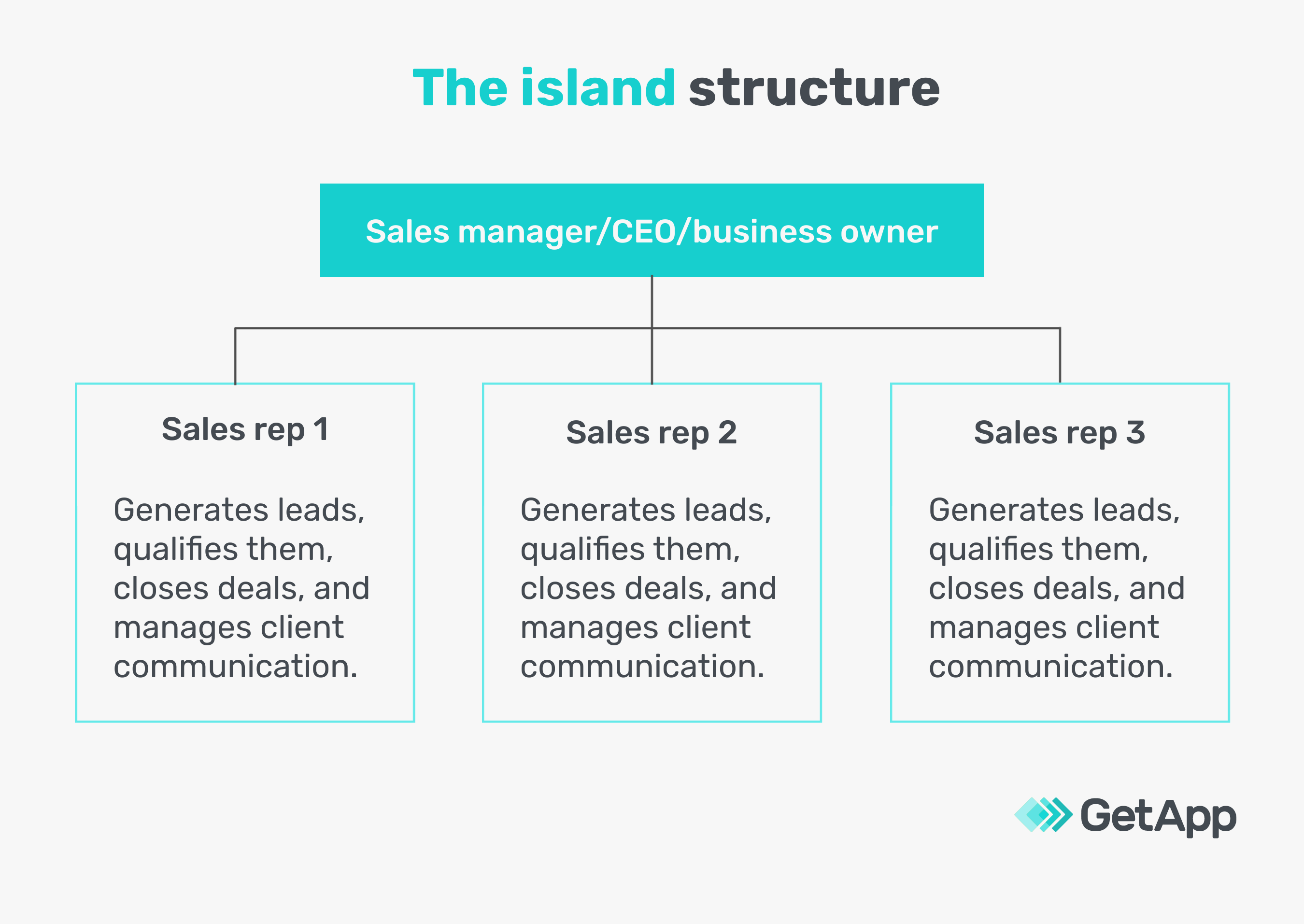
As this sales team structure’s name suggests, every salesperson in your team functions like an island, working individually on all sales tasks—from lead generation and qualification to sales closure and customer communication. Each member manages a specific client or set of clients and doesn’t interact or support others in the sales process.
In the island structure, sales reps work as individual contributors and report to a common sales manager or directly to the business owner or CEO. Every sales rep gathers leads, qualifies them, closes deals, and maintains after-sales communication with customers.
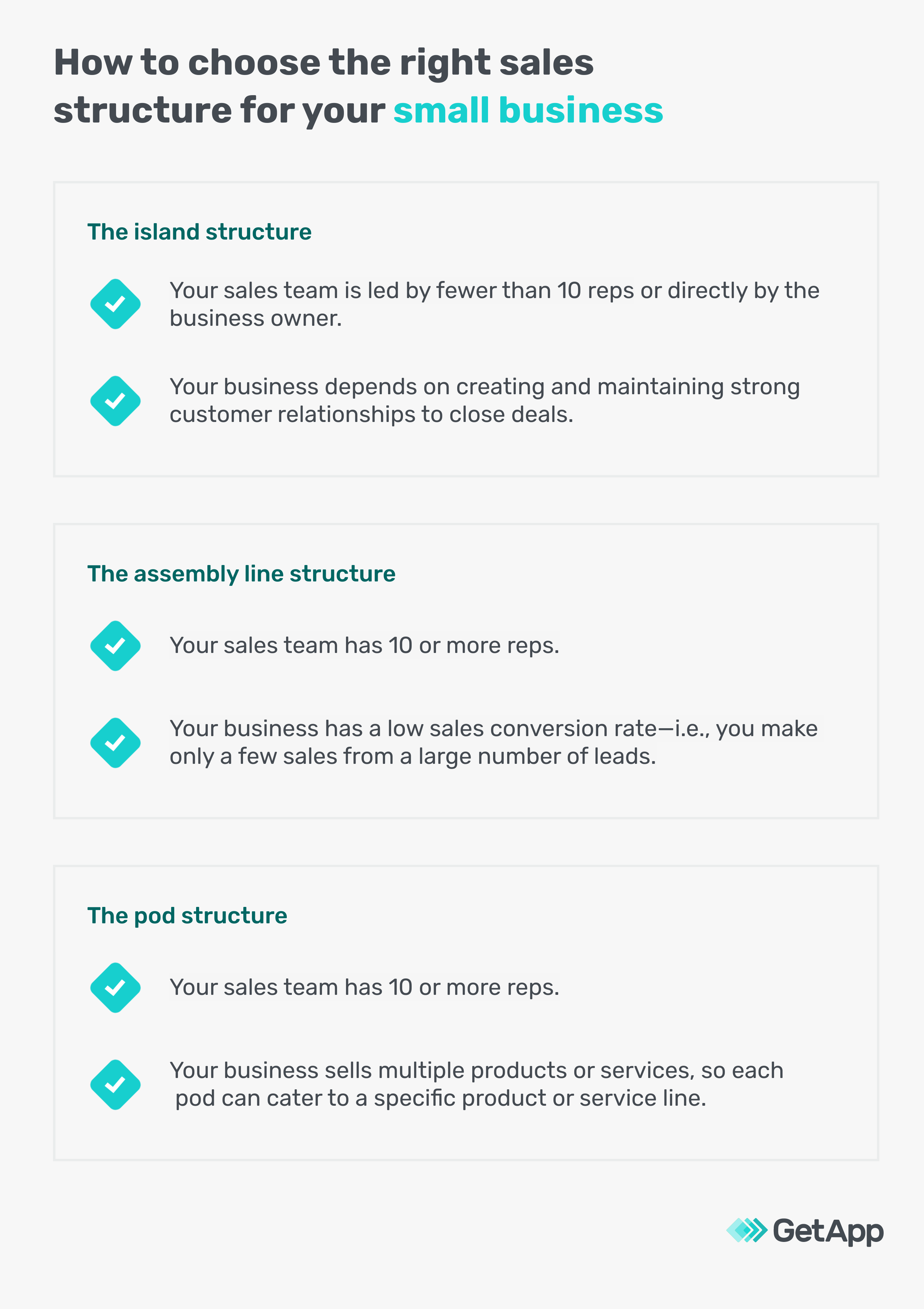
Opt for the island structure if your sales transactions need high levels of personal interactions with clients.
Things to consider when selecting the island structure
The table below provides an overview of the benefits you get and the challenges you may face when using this sales organizational structure.
| Benefits | Challenges |
|---|---|
| It’s quick and easy to set up and manage. | Hiring sales reps with multitasking skills can be difficult and costly. |
| Minimum managerial oversight is needed, as sales reps work on their own. | Fierce competition between sales reps can lead to intense work environments and high attrition rates. |
| Deeper interpersonal relationships with clients, as the same sales representative interacts with them throughout the buying process. | Due to the absence of defined sales processes, sales reps are free to use their own sales styles or methods. |
Pro tip
When hiring a sales rep for the island structure, look for the following qualities: competitive attitude, multitasking, good communication skills, go-getter attitude, and self-motivation.
2. Assembly line structure: Easily identify underperforming sales divisions
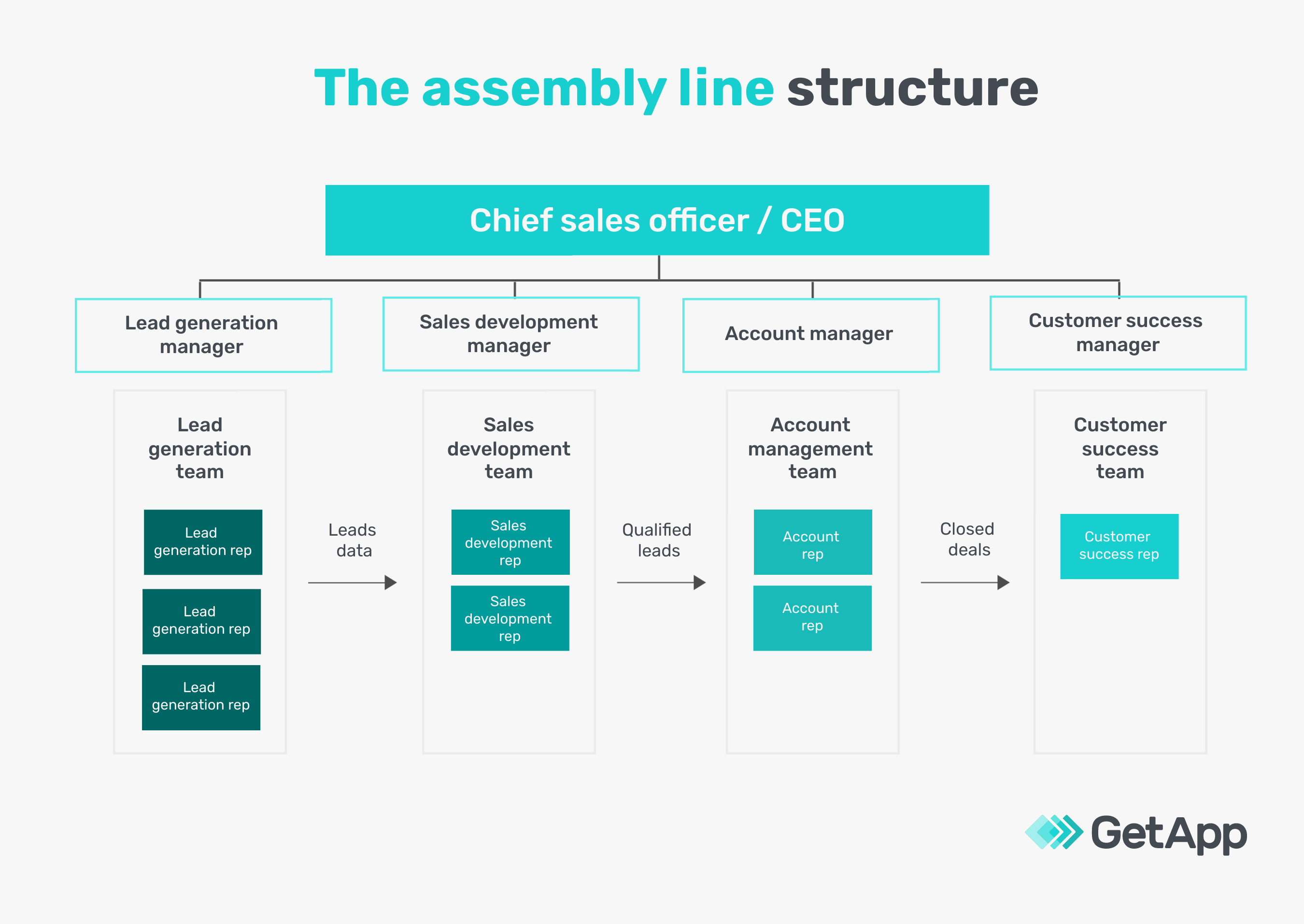
The assembly line sales structure functions similarly to the assembly lines in production units. Your sales team is divided into sub-teams or divisions working in an orderly manner to close deals. The information collected by one team is shared with the next to complete the sales process. Each sub-team or division is led by a dedicated manager and works on a specific function (e.g., lead generation, account management).
Sales divisions or sub-teams typically included in the assembly line structure are:
Lead generation team: Involved in researching prospects, collecting leads through email or web campaigns, organizing lead data, and sharing it with the sales development team.
Sales development team: Qualifies prospects through cold calling and research, and shares the list of shortlisted prospects with the account management team.
Account management team: Connects with the qualified leads to understand challenges, answer queries, schedule and give demos, and finally close the sale. It also shares details of all closed deals with the customer success team.
Customer success team: Onboards new customers, keeps in regular touch with existing customers to reduce churn, identifies upselling opportunities, and helps increase customers’ engagement with your business.
Opt for the assembly line sales structure if your business has a low sales conversion rate—i.e., you’re making only a few customers from a large number of leads.
Things to consider when selecting the assembly line structure
Here’s a quick glimpse of the benefits you can get and the challenges you may face when using this sales organizational structure.
| Benefits | Challenges |
|---|---|
| Processes are easy to understand and implement. | There can be communication and alignment issues between teams due to different sales goals or objectives. |
| As sales reps work on particular processes, they become specialized and more efficient in their specific roles. | Teams focus only on their specific tasks and don’t likely understand or know what’s going on in other sales divisions. |
| Since there’s a clear division of tasks, it’s easy to identify which sales division or funnel stage is underperforming. | More resources—employees, infrastructure, and tools—are required to set up a full-fledged assembly line sales structure. |
Pro tip
The four-team assembly structure is used most commonly, but you can have fewer or more teams per your needs. You can do with just two teams or even five based on the number of resources you have.
3. Pod structure: Ensure higher collaboration among sales staff
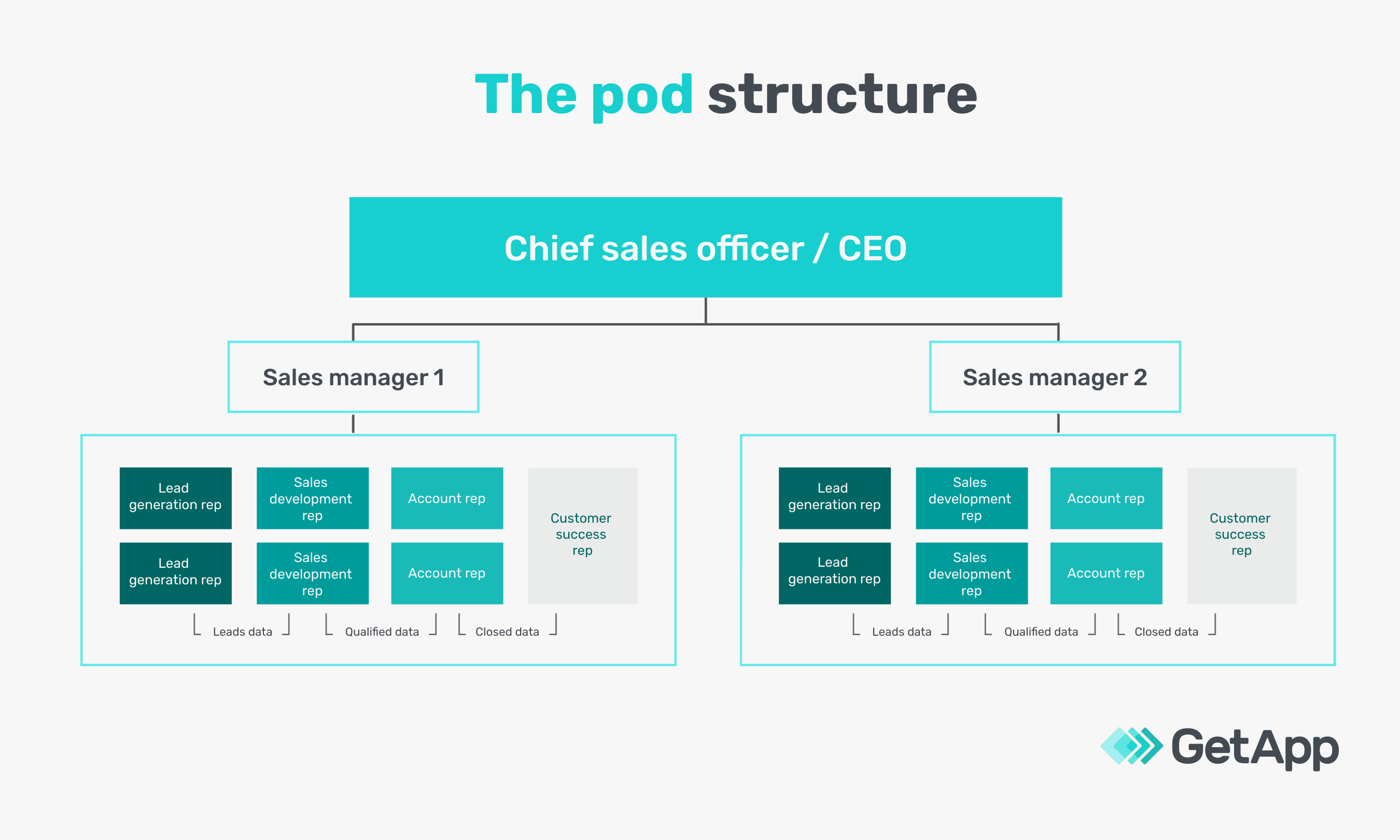
The pod structure is a combination of the island and assembly line structures. In this structure, individual sales pods—i.e., groups consisting of eight to 10 sales reps—are responsible for managing the complete sales cycle for a specific client or set of clients, just as in the island structure. However, similar to the assembly line structure, each member within the pod has a specific task assigned, such as lead generation or customer success.
In this structure, there’s better collaboration among sales staff, as the success of each pod member is tied to the success of other members in the same pod. This helps reps better understand the impact their roles have on the entire sales cycle.
Opt for the pod structure if your business caters to different types of clients or may have more than one type of product to sell.
Things to consider when selecting the pod structure
Here’s a brief overview of the benefits you can get and the challenges you may face when using this sales organization structure.
| Benefits | Challenges |
|---|---|
| An agile, flexible sales structure that improves collaboration among sales staff. | Conflict between pod members can reduce collaboration and affect sales closure rates. |
| Sales reps are motivated to participate in the entire sales process, as their success is tied to their pod’s success. | Motivating sales reps within a pod individually can be a challenge, as members don’t usually compete with each other. |
| Better collaboration among pod members results in shorter time to close. | In smaller pods, the boundaries between various tasks can get blurred, and pod members may have to work on multiple tasks, leading to less work specialization. |
Pro tip
Select the right number of members for each pod. Though there’s no magic number, consider the bottlenecks you face at each sales stage and accordingly decide how many members you need for individual sales functions. Too many or too few reps for any function can affect the success of the entire pod.
Recap: Which sales team structure should you pick?
The sales organization structure you select should not only be easy to implement but also cater to your targeted market or customer segment. To help you decide, here’s a quick recap of the different scenarios in which each of these sales team structures works best.
Besides implementing an effective structure, you should also equip your sales force with the right tools to get their jobs done. Here’s a list of tech tools you can consider investing in:
Interested in learning more about the best ways to support your sales team? Check out these articles:
Lauren Spiller