GetApp offers objective, independent research and verified user reviews. We may earn a referral fee when you visit a vendor through our links.
Our commitment
Independent research methodology
Our researchers use a mix of verified reviews, independent research, and objective methodologies to bring you selection and ranking information you can trust. While we may earn a referral fee when you visit a provider through our links or speak to an advisor, this has no influence on our research or methodology.
Verified user reviews
GetApp maintains a proprietary database of millions of in-depth, verified user reviews across thousands of products in hundreds of software categories. Our data scientists apply advanced modeling techniques to identify key insights about products based on those reviews. We may also share aggregated ratings and select excerpts from those reviews throughout our site.
Our human moderators verify that reviewers are real people and that reviews are authentic. They use leading tech to analyze text quality and to detect plagiarism and generative AI.
How GetApp ensures transparency
GetApp lists all providers across its website—not just those that pay us—so that users can make informed purchase decisions. GetApp is free for users. Software providers pay us for sponsored profiles to receive web traffic and sales opportunities. Sponsored profiles include a link-out icon that takes users to the provider’s website.
Lead Qualification: What It Is and Why Your Business Needs It
Lead qualification prioritizes your sales team’s efforts by keeping them from chasing leads that aren’t a good fit for your product or service. Learn more in this primer.


If you oversee sales or marketing for a small business, you’ve likely researched ways to generate more leads to boost your sales pipeline. But all the leads in the world won’t help you reach your sales goals if they aren’t a good fit for your product or service. And that’s why you need to shift your focus from lead generation to lead qualification.
Knowing how to qualify leads helps save time and money, and it prioritizes your sales team’s efforts by keeping them from chasing leads who aren’t likely to convert. To help you get there, we’ll walk you through the basics of lead qualification, backed by insights from Gartner, a leading global research firm. We’ll also share some tools you can use to build your own lead qualification strategy.
What is lead qualification, and why is it important?
Lead qualification is an early sales funnel activity that assesses the likelihood of a lead completing a sale and converting into a customer, according to Gartner [1]. It’s important for two reasons:
It keeps your marketing and sales teams on the same page. Almost a third of sales reps surveyed by Gartner [2] say alignment between marketing and sales is a challenge impacting lead quality.
It drives sales. When you shift your focus from unqualified leads to qualified leads, your conversion rate increases.
An unqualified lead is either a lead with whom you’re yet to establish a relationship or one who’s been vetted and determined to be unfit for your product or service. A qualified lead is the same as a prospect or an individual who’s indicated that they’re likely to make a purchase. There are four types of qualified leads, and we’ll define each in more detail below.
Types of qualified leads
Qualified leads are mainly of four types, but not all of them are ready to purchase. To optimize the bandwidth of your sales team, let's understand where these qualified leads stand in the sales funnel.
Information qualified lead (IQL)
An information qualified lead has newly entered your sales funnel by providing their contact information in exchange for content. An IQL will typically find you by searching for information on Google and is likely unfamiliar with your business. Because they don’t yet know what you’re selling, they’re unlikely to make a purchase. IQLs are also known as cold leads.
Marketing qualified lead (MQL)
A marketing qualified lead refers to a potential sales lead that has expressed interest in your product or service. They may follow you on social media or subscribe to your podcast. MQLs are yet to commit to a purchase and haven’t yet spoken to a sales rep, but because their interest indicates a likelihood of conversion, they’re also known as warm leads.
Product qualified lead (PQL)
A product qualified lead has firsthand experience with your product or service, usually as the result of a free trial or free version of your offering. Because they know the value of your product or service, they’ve progressed a step further in the sales funnel than an MQL.
Sales qualified lead (SQL)
Also known as a hot lead, a sales qualified lead refers to a prospective lead that has moved into the high probability phase of converting into a customer. Naturally progressing from an MQL or a PQL, an SQL has already expressed an interest in your business offering and has the funding capability to make an outright purchase.
What does the lead qualification process look like?
As we mentioned earlier, a well-defined lead qualification process aligns your marketing and sales teams and drives sales. But this can happen only if you take the time to establish your ideal customer profile (ICP).
Establishing your ICP means knowing what you’re looking for in a potential buyer. If you’re a business-to-business (B2B) brand, this means understanding the type of companies that would benefit the most from your offerings. For business-to-customer (B2C) companies, this means segmenting potential leads by traits such as demographics, goals, and motivation factors.
Gathering this information before you begin lead qualification is critical and will help you identify which leads are most likely to convert. Once you’ve established your ICP, move on to the following three lead qualification activities: develop a lead scoring process, research leads, and ask the right questions through a lead qualification framework.
1. Develop a lead scoring process
Gartner [3] defines lead scoring as a method of evaluating the quality of sales leads by using a relative and objective ranking of one lead against another based on a variety of ICP fit and behavior criteria. But Gartner research [4] suggests that only a small percentage of marketing-generated leads convert to closed business.
This highlights the need for a scoring model that considers what your current customers have in common as well as characteristics shared by leads that didn’t convert. These attributes may include demographics; online behavior; engagement with social media; or company size, type, and industry (if you’re B2B). We recommend marketing analytics tools to sift through all this data.
Once you identify a pattern of shared attributes, decide which to weigh most heavily. Then, assign specific criteria for each attribute. For instance, positive scoring criteria for social media engagement might include “Follows us on Instagram.” You should also have negative criteria to indicate a lead’s inability to purchase or lack of interest [4]. A negative attribute for demographics, for example, might read, “Lives in a region we don’t serve.”
Once you’ve finalized the criteria, you're ready to score your leads, and once you have the scores, you know which leads to pursue further by researching their needs and situation.
2. Research leads and record your findings
For this step, you’ll want to research everything you can about the lead you’re looking to qualify. For B2B brands, research will be focused on the buying company’s current situation, such as their funding, number of employees, problem they’re trying to solve, whether they’re currently hiring, and whether they’ve had any recent layoffs.
You’ll also want to ensure the lead you’re selling to fits your ICP. We’ll expand on this in our next section, but for instance, if you typically sell to executives and your lead oversees the marketing team, you shouldn’t progress them through your funnel. Instead, you can research a more appropriate contact to sell to.
Once you’ve researched your leads, don’t stop there. Record your findings using customer relationship management (CRM) software. The image below shows an example of a marketing automation tool with a built-in CRM database that makes collecting and accessing lead information easier.
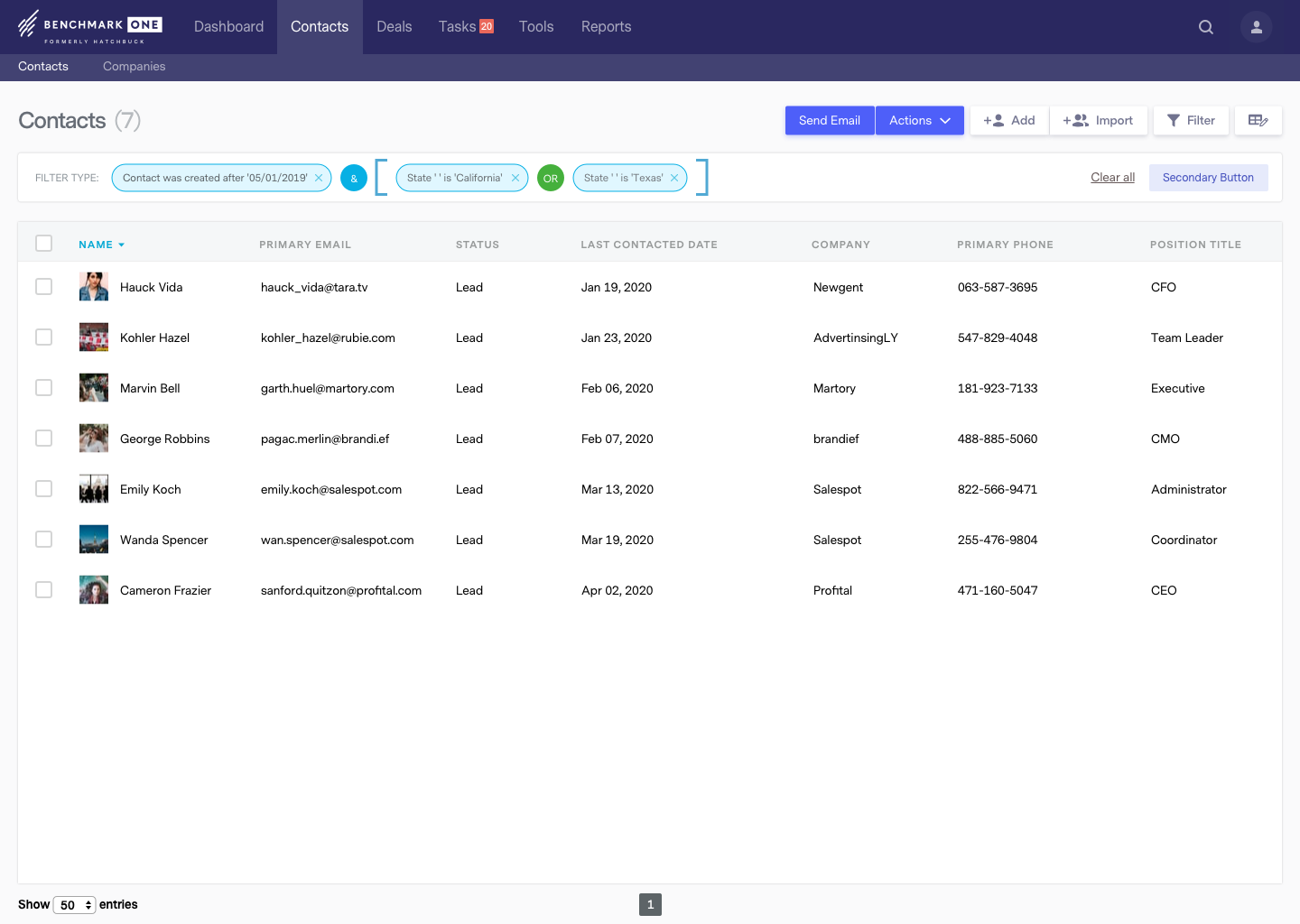
CRM database feature in marketing automation tool BenchmarkONE
An alternative is a marketing automation tool that integrates with your existing CRM.
3. Ask the right questions through a lead qualification framework
According to Gartner [5], the right questions can keep a lead moving through your sales funnel, while wrong questions can leave them stalled. To know what to ask, a sales team typically has a preferred framework depending on the type, cost, and volume of a product or service, the types of leads they’re selling to, their decision-making authority, and their level of interest.
Let’s discuss some popular lead qualification frameworks and example questions to ask.
BANT stands for budget, authority, need, and timeline. It’s one of the best-known lead qualification frameworks; however, Gartner [4] [5] cautions against overreliance on BANT because it’s outdated and doesn’t recognize emerging demand signals.
Budget: Does our product or service fit into the lead’s budget?
Authority: Does the lead have the authority to make the purchase decision, or is someone else the decision-maker?
Need: Does the lead need our product or service, or are they just browsing?
Timeline: Is the lead ready to purchase our product or service?
CHAMP stands for challenges, authority, money, and prioritization. This framework is similar to BANT, but it’s more focused on the problem a buyer wants to solve as well as their timeline.
Challenges: What problems does the lead hope to solve through our product or service?
Authority: Does the lead have the authority to make the purchase decision, or is someone else the decision-maker?
Money: Does our product or service fit into the lead’s budget?
Prioritization: How soon does the lead want to implement our product or service?
MEDDIC stands for metrics, economic buyer, decision criteria, decision process, identification of pain points, and champion. It differentiates between leads that are merely browsing and those that are more serious about making a purchase soon.
Metrics: How does the lead intend to measure their performance after purchasing our product or service?
Economic buyer: Does the lead have the authority to make the purchase decision, or is someone else the decision-maker?
Decision criteria: How will the lead decide whether to make a purchase decision or not?
Decision process: What process will the lead use to make a purchase decision?
Identification of pain points: What problems does the lead hope to solve through our product or service?
Champion: Do we have a contact in the lead’s company who has used our product or service and can attest to its value?
ANUM stands for authority, need, urgency, and money. It’s similar to BANT and CHAMP, but it’s adapted for newer businesses that haven’t yet established their buying process.
Authority: Does the lead have the authority to make the purchase decision, or is someone else the decision-maker?
Need: Does the lead need our product or service, or are they just browsing?
Urgency: How soon would the lead want to implement our product or service?
Money: Does our product or service fit into the lead’s budget?
FAINT stands for funds, authority, interest, need, and timing. It’s a longer version of BANT and CHAMP and is best suited for leads that know little or nothing about your business.
Funds: Does our product or service fit into the lead’s budget?
Authority: Does the lead have the authority to make the purchase decision, or is someone else the decision-maker?
Interest: Does the lead want to know more about our product or service?
Need: Does the lead need our product or service, or are they just browsing?
Timing: How soon would the lead want to implement our product or service?
Supercharge your lead qualification with the right tech tools
A lead that seems to be a good fit can still fail to convert. Lead qualification is a two-way street and requires effort, cooperation, and investment from both parties. To make the process easier and more efficient, we suggest the following tech tools:
Lead management software: Lead management software helps businesses gather, store, and manage information on leads. The tool captures lead details from multiple sources, such as your website, social media pages, and online ads. It then consolidates all the information into a centralized database for all your stakeholders to access.
Marketing analytics: Marketing analytics software collects and processes data needed for performance evaluation and strategic planning within your marketing departments
Marketing automation software: In addition to scoring leads, marketing automation tools can help implement product-based lead qualification. All you need is a marketing automation tool that supports receiving events from your app and scoring leads based on app behavior. Click this link to explore products that include these features.
Predictive lead scoring software: Predictive lead scoring software surfaces the most promising leads from your CRM and marketing automation systems by applying predictive models—which often utilize artificial intelligence (AI) and machine learning—to a variety of lead characteristics.
For more resources on sales and business development, check out our collection of articles here.
Sources
Seller Time Spend Assessment, Gartner
Top 3 Areas Where Sales Development Representatives Need Support From Marketing, Gartner
Lead Scoring, Gartner
Ignition Guide To Improving Your Lead Scoring Process, Gartner
Quick Answer: How Do We Move Leads That Are Stalled Midfunnel?, Gartner
Note: The screenshots of applications selected in this article are examples to show a feature in context and are not intended as endorsements or recommendations.
Lauren Spiller