GetApp offers objective, independent research and verified user reviews. We may earn a referral fee when you visit a vendor through our links.
Our commitment
Independent research methodology
Our researchers use a mix of verified reviews, independent research, and objective methodologies to bring you selection and ranking information you can trust. While we may earn a referral fee when you visit a provider through our links or speak to an advisor, this has no influence on our research or methodology.
Verified user reviews
GetApp maintains a proprietary database of millions of in-depth, verified user reviews across thousands of products in hundreds of software categories. Our data scientists apply advanced modeling techniques to identify key insights about products based on those reviews. We may also share aggregated ratings and select excerpts from those reviews throughout our site.
Our human moderators verify that reviewers are real people and that reviews are authentic. They use leading tech to analyze text quality and to detect plagiarism and generative AI.
How GetApp ensures transparency
GetApp lists all providers across its website—not just those that pay us—so that users can make informed purchase decisions. GetApp is free for users. Software providers pay us for sponsored profiles to receive web traffic and sales opportunities. Sponsored profiles include a link-out icon that takes users to the provider’s website.
3 Pro Tips to Get Max Value From Your Content Marketing Dashboard
These tips will help you better understand your content and your customers’ journey.


Making sense of marketing analytics for one channel is hard, but what if you have several? Tracking emails, social posts, texts, videos—you name it—can be more than a full-time job.
The results of a proper multichannel marketing strategy are more than worth it, though, which is why you have analytics software in the first place. Creating dashboards to track content performance and communicate results internally allows you to make smarter marketing decisions faster (and more accurately).
If you’re a content marketer eager to bust into the data but you’re having trouble wrangling your software, these three tips from Mason Endres, Content Marketing Manager at Ottobock [1], will give you insight into getting the most out of your tools.
For her, it’s all about using dashboards to hone in on the content that resonates with Ottobock’s audience:

Mason Endres, Content Marketing Manager at Ottobock [1]
“We can even see if an interaction comes from a particular piece of content. That's definitely the most valuable for us: being able to get down to an individual message.”
—Mason Endres, Content Marketing Manager at Ottobock
Before we dive into the tips, here's a video preview:
Tip #1: Tracking content performance and audience growth
For Endres, engagement and audience growth are the two most important metrics when planning future content, and that includes attributing results to a specific piece:
“Seeing how our followers are growing has been the biggest thing. And what is contributing to that… is this individual post the driving factor for this latest spike in engagement?”
The first piece to this is choosing specific metrics that ladder up to organizational goals as well as ones that align with the response you’re hoping to get from prospects and customers. [2] As a manufacturer specializing in advanced prosthetics, Ottobock operates in a smaller space and isn’t necessarily looking for brand awareness. Instead, they seek to grow their active audience and increase engagement with their content with the help of customizable dashboards.
Feature overview
Customizable dashboards are a staple feature offered by the majority of marketing analytics tools. They offer a graphical interface that gives an overview of various aspects of marketing performance, including metrics such as engagement, impressions, clickthrough, and more. Depending on how your software is set up, much of this data is available in real time, allowing you to take advantage of learnings immediately.
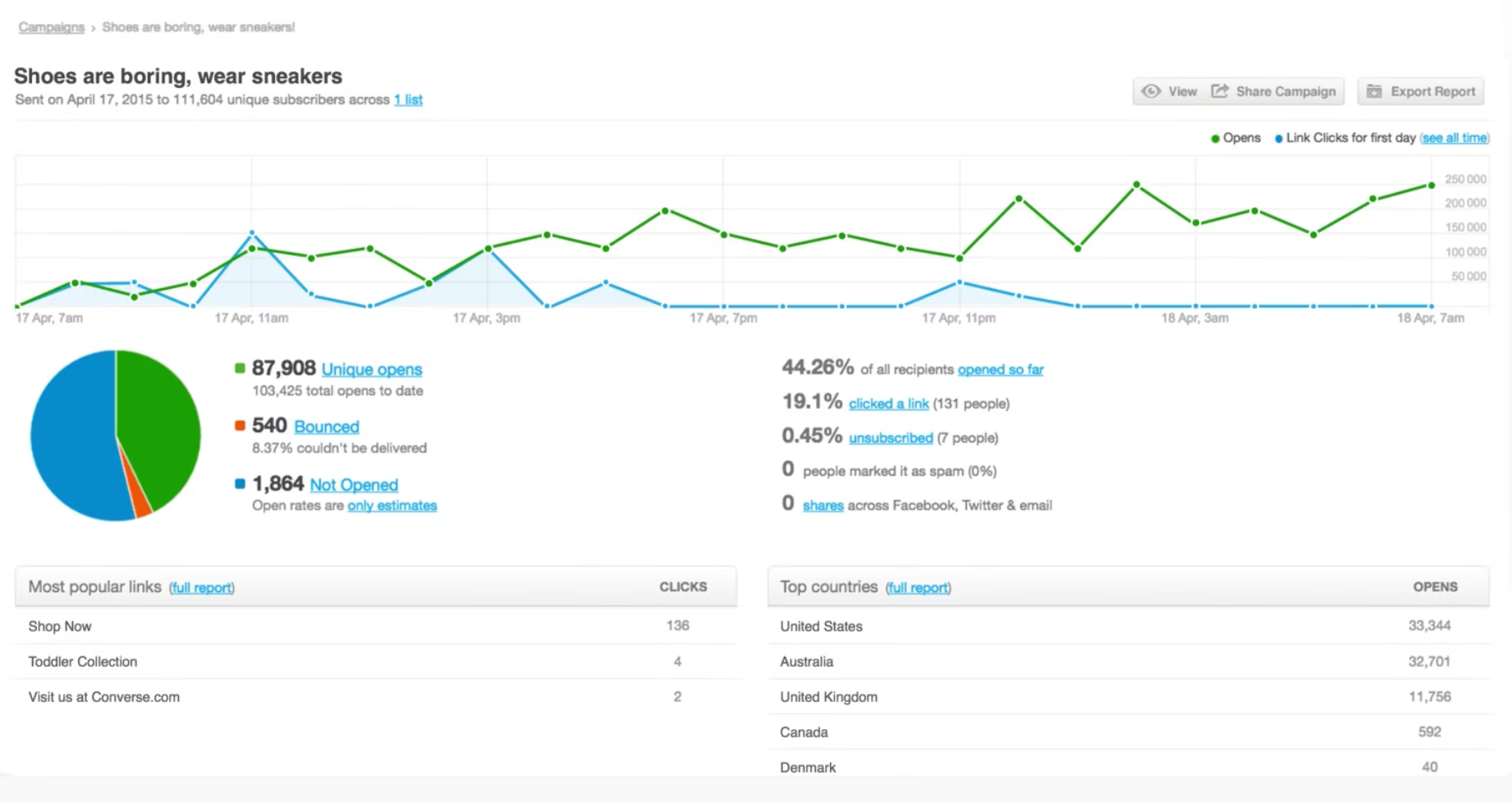
An example of a content marketing dashboard to monitor performance from Campaign Monitor (Source)
This is where dashboards that let you hone in on (and communicate) the impact a specific piece of content has come in strong. [2] In other words, “did this blog post actually drive people to the product page, or did this email get people to sign up for a product trial?”
Ready to get more specific with your dashboard creation?
First, identify your key metrics: In the case of Ottobock, engagement and audience growth are primary metrics. This will likely differ for your business, but you should still focus on having 1-2 key performance indicators (KPIs) to track towards. This allows you to be more specific by choosing KPIs that ladder up to your marketing and overall organizational goals.
Second, adjust your dashboard to place important data front and center: The beauty of customization is that you can remove extraneous information to place the focus on what really matters. Dashboards are less useful when they include irrelevant data, so hide unnecessary information then arrange the most important metrics in a way that’s easy to interpret.
Third, strive to attribute results to specific pieces of content: Achieving multi-touch or “true attribution” is no small feat, and a properly set up analytics dashboard is a feature that will help get you there. Identify trending metrics within your content and view results in real time as pieces are posted. This allows you to pinpoint results to a specific campaign or piece of content. When you add in integrations with other tech in your stack, you have a recipe for truly contextualizing the customer journey (more on both of these topics below).
Tip #2: Integrating data to create a source of truth
Regardless of the type of marketing you’re doing, it’s crucial to have a clear understanding of how data from your analytics software aligns (or doesn’t) with what you’re seeing live on marketing channels.
This can create confusion and lead to inaccurate results, which is where integrating your content marketing platform with other tools in your tech stack comes in. For Endres, this means implementing data from multiple sources with the goal of establishing a source of truth within one analytics platform:
“There is a lot of back and forth [between data sources]. Is this lining up with what we're seeing in our social media management tool? What does our professional dashboard look like on our marketing channel?”
Feature overview
Analytics integration allows you to migrate data to and from your content marketing platform into other tools that house data specific to your various marketing activities. Whether it’s a social media management tool, email software, customer data platform (CDP), or even your customer relationship management (CRM) tool, taking advantage of the integrations available allows you to connect the dots between various sources of data to ensure accuracy and gain more actionable insights.
Aside from having data from more sources at your disposal, a proper integration framework also allows you to do more with that data, including easily sharing it with cross-functional teams. This means less manual intervention and less points of contact surrounding data governance i.e., teammates can freely access the platform to glean what they need without the help from a designated data specialist.
Interested in embracing data integration for your own content marketing efforts?
First, explore your current integration options: Different integrations will be available based on the tools you currently use. Assess the platforms you use to manage your content marketing efforts to see what integrations are available, seeking to identify opportunities to integrate and gaps that may need to be addressed e.g., a key platform that doesn’t integrate fully or a feature that isn’t currently being utilized to the fullest.
Second, implement the most impactful integrations: First and foremost, you’ll want your marketing analytics platform integrated with your CRM or CDP. This is the primary integration that enables you to share data with internal stakeholders and conduct more advanced analysis. Here you’ll also want to identify individuals and teams that will be granted access to your content marketing data e.g., marketing, sales, social media, email, etc.
Third, discuss API options with your software vendor: It’s entirely possible that your current tools don’t integrate well with each other. In this case, it’s crucial to approach your software vendor to discuss options to either achieve this in the future (or look for another content marketing tool, CRM, or CDP). If you choose the latter option, now is your chance to ensure that a new tool integrates seamlessly with the rest of your tech stack.
Shopping for new tech is one avenue, but it may not always be the answer. Check out our article on Building a Marketing Team to Increase Your Martech’s Impact for three findings that will increase your team’s effectiveness without the need to purchase new software.
Tip #3: Contextualizing the customer journey
With updates to data privacy regulations affecting how businesses collect and use third-party customer data (spoiler: first-party data is now more important than ever), contextualizing the customer journey has become an essential part of any winning digital marketing strategy.
Endres achieves this at Ottobock by taking a critical eye to what content resonates with individual customers: “It really boils down to personalization of content, which is probably the biggest trend in e-mail marketing.”
While this quote specifically references email marketing, the same can also be applied to any other type of content marketing. Customers want to engage with content that resonates with them—products they’re interested in, causes they care about, or content that teaches them something useful, etc. In this way, mapping content to your customer journey helps you understand where to focus future content to support both customer and business needs. [2]
And For Endres, this means drilling down on both the customer’s intent as well as the piece of content that satisfies it:
“You can even now see if an interaction comes from a [single piece of content] in particular. So if someone sees that and sends us a DM like, ‘Hey, I wanna know more. Hey, my product isn't working like this in the video.’ That's definitely the most valuable.”
Feature overview
Customer journey mapping is a feature available within many customer experience and content marketing platforms that allows businesses to hone in on specific details of a consumer’s interactions with their content. This can refer to attaching an interaction to a specific piece of content, noting when and where a customer interaction occurs (or breaks down), and keeping track of targeted marketing information like demographic and geographic data.
Mapping out your customer journey will also aid you in further honing your target audience by defining key inflection points along the way e.g., consumers interacting with a specific type of content on a given marketing channel may change your understanding of your buyer personas (or necessitate creating entirely new ones). In Endres’ case, this means serving the right content to the right person since some of Ottobock’s audience are patients while others are professionals:
“We're talking to doctors who are interacting with patients all of the time. So honing in and really personalizing the content for them is huge.”
Eager to gain a better understanding of your customer journey?
First, assess your current tool’s ability to map: Your analytics or customer data platforms may already have the capability to better contextualize your customer journey. Look for features related to multi-touch attribution within your marketing analytics tool then turn to your CRM or CDP for features related to analyzing customer data—data either collected from automated features or manually by sales personnel.
Second, apply the features you do have while noting any gaps: Depending on your marketing program’s maturity, you may already have a process in place for analyzing customer data. If not, it’s time to audit your use of customer data to inform your multichannel marketing and strengthen that strategy if need be.
Third, if feature gaps do exist make a plan to address them: Start by connecting with your software vendor to see if capabilities you’re interested in are currently available or on the design roadmap. You may discover you already have the tool you need to accomplish these updates. If you don’t, it may be time to assess other available options with the goal of purchasing new software in the mid to long term.
Parting advice for business leaders hoping to make the most out of their content marketing dashboard investment
The impact dashboards can have on coordinating and personalizing content marketing efforts cannot be overstated.
Dashboards track the metrics that truly matter, connect the dots between disparate sources of data, and personalize content that will help customers feel seen. In Endres’ words, “It's all about making it feel like you really listened to your customer and are giving them useful content.”
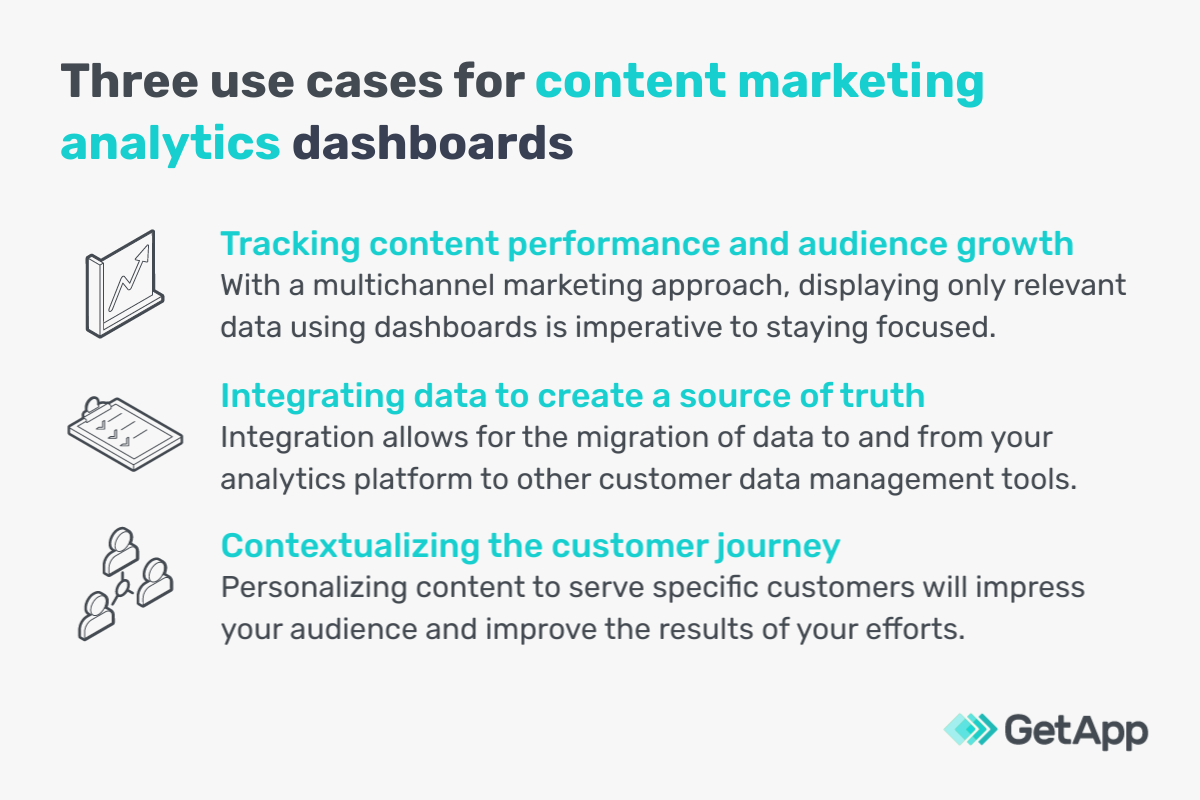
Ready to get started? Begin with these three use cases and their accompanying tips then refer to the GetApp blog for more content on all things content marketing:
How To Be Good at Content Marketing as a Small Business (With Examples)
4 Tips to Improve Your Content Marketing as a Small Business
Sources