GetApp offers objective, independent research and verified user reviews. We may earn a referral fee when you visit a vendor through our links.
Our commitment
Independent research methodology
Our researchers use a mix of verified reviews, independent research, and objective methodologies to bring you selection and ranking information you can trust. While we may earn a referral fee when you visit a provider through our links or speak to an advisor, this has no influence on our research or methodology.
Verified user reviews
GetApp maintains a proprietary database of millions of in-depth, verified user reviews across thousands of products in hundreds of software categories. Our data scientists apply advanced modeling techniques to identify key insights about products based on those reviews. We may also share aggregated ratings and select excerpts from those reviews throughout our site.
Our human moderators verify that reviewers are real people and that reviews are authentic. They use leading tech to analyze text quality and to detect plagiarism and generative AI.
How GetApp ensures transparency
GetApp lists all providers across its website—not just those that pay us—so that users can make informed purchase decisions. GetApp is free for users. Software providers pay us for sponsored profiles to receive web traffic and sales opportunities. Sponsored profiles include a link-out icon that takes users to the provider’s website.
How to Choose the Best Risk Management Software to Fight Fires in Your Business
Risk management helps organizations identify, assess, and control potential business risks. Learn how to choose the best software to manage this important function.
2016 marks the six-year anniversary of the Deepwater Horizon oil spill, the largest environmental disaster to-date in U.S. history. The economic and environmental impact of the incident was considerable and BP had to spend billions of dollars to settle claims for safety violations, compliance issues, legal implications, environmental damage, amongst other things.
Much of this damage could have been avoided if there had been an efficient risk management software in place.
In this article, we'll talk about what risk management software is and whether it's necessary for your small business. We'll highlight what features to look out for when buying and give you some examples of popular risk management software.
What is risk management software?
Risk management is a process by which an organization identifies, assesses, and controls potential business risks. These risks can include financial uncertainty, legal obligations, IT and data security threats, strategic management errors, workplace accidents, and natural disasters.
Risk management software helps identify such risks and communicate them to the business. Most of these solutions analyze existing and forecast data to help you spot risks and take necessary measures to mitigate them. Organizations implement these solutions to protect their employees, customers, data, brand, inventory, and shareholders.
Do I need risk management software in my small business?
Governance, risk, and compliance (GRC) is something that businesses always have to worry about since a little negligence can result in huge fines, lawsuits, and even dissolution. Examples are far and wide.
Let's take a real-life example. Back in 2014, Tiny Tots Images Photography landed itself in hot water when it failed to comply with the Australian Consumer Law. The company was accused of misleading its customers regarding their contract termination rights and had to refund up to $50,000.
The global GRC market is forecast to grow at a CAGR of 14.6 percent between 2014 and 2019. Due to increasing government regulations and compliance mandates many companies are implementing GRC solutions to become resilient and compliant.
Is my business ready?
Here are some questions to ask yourself to find out if your business is ready to implement a risk management software.
Do you operate in a highly regulated environment and often find it difficult to keep a track of changing laws? Geographic location and type of industry affect the level of regulatory complexity for any business. Companies that handle confidential data often face an array of stringent regulations. A risk management software helps businesses eliminate non-compliance risks by helping them understand what regulations are applicable to them and also helping them manage any changes to these regulations.
Is your business spread across multiple locations? When it comes to managing operations across multiple locations, a manual GRC approach becomes unsustainable. A risk management solution allows for centralized coordination and shared services. It follows common standards and methods for risk identification, management, and reporting throughout all sites.
Is your workforce exposed to hazardous and potentially unhealthy working environments? Failure to ensure a safe working environment can result in large penalties and legal complications that can put your whole business in jeopardy. Most GRC solutions offer organizational health and safety (OH&S) features that track medical trends, manage compliance and regulatory requirements, and help you make informed decisions on how to improve employee health.
Is your business highly dependent on online transactions? For example, if you own an eCommerce website , chances are high that your business might someday fall a victim to online transaction fraud. A risk management software identifies unusual patterns across multiple data sources and notifies users in case of any fraudulent activity.
Do you often fail to deliver your projects on time and within budget? A risk management solution assists project managers in planning, allocating resources, tracking progress, managing budgets, and analyzing workload to ensure that projects are completed on time and within budget.
What to look for when buying risk management software
Assuming your business is in need of a risk management software solution, how do you know what to look for when you're doing your research? Here are some key considerations you should take into account.
Will you choose an in-house software or go for a cloud-based solution? In case of a disruptive event, you can easily share internal data with authorized external suppliers, emergency services providers, and regulatory officials if you are using a cloud-based solution.
Will you be able to integrate it with other software you are already using? Most risk management solutions offer integration with existing business software such as ERP , Accounting , HR , eCommerce , and point of sale systems. For example, Integrum's integration with Yellowfin's BI platform allows businesses to manage risk and meet compliance obligations, as well as optimize business processes. Similarly, Avalara AvaTax's 3dcart integration helps calculate sales tax in more than 10,000 taxing jurisdictions.
What mobile capabilities should you look for while buying a risk management software? Does it have an iOS and Android app? A mobile app reduces desktop dependency and allows you to check for risks to your business wherever you go. For example, eCompliance's mobile app, eCompliance Mobile , eliminates the need for paper forms and facilitates a 360 degree real-time view of safety performance. Similarly, Integrum's mobile app SmartCAP allows users to submit forms configured in the integrum SmartForm System without internet access.
What pricing options are available? Risk management software are available in different types of licensing depending it's on premise or in the cloud. If you choose on-premise software then the one-time license model applies, where users make an upfront, one-time payment for the purchase of the licenses and own them forever. Cloud-based software is subscription-based, with companies normally paying per user on a monthly basis. Users can be added and removed as required, and there are normally different tiers according to usage needs. In a freemium-based model, businesses can use limited features of the software free of charge, with the option to upgrade to full functionality.
Key features to look for
Once you answered all the questions above, you'll want to explore key features of a risk management software. Here's what you can typically expect to find in a GRC solution.

Examples of popular risk management software solutions
Resolver
Resolver is a cloud-based enterprise risk, security and compliance management software. It ensures that an organization's plans, budget, and forecasts address key business risks. Its internal audit management platform offers a data analytics and reporting engine that provides interactive data visualizations. Management can use this data to uncover potential risks. Resolver also helps in corporate compliance management and training. Users can also import compliance-related frameworks and policies.

Integrum
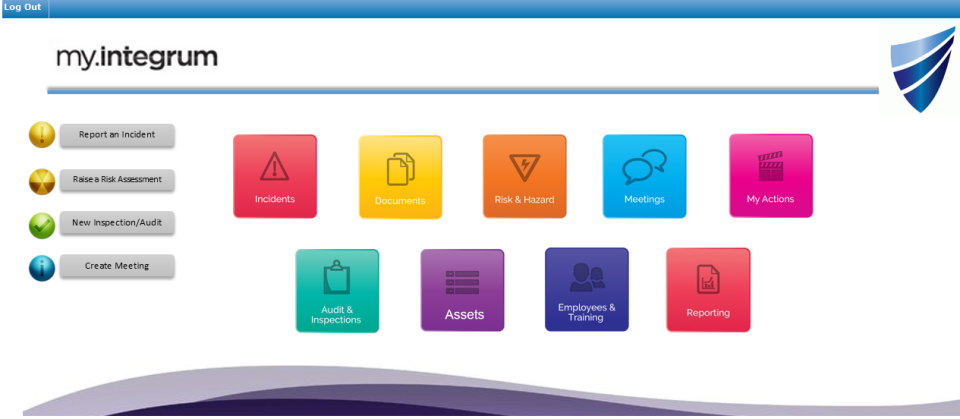
Integrum is a web-based risk and compliance software designed specifically for quality, health, safety and environment (QHSE) management. It is used by mostly manufacturing, construction, energy, and healthcare businesses. Some of its key features are incident management, compliance management, risk management, asset management, and audit and inspection management. Integrum also offers mobile apps for incident, inspection, audit, and defect management.
Optial
Optial is a web-based risk management software used by mostly manufacturing, retail and insurance companies. It helps users define, manage and track major metrics including key risk indicators (KRI's), key performance indicators (KPI's) and key control indicators (KCI's). Its scenario analysis feature defines and analyzes potential risk scenarios, determines the probability and associated costs, and suggest risk mitigation methods. The tool offers many reporting options and users can view their data through dashboards, trends, heat-maps, radars, bar charts, line charts, grids, tables, etc.

What to do next
To get started check out a comprehensive list of risk management software. You can also compare some of the top risk management solutions based on features, integrations, mobile support, online presence, and pricing.
If you've already bought a risk management, leave a review and let others know about your experiences.
More on Project Management


May 30, 2024

Jun 11, 2024

May 28, 2024