GetApp offers objective, independent research and verified user reviews. We may earn a referral fee when you visit a vendor through our links.
Our commitment
Independent research methodology
Our researchers use a mix of verified reviews, independent research, and objective methodologies to bring you selection and ranking information you can trust. While we may earn a referral fee when you visit a provider through our links or speak to an advisor, this has no influence on our research or methodology.
Verified user reviews
GetApp maintains a proprietary database of millions of in-depth, verified user reviews across thousands of products in hundreds of software categories. Our data scientists apply advanced modeling techniques to identify key insights about products based on those reviews. We may also share aggregated ratings and select excerpts from those reviews throughout our site.
Our human moderators verify that reviewers are real people and that reviews are authentic. They use leading tech to analyze text quality and to detect plagiarism and generative AI.
How GetApp ensures transparency
GetApp lists all providers across its website—not just those that pay us—so that users can make informed purchase decisions. GetApp is free for users. Software providers pay us for sponsored profiles to receive web traffic and sales opportunities. Sponsored profiles include a link-out icon that takes users to the provider’s website.
The 2022 Guide for Honest and Transparent Marketers
Struggling with what’s spammy vs good marketing? Get it right with these tips for honest and transparent marketing.


If your marketing team is a car, customer data is the fuel. You're driving on a complex highway with company policies, government regulations, and customers alike altering the rules of the road.
With the end of third-party cookies within two years and evolving customer sentiment toward data privacy, it’s time for transparent marketing practices. Businesses that don’t shift their focus to transparency risk losing customers and the ability to gather valuable data.
For small and midsize businesses (SMBs) in particular, it takes a monumental effort to incorporate transparent marketing practices, especially when you might not have abundant legal or IT support. But it’s a necessity when your business runs the risk of losing trust, credibility, and customer loyalty.
Let's take a look at some important transparency change drivers before exploring five actions SMBs can take to improve their marketing transparency practices when it comes to being straight up with customers about their data.
4 drivers of the marketing transparency shift
1. New regulations
Because of its inherent power and potential impact, world governments continue to set new standards for how businesses can collect and use customer data.
China's Personal Information Protection Law (the country's first significant data privacy statute) passed in August, and enacts restrictions on the transfer of personal information from China to the U.S.
The EU’s 2016 General Data Protection Regulation (GDPR) has resulted in hundreds of fines of companies including Amazon, Facebook, and Google.
In the U.S., individual states have rolled out privacy policies (e.g., California's CCPA, Colorado’s ColoPA, Virginia’s VCDPA).
2. Shift from third-party to first-party data
Last year, Google announced that it will no longer support third-party cookies in its Chrome browser. Apple’s new app tracking transparency adds restrictions on data collected in apps.
Changes from major players like these means the end is nigh for marketers targeting customers using third-party data, which they have heavily relied on til now. The alternative is to collect more data themselves—first-party data.
3. Changing consumer privacy attitudes
The proliferation of data collection has led to heightened consumer concern about personal data online.
According to Gartner (full report available to Gartner clients), 72% of consumers agree that it makes them very nervous to share any personal information online (an increase of 13% from 2014 to 2020). More than three-quarters of consumers (76%) are somewhat or extremely concerned about how companies collect and use their personal data.
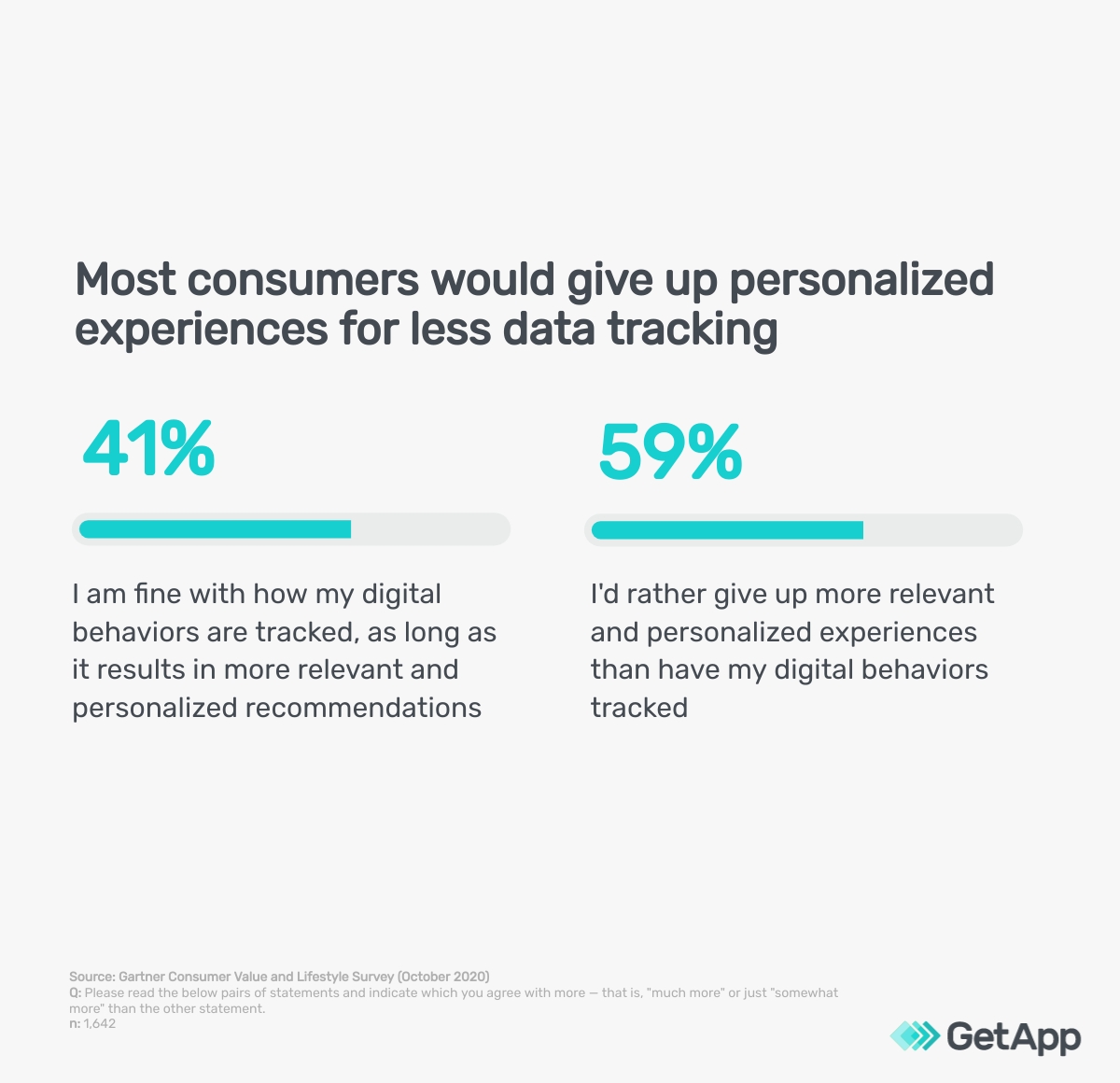
Another key insight to keep in mind is that the value of personal data privacy trumps the benefits consumers receive in exchange for sharing data. The same Gartner report states that 59% of consumers would rather give up personalized experiences (e.g., ads, recommendations) than have their digital behavior tracked by brands (41%).
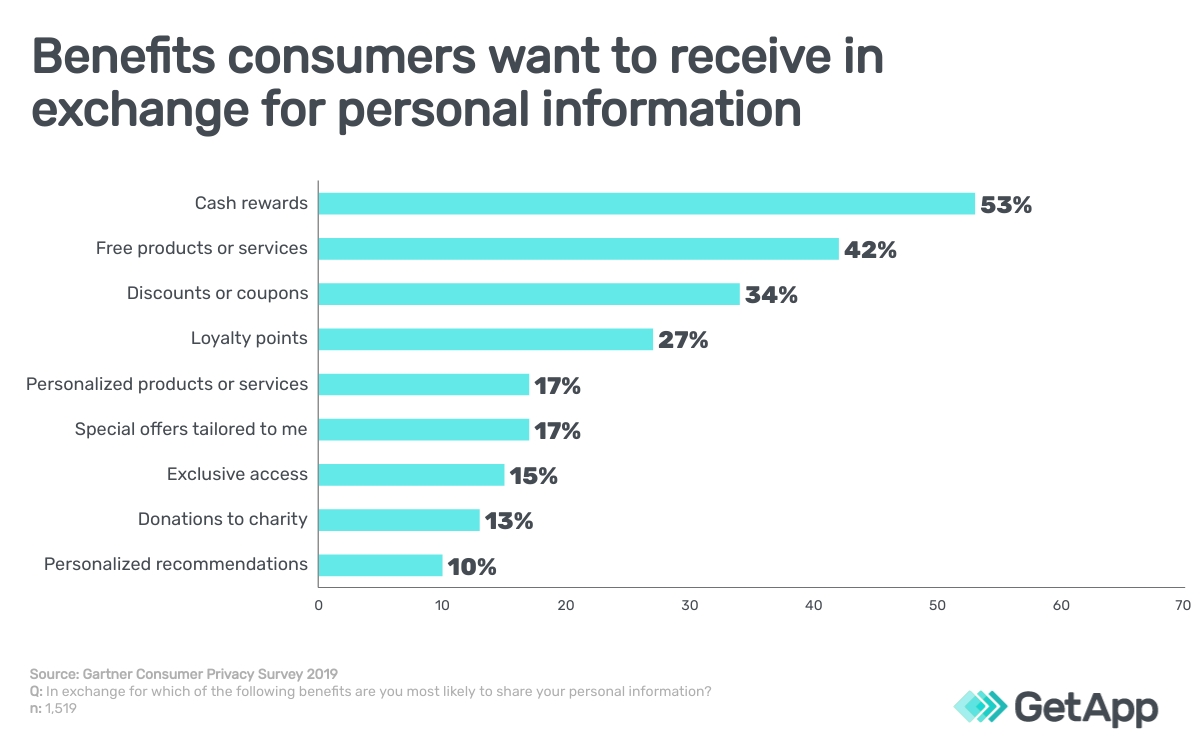
Monetary rewards such as gift cards, discounts, and loyalty points continue to be more enticing to consumers than experiential rewards such as personalized recommendations and exclusive access in exchange for their data (full report available to Gartner clients).
To achieve transparent marketing, marketers need data security and privacy support
SMB marketers carry the weight of protecting customer data, and acknowledge how imperative data privacy and security are in today’s digital environment.
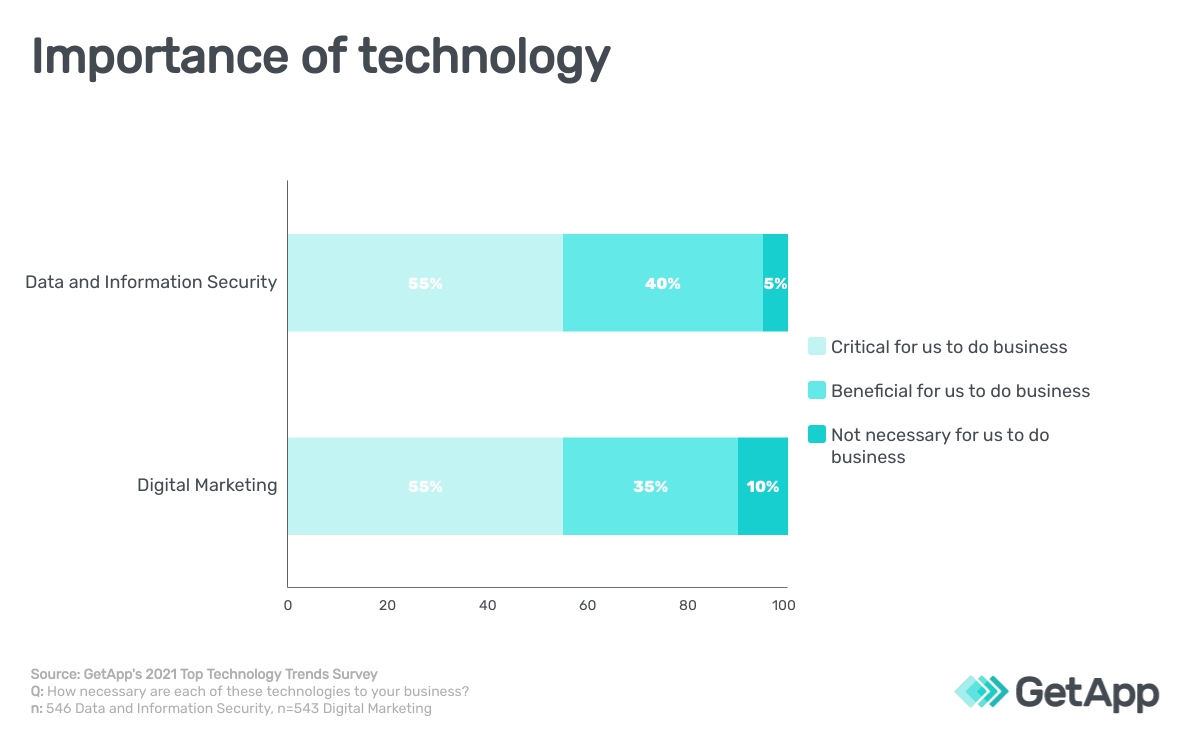
In GetApp’s 2021 Top Technology Trends Survey (methodology at the bottom of this page), more than half (55%) of surveyed U.S. SMBs rate data and information security technology as critical for their business operations.
These percentages are on par with how SMBs rate the importance of digital marketing technology, demonstrating the equal weight of security and marketing tech when it comes to running a business:
But do SMBs have the support they need to make their marketing transparency efforts possible?
In the same GetApp survey, just 60% of respondents say they are currently using data and information security technology. That leaves 40% of SMBs either planning to use it, evaluating it, or with no plans to evaluate this technology.
In GetApp’s Employee Data Survey, 80% of full-time employees say that their employer has become more concerned with data privacy over the last year. Among those respondents, 37% indicated that this concern is due to a need to protect sensitive customer data.
Start your transparent marketing journey with these steps
The good news for marketers at small and midsize businesses is that there are specific actions they can take to achieve honest and transparent marketing while protecting customer data.
When paired with the right technology and workflows, these five actions can help you incorporate more transparent marketing practices:
Give consumers more control over their data. First and foremost, get consent from your customers to use their data. Make sure they have the ability to opt in or out of sharing personal information. Lead generation software can help secure permission; it allows SMBs to create website forms that capture customer data in a transparent way.
Give real value in exchange for customer data. Offering personalized recommendations is no longer enough. Your customers need to receive something tangible in exchange for their data. Survey software can help you explicitly ask customers for data in exchange for monetary incentives.
Explain how customer data is protected. Clearly communicate what actions are being taken or if any changes have been made to safeguard consumer data. Be explicit about how your business collects and uses customer data to mitigate concerns. An all-in-one marketing tool can ensure your data collection and safety messages are seen by coordinating your messaging across multiple outreach channels.
Be responsive. It’s important to quickly acknowledge customer requests, as earning trust and being transparent often start with exceptional service. Luckily, there’s a growing number of marketing automation, personalization, social media, email, and chat software options out there that can help your brand address customer concerns consistently and efficiently.
Ask for feedback. Go directly to the source to gauge how your marketing tactics are performing. Gather regular feedback from customers and adjust as needed by using a market research tool to collect and analyze data.
Continue your transparent marketing journey with these resources
The above actions are a great starting place, but it doesn't stop there. We’ve got more marketing resources that can help you keep developing your new transparent marketing strategy approach.
Highest-Rated Marketing Software Tools to Health your Business Succeed in 2021
5 Consumer Behavior Changes Your Small Business Should Target
Survey Methodologies
GetApp’s 2021 Top Technology Trends Survey was conducted from August through September 2021, among 548 respondents across the U.S. to identify the technology needs, challenges, and trends for small businesses. Respondents were required to be involved in the technology purchasing decisions at companies with 2 to 500 employees and hold a manager-level position or above in the company.
GetApp’s Employee Data Survey was conducted in September 2021 among 601 respondents to learn more about employee data collection at U.S. businesses. Respondents were screened for full-time employment at companies with two or more employees. 301 respondents identified as management level or above and 300 identified as staff or senior staff.
NOTE: This document, while intended to inform our clients about the current data privacy and security challenges experienced by IT companies in the global marketplace, is in no way intended to provide legal advice or to endorse a specific course of action. For advice on your specific situation, consult your legal counsel.